
Processing: How Andrew Martin Wrote Down Time
The author on drafting, revision, and being “drawn to stories about unhappy people making one another’s lives miserable.”


Processing is Counter Craft’s semi-regular interview series where I talk to authors about the craft and writing process behind their work. You can find previous entries here. For the first interview of 2026, I’m excited to be talking to Andrew Martin about his excellent new novel Down Time, which is out in bookstores today. Down Time is Martin’s third book, after the novel Early Work and the story collection Cool for America. The novel follows a cast of unmoored millennial characters trying to navigate friendship, fucking, relationships, rivalries, art, and just growing older. The novel is set around the time of COVID lockdowns, but if that makes you wary, let me stress that the novel is very funny. Down Time conjures the lockdown period without feeling weighted down by it, and is filled with sharp observations and knowing details about the millennial generation and the strange times we’re all living in.
I talked with Martin about his chaotic drafting process, the importance of revision, and being “drawn to stories about unhappy people making one another’s lives miserable.”
Down Time is a touching and very funny novel about a group of interconnected friends who spend their time fucking, fucking up, masking, and meandering around the era of COVID lockdowns. The novel alternates between four of these characters as POVs, although others recur. The novel also pulls off a move that I at least consider somewhat risky: switching between third person and first person. In this case, four of the POV characters are in third, and one, Malcolm, is written in first.
Can you talk about how you settled on these characters and this structure for the novel? And what inspired the decision to have one character in first-person POV?
I really stumbled backwards into the structure. The characters came first, slowly, over years of writing, originally, in some cases, in what felt like standalone stories, but increasingly in what I realized needed to be a sustained narrative. Once I knew I wanted all of these people to be together in a novel, I started improvising on the ways they could be connected, and on the order of their sections. There were early drafts that were looser about chronology and less strict about the rotation between characters. But ultimately, it seemed the most generous thing to not make the reader do all of this other work in addition to moving between four different POV characters.
Leaving one character in first person was a little bit of a dare to myself, to see if I could break “a rule” and make it work. But I also like the idea of destabilizing the smoothness of the third person narration, having it feel a little bit messier and even have a slightly fourth-wall breaking quality, but hopefully not in a way that actually takes the reader out of the reality of the story.
When you are writing from the POV of different characters, is there anything you do to get into the head or the voice of a character? When you are drafting, do you focus on one perspective at a time or alternate between them?
My drafting process is pretty chaotic, and it can sometimes take me a long time to “get in the pocket” with a voice on the page that I want to move forward with. For me, the voice comes before any other conception of character, if that makes sense. So once I’ve established a rhythm and sensibility for a character’s narration, whether that’s first person or close-third, the other aspects of the character start to come into focus. I gravitate towards these talky, bookish, self-destructive characters, obviously—it doesn’t necessarily take a visualization exercise for me to inhabit their perspectives.
I alternate pretty freely between perspectives and sections when I’m working, possibly as a form of procrastination. I always find it hard to figure out what these people should do, so I do a lot of toggling between scenarios until something occurs to me.
I’ve started asking about specific craft techniques in these interviews. It just seems fun to narrow in on a specific element. One thing I loved in Down Time was your use of (often comic) asides via em dashes, commas, and parentheses. E.g., the parenthetical here: “But Aaron felt, perhaps because Xaviar was not a girl, that he could bully him in a chummy, locker-room kind of way (Aaron did not spend very much time in locker rooms), and thus cut through his mystique.” Or when Malcolm downloads a novel sent by a friend’s pushy father: “I downloaded the PDF—it was watermarked—and began reading.”
How do you think about asides when writing? And, if we can dig into the grammar, how do you view the differences between using em dashes, parentheses, or clauses set off with commas?
One of my goals is usually to make the prose conversational, to try to simulate thought on the page in a way that feels natural to the reader. So those kinds of asides are usually there to mimic the way one might belatedly or sardonically notice something, or even just to create a little bit of a hitch in a sentence so that you can’t just skim over it. It’s a little reminder that the writer is present, active.
As for the grammar, gosh, I suppose I’m mostly operating on instinct. I think there’s a hierarchy of interruption, with commas being the least intrusive, followed by parentheticals, and then em dashes as the most. So I think it depends as much on the paragraph surrounding any given sentence, the rhythm that feels needed, the sense of urgency in the scene. You probably don’t want to be throwing too many parentheticals and em dashes around during sequences of high drama, though since in my books most of the action is interior, it’s not usually a problem.
I really did laugh out loud at many passages in this novel, although Down Time also has a lovely tonal balance alternating between comedy, tragedy, melancholy, and more. I’d love to hear how you think about tonal balance when writing. Is this something on your mind when drafting or revising or both?
My instinct on the sentence level is to be funny, to look for the little twist or wink that will give the reader a moment of pleasure. But I’m also drawn to stories about unhappy people making one another’s lives miserable. While I’m writing and revising, there’s some instinctual titration going on, trying to make sure things don’t get too wacky on the one end of the spectrum, or melodramatic on the other. The only real “fights” I had with my editor on this book were about a couple of sequences where he felt I was going back to the well one too many times, overdoing the joke—once in a sequence near the beginning where a vibrator keeps humming back to life in the middle of the night, another later one in which a little kid has a pee accident requiring intervention from a childless young woman. In both cases the concern was undermining the heavier emotional material by focusing too much on the silly stuff, and I mostly took the notes, though perhaps still not as completely as he would have wanted. (Sorry Milo!)
All of which is to say, I think about it a lot, and don’t always get it right.
This is your second novel (and third book). It’s sometimes said that each novel makes you learn how to write a novel all over again. What lessons carried over from Early Work and what did you have to learn anew when writing Down Time?
Woof, I wish more lessons had carried over from Early Work. The first draft of that novel was written with the wind at my back in a way I’ve very rarely felt since. The bad lesson I learned from it was that I could write a novel more or less intuitively and be carried along by the momentum of a voice. But this project proved to be much more complex, because it required the precision work of short story writing and also the zoomed out architectural work of a multi-character novel with a lot of backstory that needed to be managed. It seems inevitably that the next novel will make me learn how to do it all over again, because I’ve resolved not to do it this way again! But since it turned out OK, eventually, I worry I’ll be tempted once again to not have learned anything.
During COVID lockdowns, I remember it was common to hear people post on social media a version of “there are going to be so damn many COVID novels and movies!” Then, not many actually came out and the complaint seemed to shift to, “Every work of fiction is just acting like COVID didn’t even happen!” I thought you handled the COVID era well, which was such a strange, horrible, and momentous event we all lived through and whose aftereffects we are still living in. What was it like to revisit that era in fiction?
Though it incorporates (retcons might be the term of art) some material from even earlier, I started writing what became the first chapter of the book in September 2020, and did a lot of the initial drafting and sketching over the next couple of years. So I was writing from the middle of it, even if, weirdly, or maybe self-protectively, already with something of a retroactive perspective. It’s very strange how that can happen. I read The Oppermanns recently, about the rise of the Nazis and its effects on a Jewish family business, which was written in 1933. Even that early, the novel has an elegiac quality that one associates more with historical fiction, with work that already knows the ending. In my case I could have it both ways—drafting while the pandemic was all still happening, and then revising and reshaping and rethinking in the aftermath. For a while, as we all remember (or maybe don’t), it felt like that era was never going to end—it almost felt unseemly reading some of the early sections out loud in, say, 2022, like I was going to cause a Covid outbreak just by invoking it. It did feel strange, in retrospect, to sort of prolong my own Covid era by a few years by living inside this book for so long.
On the question of whether there’s too much or not enough written about this and all that, I had to pretend ignorance on the discourse in order to write and edit the damn thing, and to try to believe that if the work is interesting as a work of art, the subject matter isn’t that important. At least one foreign publisher was put off by “the COVID of it all,” but they (publishers) will always find a reason not to publish something.
Can you talk about the process and timeline of writing, revising, and publishing Down Time? Whatever you’re comfortable sharing.
The writing was such a disparate and prolonged process. It was some combination of second novel syndrome, the distractions and stress of the pandemic, preparing for and then raising a baby (now toddler), run-of-the-mill need to make money, etc. It was the first book I wrote with a suite of serious adult responsibilities, I guess, and it proved very difficult. I gave a much messier draft than I usually would to my agent and wife and a few other trusted early readers, and their feedback finally helped me find my footing with the structure after struggling with it for years. Molly Atlas, my agent, is very good at not letting me send things out until she’s satisfied that they’re as good as they can be, so I went back and forth with her on it for a while. Once I had a draft she was happy with, we sent it to Milo Walls at FSG, and thankfully he took it. Then I worked closely with Milo on a few big rounds of edits over the course of a year or so. Whatever else happens with the book, it benefited so much from having these brilliant people give it so much time and attention in what felt like true collaboration.
I normally ask authors about artistic influences on their novels that aren’t other novels. However, there’s been some bizarre discourse recently about whether authors benefit from reading other books. So, can I ask you first what books provided inspiration for Down Time and then what inspiration from any other artistic mediums (movies, video games, whatever)?
I saw this discourse in your newsletter, which serves as my keyhole into the social media conversations that I otherwise usually miss! Truly strange. I recently talked to an otherwise smart and well-read guy who doesn’t believe in revision. I’ll be very curious to read the books that arise from these philosophies.
Two of the books that influenced my thinking about the structure and general approach to this novel were The Golden Notebook by Doris Lessing and Unforgiving Years by Victor Serge. Both take a multi-angled approach to both personal and world history, creating a kind of compound eye effect. Golden Notebook is a rare novel that moves freely between first and third person, though in an explicitly self-reflexive way, since they’re all versions of the same consciousness. And Unforgiving Years is almost a series of four interconnected novellas, though all of the characters fit together in surprising and moving ways. My original conception of this book was influenced by Isaac Babel’s Red Cavalry, a slightly looser “novel in stories” approach that I eventually tightened up on. Gary Indiana’s Do Everything in Dark also snuck in there I think.
Movies are a huge influence on my writing. The one I was thinking about the most for this was Robert Kramer’s Milestones, an absolutely incredible epic film about leftists wandering through the seventies, trying to find their place in the wake of/after the failure of the cultural and political revolutions of the 60s. It’s a kind of docufiction—for example, there’s an actual live birth in it—and I was really excited about the way it decentralizes the narratives of these different characters but somehow holds them all in balance. Eric Rohmer’s films are often on my mind, his zoomed-in and generous portraits of young and youngish people trying to understand themselves and their relationships. And then Hong Sangsoo, one of his contemporary inheritors, takes that approach in a more experimental direction, scrambling up timelines like puzzle pieces and asking the viewer to make more of the connections. I was also watching a lot of Fassbinder while writing this, but I don’t know if that really made it in there.
The novel features some struggling writers, so as a final question, what advice would you give to anyone reading this interview who is also struggling to finish or find meaning in their work?
The practical advice I would give is: get to the end of the damn thing, whatever it is. Even if it’s provisional and stupid, even if you know that’s not the right second half of the novel, it’s important to find a way to zoom out enough to see it holistically so that you can figure out what it needs. The sooner you get to some kind of end, the sooner you’ll realize that this book—even if it’s Infinite Jest—isn’t going to do everything you want it to do, or say everything you want to say. And that realization will hopefully help get it to the best version of itself it can be. Some kind of deeper meaning, for me, so often comes in revision, or later. It’s rare that a book says what I thought it was going to say.

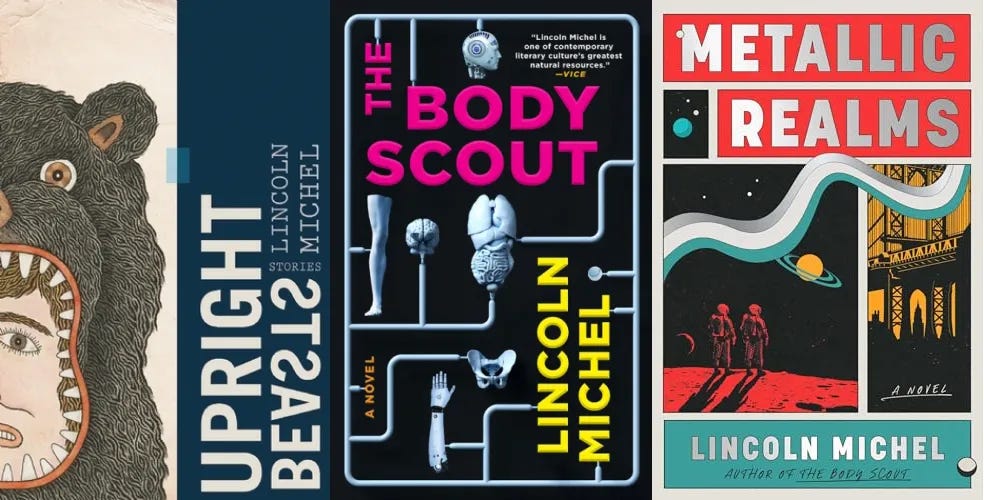
My new novel Metallic Realms is out in stores! Reviews have called the book “brilliant” (Esquire), “riveting” (Publishers Weekly), “hilariously clever” (Elle), “a total blast” (Chicago Tribune), “unrelentingly smart and inventive” (Locus), and “just plain wonderful” (Booklist). My previous books are the science fiction noir novel The Body Scout and the genre-bending story collection Upright Beasts. If you enjoy this newsletter, perhaps you’ll enjoy one or more of those books too.
Yay, Andrew!
I enjoyed Early Work when it came out. Looking forward to seeing where Martin goes with this one!