
Principles of Plotting Part III: Variation
The third entry in a series on figuring out plot and applying it to your fiction

Hello readers,
Every couple of weeks, I get a nice note or restack about my Principles of Plotting series. So, I figure it is finally time to get off my ass—or I suppose sit back down on my ass—and finish the series.
To quickly recap, I find myself annoyed at both the vague literary world aphoristic advice1 and the absurdly prescriptive rules found in many genre and Hollywood screenwriting guides2. So, this series is my attempt to offer flexible plot principles that can apply to (almost) any type of story. Or, at least any type of story that wants to have a plot. What is a plot principle that applies as much to a Kafkaesque novel as a Marvel romp? That applies to an experimental short story as much as a Hollywood romcom? In my first two installments, I went over how I’m defining plot3 and why I think authors—perhaps even especially literary/experimental/subversive ones—should pay attention to plot. I also explored what I consider to be the two most fundamental plot principles: Escalation and Oscillation.
I won’t repeat everything here. If this subject interests you, I obviously encourage you to read the first two entries before this one.


Rebutting Some Rebuttals
For the most part, the feedback on these small series has been lovely. Of course, I expected and received some pushback. I welcome it. But this is my newsletter so I get to rebut some of the rebuttals I’ve seen.
First, a certain type of writer will say that the general idea of plotting—and the specific advice of e.g. escalating stakes or providing up and down movement on the story’s main axis of meaning—are inauthentic. That stories are supposed to come out naturally, organically, without preservatives or pasteurization. I’m not saying such folks have a MAHA raw milk view of storytelling… but I’m not not saying that.
I kid, I kid. Look, my feeling is always that whatever works is what works. If you are a writer who feels your characters “tell their own stories”4 and your job as a writer is akin to a nature photographer who just camps out in a camouflaged tent pissing in a bottle while you wait for something dramatic to occur without interference in front of your view—that’s great! If it works, that is all that matters. Tell yourself whatever you need to tell yourself to produce the work you enjoy.
However, if this “natural” way of writing fiction isn’t working for you then I would suggest reframing the question. Stories are not raw milk or nature photography. They are always constructed by the author. Even in purely non-fiction genres, like highly researched biography, the author chooses what facts to emphasize, what way to organize the facts, and what events will start or end the story. You can frame nearly any life as heroic or pathetic, successful or failed, inspiring or a warning. If this is true of real lives, it is obviously true of invented ones. Plot is artificial, sure, but so are fictional characters, imagined settings, paragraph breaks, chapter titles, and everything else.
A second objection I’ve seen might be summed up as “Who cares if the plot is interesting? Maybe what matters is other elements of the story, like the voice or the character’s memories or the setting.” In both entries, I went out of my way to stress that I admire the infinite forms of fiction and that includes many “plotless” novels.5 Still, I think the question to ask yourself is why are you including a plot if you don’t find it interesting and/or don’t care to make it interesting on the page? If your story revolves around a mystery plot where a detective figure finds clues to try to solve a case, but you don’t care to make the mystery or its solving compelling… well, why is it there?
There might be a good reason! I’ve enjoyed some novels that deconstruct and subvert detective fiction. I love Kobo Abe’s The Ruined Map, where the detective seems ever further from solving the case as the confusing clues mass. Tim Robinson’s The Chair Company was my favorite TV show last year and it revolves around a character obsessing over solving a ridiculous “crime” and finding ever more ridiculous clues and conspiracies. Several Thomas Pynchon books could be added here. I would suggest that these authors still make their plots interesting, even if in absurd ways, and also that they undermine traditional detective stories for specific thematic, comedic, or narrative reasons. If your plot is thoughtlessly tacked on for no real reason except you think you need to cram one into your manuscript to sell it to publishers, well, readers will probably be as unenthused as you are about the plot.
Moving on:

Principles of Plotting #3: Variation
Much of the pleasure of any text is seeing how the writer can tweak the ideas in new and interesting ways. Some screenwriting guides will talk about how films need to include “the promise of the premise,” which is to say some part of the film—typically the middle—must, well, make good on the promise of the film’s premise. In a movie like Groundhog Day, how will the character act out the repeated day in different ways? In any movie where a character gains a superpower (or the power of God or Santa Claus or whatever), what are all the possible ways they will use that power? In any “odd couple” story, what are the varied ways the two personalities will clash?
Again, this principle is true for any type of literature. Solvej Balle’s ongoing and acclaimed novel series On the Calculation of Volume has an essentially Groundhog Day premise—a woman lives the same day over and over—but explores the premise through a very different sensibility and style. It still rests on variation. No one would read or watch a movie about someone reliving the same day if they just do the same thing each iteration. We want to see how the writer can twist the concept in ways that meet and subvert our expectations. In Balle’s series, that might be the different aspects of mundane reality the narrator fixates on. In a superhero movie, it might be how different supervillain powers will test the hero’s fighting abilities. In either case, variation is key.


How will Jane Austen’s heroines find different partners given their different temperaments and situations? How will the ghosts haunting the hotel produce unique scares in Stephen King’s The Shining? What new bizarre obstacle will prevent K. from reaching the castle in Kafka’s The Castle? What new magical hurdle will Frodo face in The Lord of the Rings? For that matter, what new rants and insults will a Thomas Bernhard narrator come up with next? Regardless of genre or style, nearly all fiction works through a balancing act of repetition and difference. When we enjoy something, we want to see it again and again… but also in new and surprising forms.
There’s an old writing saw that goes “an ending should feel both inevitable and surprising.” You can apply this to every plot beat. A clever plot consistently feels both inevitable (or at least logical) and surprising (or at least fresh). We want to see the ideas tweaked and concepts twisted—but not so much that it feels disjointed and not so little that it feels repetitive. The reader wants to be both surprised and not so surprised. Yes, this is hard to do. Who said plotting was easy?
Various Forms of Variation
How artful variation is deployed in fiction is—like everything—dependent on style, genre, and other factors. Like I said, these are loose principles. In more action-oriented stories, the variation is often in the tests of the hero’s abilities. You don’t want your superhero to beat the first villain with a laser vision blast, the second villain with a bigger laser vision blast, and the third villain with an even bigger laser vision blast. That’s going to be boring (unless the whole premise is that it is boring6). The reader wants you to mix it up. Maybe the second villain can only be beaten with frost breath and the last villain requires extreme cunning to defeat. Similarly, you don’t want a Sherlock Holmesian detective to gather every clue in the same way. You want to see him prove his mettle in different spheres of detective skills—first he shows his knowledge of herbs while inspecting the poisoned tea, next he uses cryptography skills to decode a message written on the notepad—both because it makes the hero’s powers more impressive and because it simply is more interesting.7
Speculative fiction often rests on creative variation of the speculative premise. The writer introduces a speculative idea—e.g. the devices that allow you to communicate with an alternate timeline in Ted Chiang’s “Anxiety is the Dizziness of Freedom”—and the reader reads in part to see how this will impact society in contrasting ways. Some people collaborate with alternative versions to work more effectively at their jobs, other people become depressed upon realizing their alternative versions are more successful than them, still others make money finding devices connected to universes where a popular celebrity didn’t die in a car crash. Etc.
One story I frequently teach is Lesley Nneka Arimah’s “Who Will Greet You at Home,” which I think is an excellent story in general and more specifically a perfect example of how even a surreal or fabulist story can have a classic plot structure. It has great Escalation and Oscillation as well as Variation. The story takes place in a world in which babies are made from inanimate material. It opens: “The yarn baby lasted a good month, emitting dry, cotton-soft gurgles and pooping little balls of lint, before Ogechi snagged its thigh on a nail and it unravelled.” Our protagonist, poor and made by her mother from “mud and twigs,” is driven to have a baby who is “a thing of whimsy, soft and pretty and tender and worthy of love.” We see the variations of the premise—Ogechi is taunted by a baby made of porcelain and in desperation makes a baby out of stray hair clippings—all applied to the central themes and character drive. Anyway, I don’t want to spoil the story and I will return to it when I talk about my fourth plotting principle of Intersection (specifically the intersection of character and plot arcs). But it and Chiang’s stories are good examples of how plot Variation is strongest when it powers the themes and characters, and vice versa.
Part of why Variation is so important in any genre is that it provides the reader with another reason to turn the page. They aren’t just reading to find out what happens next. They are also reading to see how you can delight them with the unexpected.8
Variation Accumulation
Although perhaps a little outside the scope of an article on plot, plotless fiction often functions through a sort of escalation through accumulation. It provides a sense of plot without plot. Italo Calvino’s Invisible Cities is a good example of that. It would be a stretch to say there is anything resembling a plot or even traditional characters in that book. The novel is 55 descriptions of imagined cities with no throughline of character9 or story. Still, the accumulation of various cities adds up to something compelling. The reader turns the page, in part, to learn how Italo Calvino can describe dozens of different imaginary cities in ways that are fresh instead of repetitive.
Another story that comes to mind is Robert Coover’s postmodern classic “The Babysitter.” The story is composed of a hundred non-linear fragments that alternate between the banal and brutal, mundane and insane. The variation is done through juxtaposition. (The structure thematically mimics flipping through TV channels in which you surf through local news, violent crime drama, goofy sitcom, and more back to back.) There is no traditional plot because there is no clarity on what is “real” and what is fiction. The reader must construct their own story from the dozens of various possibilities.
But variation through accumulation can occur in a more traditional and/or realist story as well. I recently reread one of my favorite Cheever stories, “Reunion,” which is a good example of escalation through accumulation in a short space.10 It’s very short so you might as well go read it now. But to summarize, it opens with a young narrator who is excited to see his estranged father. The father takes him around to a series of restaurants where he (the father) is extremely rude to waiters. This is a simple pattern story in one way and much of the pleasure is in the tweaks on the father’s rudeness—he snaps his fingers at one place, he insults in Italian at another, and at a third he’s so drunk he says “Bibson Geefeaters” instead of “Beefeater Gibsons” and is pissed when corrected, and so on—but the story achieves an escalation of the father’s assholeishness through the accumulation of shitty comments. You might describe the story as one in which a young boy realizes his father is a piece of shit, but that is something that occurs offscreen. What we see onscreen is the various ways his dad is a dick.
Variation of Variation
There’s a more complex form of variation that I’ll attribute to George Saunders’s essay “Rise Baby Rise” that discusses Donald Barthelme’s classic story “The School.” Barthelme’s story is all about variation as it is a pattern story made up of ever-bigger things dying in the titular school. The herb garden dies and the pet gerbils die and a puppy they find in the parking lot dies and then grandparents and then some of the children. You get it. Saunders makes the point that being too straightforward in your escalation is off-putting. “Why? Because I’m condescending. I’m assuming that this simple, linear pattern is enough to interest you. I’m treating you like a dumb beast, endlessly fascinated by a swinging weight on a cord.” At the end of the essay, Saunders suggests one way to solve this problem: “escalating escalation.” In Barthelme’s story, the catalogue of things dying in the school shifts into a philosophical discussion about life and death between the narrator and his students. This is another way to think about variation. Take the themes and interests of your story and shift them into new terrain. If you can pull it off, it’s a very useful trick.
That’s enough various comments on variation. Next up, I’ll talk about Intersection aka how the various plot lines (and character arcs) get tied together.
“Write what you know!” “Show don’t tell!” “Every story is either a man going on a journey or a stranger coming to town—and they’re two sides of the same story!
“Save the Cat says Theme Statement occurs at the 5% mark during the 10% Set-Up stage that ends with the Inciting Incident at exactly 11%!”
Roughly, I’m defining plot as the cause-and-effect sequence of exterior world events as well as the relevant interiority related to the cause-and-effect events. Basically, plot arcs plus character arcs. In this schema, “plotless fiction” is when exterior events and interior thoughts do not tie together in a cause-and-effect way into a larger story. This is descriptive, not pejorative. I love many plotless—or at least minimally plotted—works of fiction such as Invisible Cities, The Mezzanine, Outline, or [one could go on and on] and write about them frequently.
I’m afraid I fall closer to the Nabokov camp: “My knowledge of Mr. Forster’s works is limited to one novel which I dislike; and anyway it was not he who fathered that trite little whimsy about characters getting out of hand; it is as old as the quills, although of course one sympathizes with his people if they try to wriggle out of that trip to India or wherever he takes them. My characters are galley slaves.” ―Vladimir Nabokov
See footnote 3.
See One-Punch Man.
All this applies both on the level of individual stories and overall series or even subgenres. We expect our detective to face different cases in each entry and our superheros to face different challenges in each story arc. At least if the author is good…
But the expected unexpected. The new that emerges with aesthetic logic from the old.
There are interstitial chapters describing Marco Polo talking to Kublai Kahn, but these are mostly vehicles for Calvino’s poetic musings and he does not attempt any kind of character coherency or interior arcs.
Many of Cheever’s stories could fit this topic. Certainly his most famous story, “The Swimmer,” is propelled by the variation in the swimming man’s encounters.
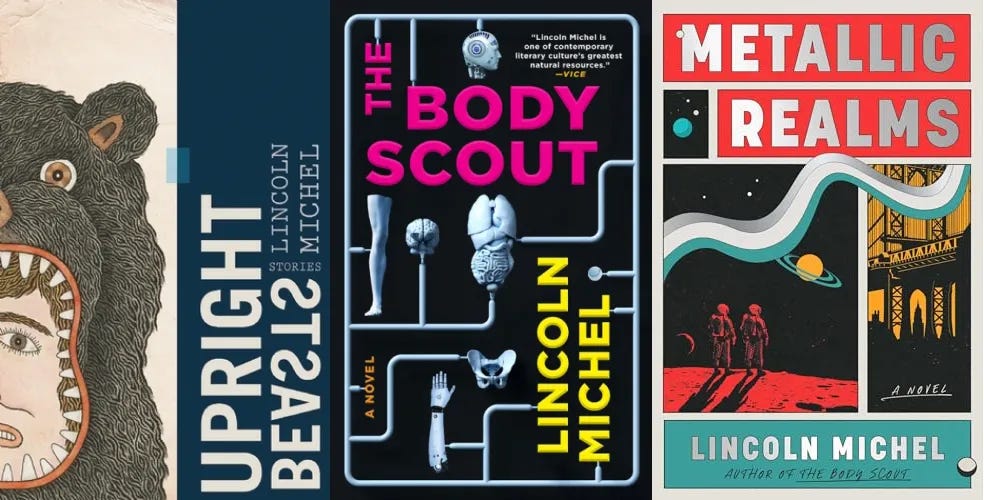
My new novel Metallic Realms is out in stores! Reviews have called the book “brilliant” (Esquire), “riveting” (Publishers Weekly), “hilariously clever” (Elle), “a total blast” (Chicago Tribune), “unrelentingly smart and inventive” (Locus), and “just plain wonderful” (Booklist). My previous books are the science fiction noir novel The Body Scout and the genre-bending story collection Upright Beasts. If you enjoy this newsletter, perhaps you’ll enjoy one or more of those books too.
I really like what you said about Invisible Cities. It reminds me of the Invisible Seas story in Metallic Realms (unsurprisingly, and as I write this and look at the two titles...well done). It could easily be boring to read about four planets that don't exist. But one was about adaptation for survival. Another about the cyclical nature of an eternal fall.
I'm struggling with my manuscript because my characters are all (intentionally) isolated people. They don't stray from their core group often, and it feels...boring. Things change throughout the book, but the way I talk about them doesn't. This makes me think that it's less that my story isn't right as the telling isn't correct yet.
right, variation is what keeps a pattern from becoming a formula.