
The Writer as Chimera (and Where Substack Fits In)
Or MFA vs. NYC vs. Streaming TV vs. Substack Feed vs...

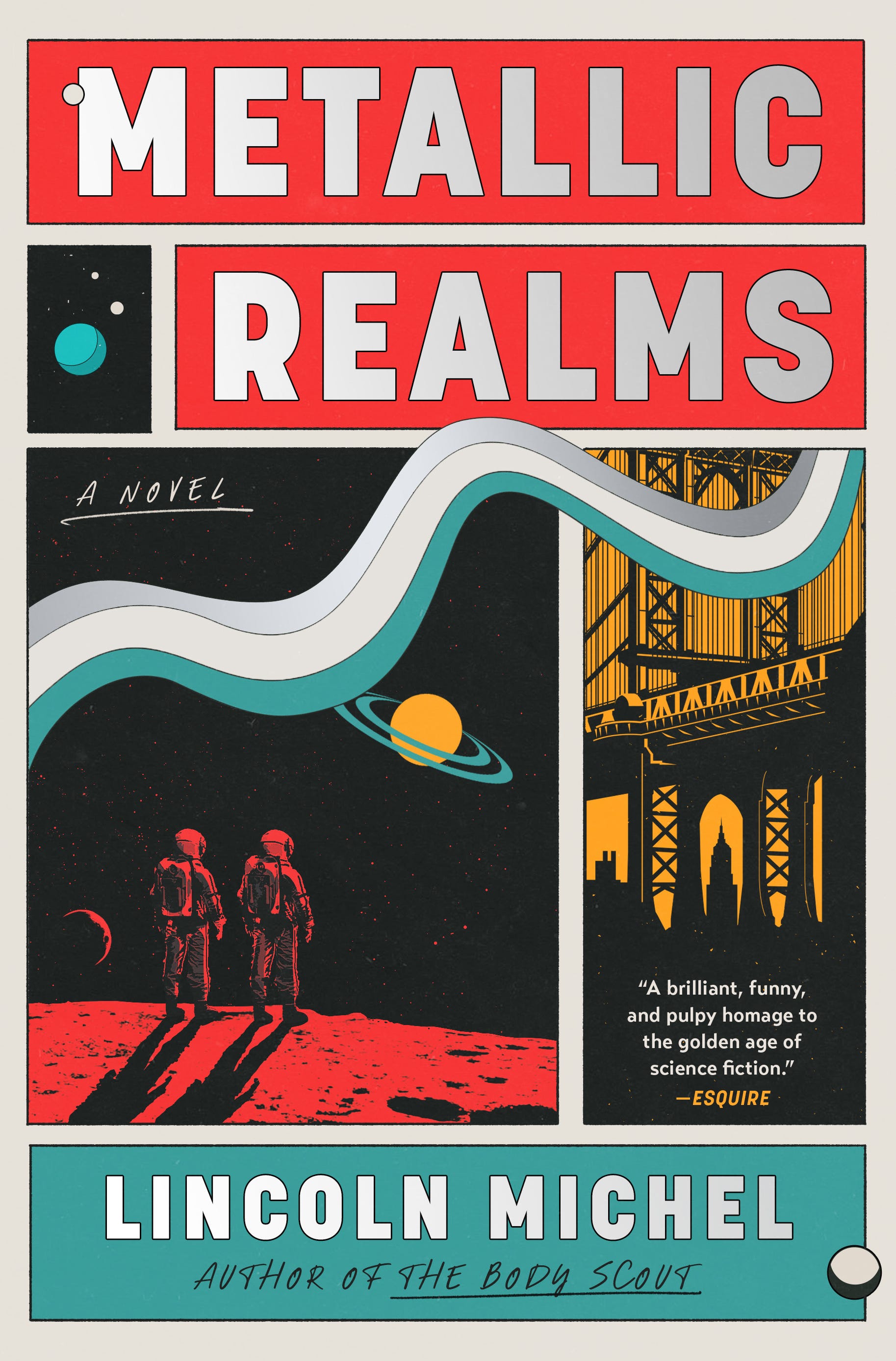
A reminder that my comic-autofiction-meets-space-opera novel Metallic Realms was just released! The novel has gotten lovely reviews, most recently from John Warner in the Chicago Tribune who called the book “a total blast” and referenced an article in this Substack where I said I thought the novel might not sell because it violated so many “rules” of publishing: “Exactly! This is what is so great about the novel. Here we have an author who is 100% committed to mapping the territory of his own interests and idiosyncrasies. It is a novel only one person could write.”
If your interest is piqued, you can find more information here. Now, onto the article:
Recently, I’ve seen a lot of chatter about what the increased attention to Substack means for the platform and especially what it means for Substack vis-a-vis traditional media. (Regarding the increased attention, see e.g.
’s “Substack Has Changed in the Last 30 Days” and mainstream outlets like New York Magazine creating Substacks.) I was planning to write a long post about my thoughts on this question as it relates to book publishing… but, well, I’m not sure there is that much to say. I got my take down in a short note:I obviously think Substack is an interesting platform, and one growing in importance to the literary conversation and book sales. I’m here, after all. Still, I’m skeptical it will radically change traditional publishing. Some interesting novels will be serialized here and the popular ones will get physical book releases. I expect a lot of nonfiction Substack-to-book deals. But novel serialization is older than Dickens, and before the Substack-to-book deal there was the Tumblr-to-book deal and podcast-to-book deal and blog-to-book deal and so on.
I see no conflict between a newsletter and a book. The great thing about Substack is that readers subscribe to support writers—obligatory subscribe to Counter Craft link!—more than to get something in return. It is a creator-supporting economy more than a market economy. Sure, a Substack audience appreciates getting early access to work but I have a hard time believing many would be offended by a writer turning serialized work or essays into a book. I think they’d be supportive, and many would go buy the book too. This really is what makes the platform special.
This isn’t to say I don’t think Substack has “disruptive” potential. What I see Substack, and similar platforms, threatening is not books but magazines and papers. (I’m not saying this is a good thing necessarily.) Even that isn’t an original thought worth expanding on. Substack got famous by luring high-profile journalists away from traditional media. That’s been well-covered. What has been less discussed is how newsletters and other direct-to-creator platforms like Patreon are replacing freelance writing income for those of us who write articles on the side. I used to pitch and write many dozens of articles a year. Now? One or two.
I guess I have a hard time buying into the “us vs. them” “outsider media vs. establishment media” mindset that can be popular on here. Is Substack new media? Maybe. But as I just said this platform is filled with famous journalists and pundits who moved here from jobs at newspapers and major websites. Many continue to have those jobs while doing a Substack on the side. In literature, the biggest Substacks are well-established names like George Saunders and Miranda July. And even many of the outsider writers here also freelance for established venues and publish books with Big 5 publishers.
What writer doesn’t these days?
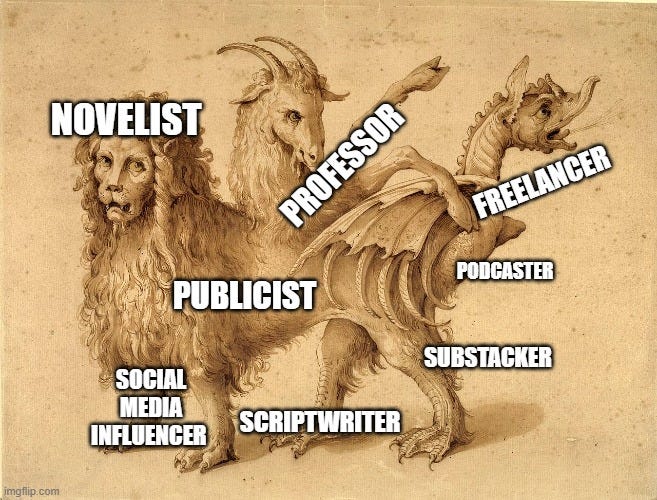
What this general discourse makes me think of is how we writers have to be weird hybrid animals in 2025. It is nearly impossible to be just a novelist. It is very, very hard to be just a novelist plus one other writing-related thing either. Today, almost every author—outside of the bestselling .01%—has to Frankenstein a career out of many different parts: novelist + professor + Hollywood scriptwriter + freelance journalist + Substacker. Or maybe a poet + podcaster + publicist + freelance editor. Probably add (self) publicist and (aspiring) social media influencer onto whatever other chimera you’ve created for yourself.
As always, genre writers have been more forward-thinking than literary authors in this regard. For years, many science fiction and fantasy authors have had Patreons that can generate more revenue than their actual books. SFF writers are often admirably open about how they cobble together income through a mix of self-publishing, Patreons, traditional publishing, Hollywood work, and so on. (Literary writers are a lot more reluctant to talk about money or to discuss careers in professional terms. Though that seems to be changing, thankfully.)
This is where I see Substack fitting into things, from the writer’s POV at least. Not as a replacement for another career but as one of the parts we use to cobble together a literary career.
I know some readers are thinking, “Making a living as an author has always been hard! Even Faulkner went to Hollywood!” This is true. It is also true that it is harder today. Universities really do have fewer tenure tracks, and adjunct rates really do pay less than full-time work. Magazines and newspapers actually do pay less in inflation-adjusted dollars. And while it is harder to get firm numbers here, novel advances really do seem to have declined.
When I started taking writing seriously as my future twenty years ago or so, the era of living off literary fiction was dying although not quite dead. There were still your occasional million dollar book deals for debut novelists in the late 2000s. Still, those were rare. What I gathered was that there were two models to building a literary life if you didn’t come from or marry into great wealth:
You could get a teaching job (and write novels on the side).
You could be write for magazines and newspapers (and write novels no the side).
The other option, beyond generational wealth, was having a high-paying job in an entirely unrelated field. But, if you wanted a literary focused life these were the two big options. You secured a teaching job, ideally teaching creative writing, and wrote in the summers. Or else you earned a living writing non-fiction for journals while also making a name for yourself that could be parlayed into book deals. We might call these paths “MFA vs. NYC”—after the much-discoursed essay from 15 years ago—although the internet made the “NYC” model possible in other locations. (I actually planned to write an article called something like “MFA vs. NYC vs. Streaming TV,” riffing on that article but noting how much Hollywood work had grown as a means of income for novelists. But, it seems Hollywood is in a hard spot these days too…) Obviously, one could both teach at a university and write for magazines and newspapers (while writing novels on the side). But most writers focused on one or the other.
You know where this is going.
Both the teaching and freelancing models collapsed simultaneously. Universities rapidly “adjunctified” to where something like 70% of college professors are adjuncts. Tenure lines dried up, and the older professors stopped retiring anyway. Even more disastrous was the collapse of journal income as the internet destroyed ad rates while increasingly sucking away traffic. The kind of article that might have fetched you a couple thousand dollars pre-2000 quickly became one you were lucky to get a couple hundred dollars for, even at the same prestigious magazine or newspaper. I expect both trends to only continue, especially as tech corporations are using GenAI to suck up all the web traffic they can and modern universities move ever more from a “students are here to learn” mindset to a “students are the customer” one.
With those models collapsing, most of us have to be chimeras and create a literary life out of disparate parts. When my writer friends get together to grumble, discussions are often about where we are moving our time in search of stability and revenue streams. “I’m really burned out on teaching and trying to do freelance editing these days.” “I’ve given up on the freelance hustle, I’m trying to sell some movie scripts right now.” “Hollywood is a bust post-writers’ strike, I’m loading up on courses this fall.” Etc.
In a way, being a writer is a zero-sum game. Not against others but against yourself. There are a finite number of hours in the day and a free afternoon spent trying to publicize your published books (or pitching an essay or writing a Substack post) is an afternoon you aren’t spending writing a new book.
Sigh. But also, c’est la vie. This is the world and it is good to go into things with clear eyes.
To make this article end a bit more positively, let me say that as far as Substack goes there is great potential here to combine some of your limbs (if I may stretch this chimera metaphor). Substack is a hybrid social media and publishing platform. If you build up a following here, it can replace the time you might otherwise spend pitching and hustling freelance article work and the time you spend on social media trying to build a platform. You get to do both here simultaneously.
Social media is fracturing. And the lesson of Musk buying and tanking X née Twitter—and threats of TikTok bans and Facebook’s ongoing enshittification etc.—is that all the time and effort spent building up a social media following can go bust in an instant. As social media keeps fracturing, it will only be more important to build up your own following. Maybe that’s on Substack or maybe Patreon or your own website. But in 2025, I would advise emerging writers to focus on this.

The second bit of advice I’d offer to writers in the chimera age is to make your parts work in sync as much as possible. I explained this more in my “Reflections on Four Years of Counter Craft” post, but basically think about how you make the disparate jobs work in tandem. My craft articles here inform my teaching, and vice versa. Both of those inform my fiction writing, and my fiction writing gives me ideas for articles and classes. Etc. Maybe you will serialize a novel on Substack to build an audience to sell that same book to a publisher. Or freelance essays on topic X to build buzz for your podcast on X that then becomes a nonfiction book.
This is my advice, at least for those of us who aren’t yet those mythical beasts that can live on novels alone…
If you like this Substack, please consider subscribing or checking out my new novel Metallic Realms. It is out in stores and getting great reviews: “Brilliant” (Esquire), “riveting” (Publishers Weekly), “hilariously clever” (Elle), “I left this book feeling … assured of the future of storytelling” (The Masters Review), and “Just plain wonderful” (Booklist). You can also read an excerpt of the novel in the excellent Substack magazine The Metropolitan Review.
> "It is very, very hard to be just a novelist plus one other thing either."
There's definitely a path many genre writers go down where they have a single, lucrative job outside of writing but also write novels related to their job in some way. Most obviously the Grisham/Turow lane, but there are definitely cyberpunk authors who work in the tech sector, and arguably authors who work at *and* write about a college count too. Perhaps the Great American Plumber Novel is next? ;')
”Will Substack replace publishing?” I thought Substack was publishing. It's the author's newsletter. It's great