

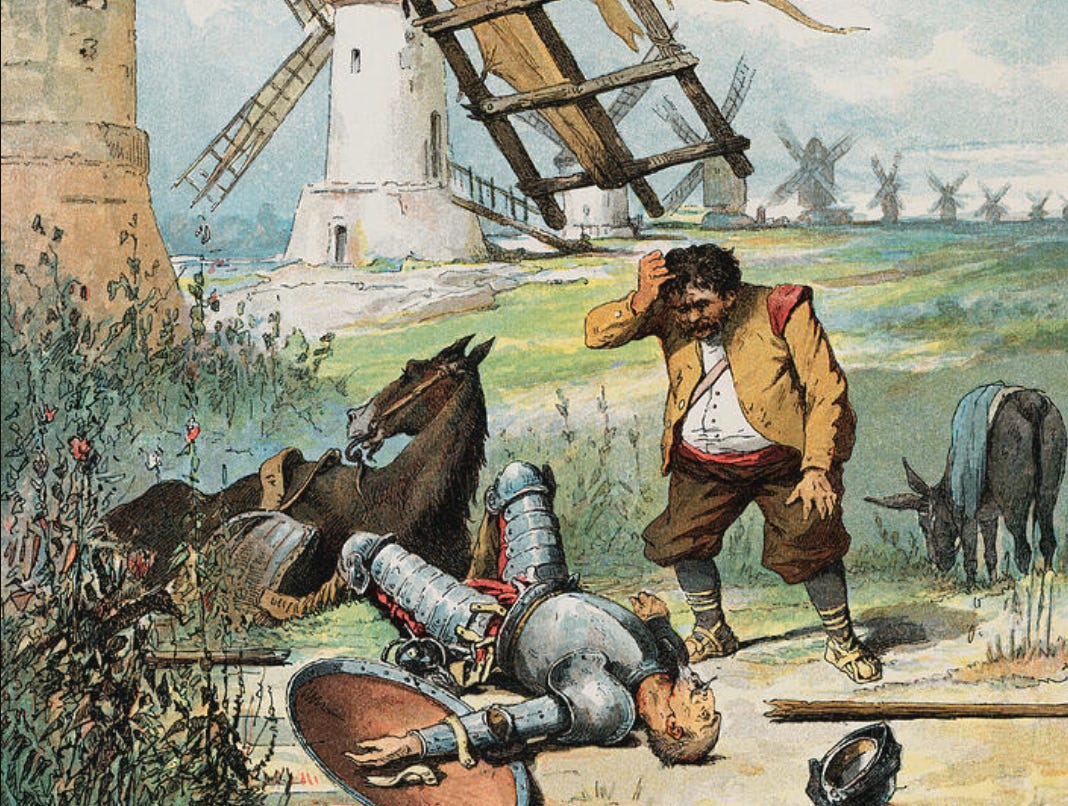
Get in loser, we’re tilting at windmills.
Each year I try to conquer one big ol’ classic that I’ve yet to read. This year, it’s Don Quixote aka “the first modern novel” aka the 950+ page adventures of an insane wannabe knight and his portly sidekick. Don Quixote’s influence is so vast and I have seen or read so many different parodies, pastiches, and playful references—from cartoons to experimental short stories1—that I felt as if I’d absorbed the novel by cultural osmosis. This might be an appropriate way to read Don Quixote really (more on that below), but I also wanted to finally read the thing itself. So, I have been. And it’s been a goddamn blast.
Look, I’m aware that whole libraries of scholarship on Don Quixote exist. I’m under no illusion that I can provide fresh insights into one of the most discussed novels in world history. I can only talk about my own thoughts and reactions. But so far my reading experience has been one of unmitigated delight, and the reading has inspired some stray thoughts about the form of the novel. (I’m reading the Edith Grossman translation, so all quotes to come will be taken from that.)
I’m not surprised that Don Quixote is hilarious and deranged. I’ve often found that the dusty classics that are supposed to be dreary chores to read are, in fact, far funnier and stranger than their reputations would suggest. However, I was surprised by how modern the novel feels. It is filled with metafictional conceits and techniques I associate with the postmodernists2 of the mid-to-late 20th century and various post-postmodernist works of today. Cervantes makes up fake ballads, interjects to complain about his protagonist, and has characters (in the second volume) who have read the book they’re inside. Even the premise of the book—an insane man goes on failed adventures while imagining he is a knight—feels like an extended bit novel I associate with postmodernists, Oulipians, and other more contemporary literary trends.
(Cervantes is hardly the only early novelist to use such moves. Tristram Shandy is equally comic, parodic, and metafictional. How much of postmodernism was merely a return to the novel’s playful origins?)

Going in I knew that Don Quixote was a wannabe knight who imagined adventures (e.g., attacking windmills he thinks are giants) and was thus about the dangers of confusing fiction for reality. What I hadn’t known was that Don Quixote is literally driven insane by reading badly written books. It’s the first novel about fan fiction! The gentleman who dubs himself Don Quixote—the narrator says on page one that they aren’t sure what his actual name is—becomes obsessed with trashy chivalric romances3 full of meaningless flowery sentences that melt his mind. Cervantes provides a few examples of the highfalutin yet empty prose that Quixote reads: “The reason for the unreason to which my reason turns so weakens my reason that with reason I complain of thy beauty” and “the heavens on high divinely heighten thy divinity with the stars and make thee deserving of the deserts thy greatness deserves.”
With these words and phrases the poor gentleman lost his mind, and he spent sleepless nights trying to understand them and extract their meaning, which Aristotle himself, if he came back to life for only that purpose, would not have been able to decipher or understand.
Bad prose drives him mad. (What would Quixote have done in the age of LLM slop?) This is all quite funny although I should underline that the humor of Don Quixote is not limited to linguistic pastiche. The humor is as “lowbrow” as “high-minded.” Quixote and his squire Sancho are physically injured in slapstick sequences out of The Three Stooges and at times gross-out comedy you might expect from South Park:
One might reply that this humor is less like Stooges or South Park and more like his contemporary Shakespeare.4 Quite true. But since I read Shakespeare untranslated, his language remains archaic and (at least for me) requires a second of deciphering that makes even gutter groundling humor land in my head rather than my gut. In this way, Cervantes is making me understand how Shakespeare’s humor landed in its time.
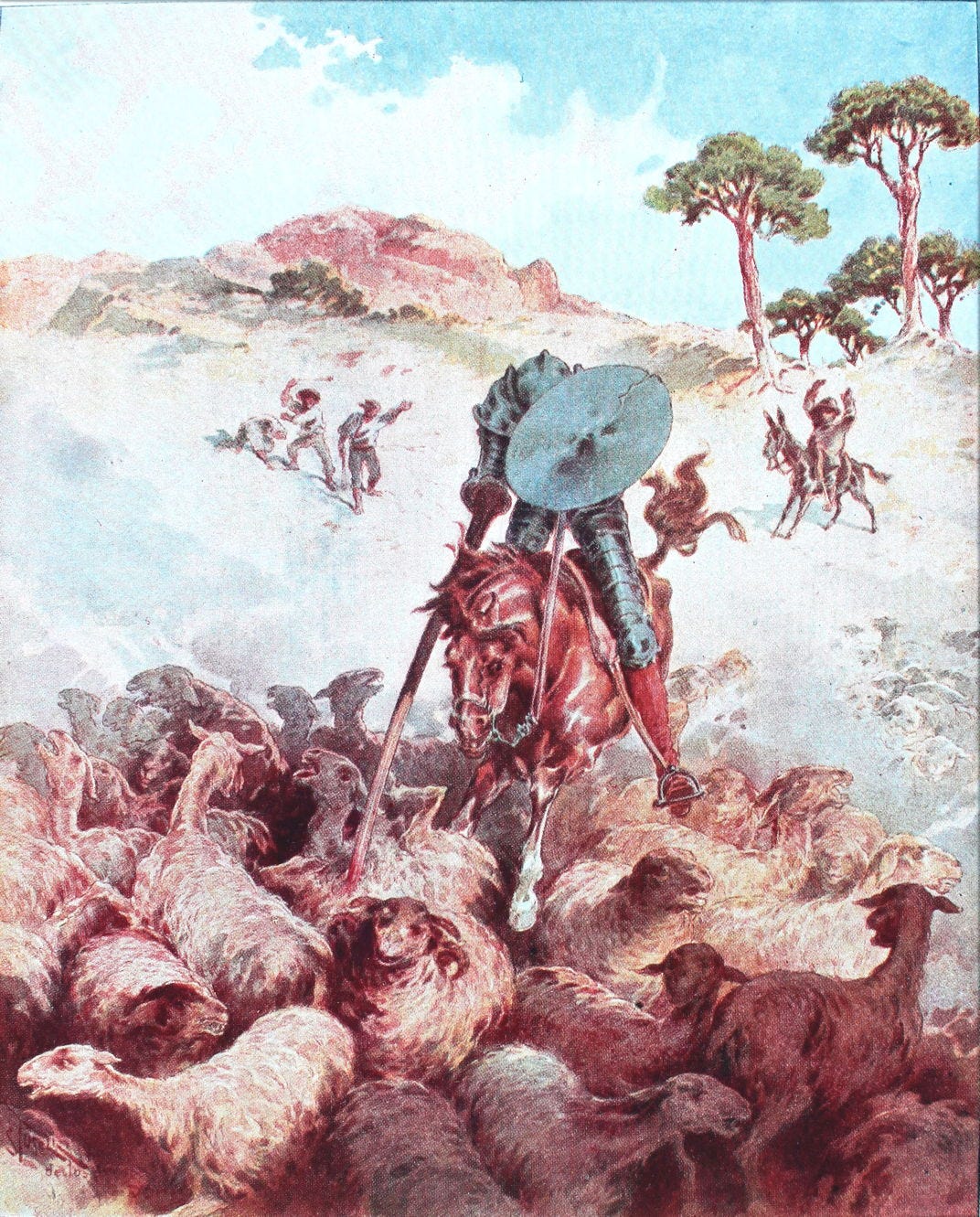
Back to the Don. The narrator will not infrequently interrupt the story to subvert chivalric tropes or to just complain. Cervantes (the narrator5) pauses during the first big battle to tell a longwinded tale of how he found the manuscript to Don Quixote that he claims to have merely translated, mocking a tradition of chivalric romances. I particularly enjoy when the author-narrator gets irritated with his own characters. The aforementioned sheep incident involves Don Quixote spotting dust clouds (from herds of sheep) that he believes are grand armies filled with famous warriors carrying bright banners and shining armor. Quixote goes on for pages monologuing to Sancho about all the great warriors he sees. Finally, the narrator interrupts with exasperation:
Lord save me! What a number of provinces he mentioned and nations he named, attributing to each one, with marvelous celerity, the characteristics that belonged to it, so absorbed and immersed was he in his lying books!

I almost can’t believe I haven’t already read this novel. I don’t mean just because it is great and I should have read it before. That’s true. But Don Quixote is so invested in so many of the themes and techniques I use in my own work. My most recent novel, Metallic Realms, is also a genre parody slash homage with metafictional elements and a buffoonish yet sympathetic protagonist who can’t separate fact from fictional tales. I’m not saying I came to these elements independently. These are parts of my aesthetic DNA because I devoured authors like Borges, Calvino, and Nabokov6 who themselves were influenced by Cervantes. But suddenly, I feel like I am seeing the source code of my aesthetic world.
(Side note: the paperback of my novel Metallic Realms is coming out this November! If you were waiting for the paperback release, I’d love it if you preordered)

There’s one question I keep thinking about while reading. Don Quixote is often described as the first modern novel. The grandfather of every novel on the shelf today, at least in the Western tradition. What does it mean that the first novel is a slapstick satire? That it parodies another genre of writing and is committed to messing around, experimenting with techniques, and poking fun? Does it say something about the novel that its roots are satire and play?
Plenty of novels would not take those descriptors. Many—including great ones—are dour, somber, and dreary. Yet many seminal novels do have the same puckish spirit including the two that would likely top votes for the greatest English-language novels: Ulysses and Moby-Dick. Both are relentlessly inventive books that change tones, styles, and form. Both satirize and/or pastiche other genres and types of writing—e.g., each has a chapter in the form of a play script—and are happy to digress or switch topics at will. In all these books there is a deep joy of language, which necessarily includes some mockery.
Your Novel Should Be More Like Moby-Dick

Moby-Dick resurfaced in the discourse this week, and whenever Melville’s leviathan breaches the timeline there are complaints that the novel is ruined by chapters of “whale facts” that “distract from the plot.” Seeing these grumbles again made me think about, whew, I wish there were more whale facts in contemporary novels!
I’m inclined to believe this playfulness is essential to the novel. At the very least, most of my own favorite writers and literary movements had a similar puckish and playful muse. The Surrealists, the Oulipians, the magical realists, the New Wave of SFF, etc. The great strength of the novel is its protean form. It can take any shape and absorb any style. Any new type of language or vehicle for language can be subsumed by the novel. chivalric romance, drama, poetry, corporate jargon, email reply chains, text messages, resumes, etc. You name it, the novel can repurpose it. Hell, that can even be the whole book. I’ve read novels made out of fake book reviews, descriptions of imagined locations, and invented standardized test questions.
Perhaps it is too much to make a grand statement about the nature of something as vast as “the novel.” But reading Don Quixote is reminding me that at least a point of literature is to goof around. For my biases, the novels that have felt the most alive to the form have involved these elements, especially the sense of play. So, sally forth. Have fun and make it fun for others. Get on the horse, grab your lance, and let your imagination go wild.
My new novel Metallic Realms is out in stores! Reviews have called the book “brilliant” (Esquire), “riveting” (Publishers Weekly), “hilariously clever” (Elle), “a total blast” (Chicago Tribune), “unrelentingly smart and inventive” (Locus), and “just plain wonderful” (Booklist). My previous books are the science fiction noir novel The Body Scout and the genre-bending story collection Upright Beasts. If you enjoy this newsletter, perhaps you’ll enjoy one or more of those books too.
Because American conservatives use the word “postmodern” as some vague pejorative that applies to anything they dislike I always get some readers who think “postmodern” literature means like “super woke” literature or something. To clarify, I mean the loose genre of experimental, metafictional, and formally inventive literature that emerged around the 1960s. Writers like Pynchon, Calvino, DeLillo, Cortázar, etc.
These were not romance in the sense of “romance books” in a 2026 bookshelf, but rather the popular medieval tales of gallant knights and high adventures that were a dominant literary genre in Europe before, well, Don Quixote. Think tales of King Arthur’s roundtable knights. The term “romance” comes from the texts being written in vernacular Romance languages (Old French, Old Spanish, Old Occitan, etc.)
It feels crazy that perhaps the most important playwright (Shakespeare), essayist (Montaigne), and novelist (Cervantes) were all contemporaries.
Always good to remember the narrator is not the author. No, not even in autofiction.
The always prickly Nabokov often derided Cervantes—mainly for being overly cruel to his hapless heroes—but studied him closely in the years before his seminal run of Pnin, Lolita, and Pale Fire. It doesn’t seem like a stretch to read all three in part as responses to Don Quixote with their “unlikable” narrators and metafictional conceits.
Great review which reminded me what I loved so much about DQ when I read it years ago..
I think there is much to be explored in the idea that the post-modernists weren't doing something all that crazy and returning to a playfulness.
I've been researching and writing a monograph on Kipling, and he is also doing some post-modern stuff in his later fiction, so much so that he inspires both Joyce and Borges! In fact, you can read interviews with Borges and the interviewer gets kind of exasperated at him for constantly referencing Kipling.
So yeah I think you're right that if you are a master of the craft of writing fiction, you can't help but realise the inherent silliness and latent-creative-power of the novel as a form, and start experimenting with it
I love DQ. Both Diary Queen and Don Quixote.
A fave quote from Don Quixote = "since I'm always reading, even scraps of paper I find in the streets" -- Isaac Babel used it as the epigram for his 1920 diary