

If you missed it, my flash fiction story from the slickly designed and sharply edited Thirty Cabins zine was republished on the Thirty Cabins Substack along with an interview. Give it a read, if you’d like.
While I titled this newsletter Counter Craft to imply a contrary (or at least counterintuitive) approach to the common craft advice, I have a sincere interest in the craft of fiction. I know, I know. “Craft.” It sounds like a children’s summer camp activity. And anyway aren’t real writers the ones whose prose is powered by vague abstractions like blood and guts rather than the senseless shibboleths of pretentious MFA professors smacking their ruler against the blackboard to demand every original edge get sandpapered away to fit into the draconian rules of craft? Maybe. I dunno. Perhaps what I find fascinating is less craft than process. How the methods you use change what works are possible. (This is why I call my interview series Processing and why the first series I wrote here was titled Strange Methods.1) I thought I’d write about this question of product and process for Labor Day.2
Process is central to understanding most other art forms, perhaps because the results are so obviously determined by the materials and techniques used. Electric vs. acoustic guitar. Black and white vs. color photography. Watercolors vs. oil. Etc. And there is often behind-the-scenes or documentary footage of musicians, painters, and filmmakers creating the work that doesn’t really exist for authors. (Understandably, it would be quite boring). With fiction, it isn’t as clear what process went into a work. Did the writer compose by laptop, notepad, or by dictation? Did they vomit up a messy draft and revise it or did they carefully craft each paragraph to perfection before moving on to the next one? Unless you’re a scholar digging through the archives, you probably don’t know.
What’s true of other art forms is true of fiction, even if obscured. The methods we choose to use to compose the work determine the final work as much as any decision by a painter or musician. Certainly I find that my own stories take on very different qualities depending on the constraints, methods, and processes I pick. Since I’m always on the lookout for different writing processes, here are a few of the unusual composition methods that I’ve come across.
César Aira’s Escape Forward
This was the first process I wrote about in my (brief) Strange Methods series in 2021. César Aira is one of the most prolific authors alive and one of my favorites. He publishes several short books a year that can jump all over the place in terms of style, genre, and form… often within the same work. This stems from his “la fuga hacia adelante” or “the escape forward” method that means he never revises work once completed. Here’s how translator Heather Cleary describes the method in a Words Without Borders review:
Aira is perhaps best known for his aleatory narrative style, the product of a technique he calls the “flight forward,” which allows for no backward glances, no revision; only a dizzying accumulation of characters and plot twists that brings to mind an image of the author stumbling across an idea, dusting it off, and adding it to the motley strand of his narrative. Paradoxically, yet perhaps necessarily, these baroque storylines are typically expressed in a spare, precise prose that skates between the colloquial and the theoretical.
Most writers revise earlier chapters to fit new ideas, plot points, or characters. Aira, instead, looks for a solution by going forward. Often Aira’s “escape forward” (or “flight forward”) involves literal time jumps into the future or else wild shifts in scope. This process gives Aira’s works a wonderfully anarchic and freewheeling quality. His novella The Literary Conference, for example, begins with a down-on-his-luck translator named César Aira solving a riddle to find buried pirate’s treasure. Then the narrative leaps forward to a wealthy Aira who has become a literary supervillain. He plans to clone Carlos Fuentes at the titular literary conference, which leads to a series of ever more surprising turns. This isn’t the kind of novel you’d be likely to write by heavily plotting your book before writing or by heavily revising it over years and years. You need a freewheeling process to create a freewheeling work.
If you’re interested in trying Aira, my favorites are The Literary Conference, Fulgentius, and An Episode in the Life of a Landscape Painter.
Don DeLillo’s Paragraphs
Many authors are described as “sentence-driven” in contrast to “plot-driven” writers, as if the options were focusing on the smallest unit or the overall picture. But there are options in-between. Don DeLillo is the sort of writer who is often called sentence-driven but he says he writes by paragraph. I’m sure some readers will find his process “pretentious,” yet it gives a unique character to DeLillo’s style. DeLillo explained this process in an interview with David Marchese for the New York Times. Bolding is mine:
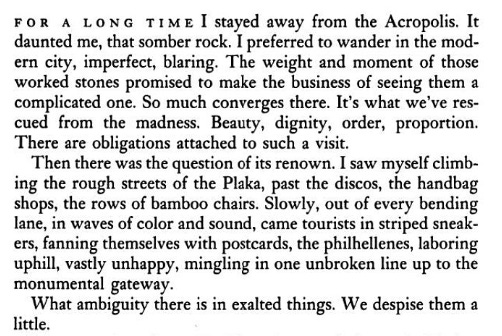
Technology has changed the way we think, talk. Everything was different before this somewhat abrupt technological advance. Our thinking is less meditative and somewhat more instantaneous. I don’t use a cellphone, because I want to keep thinking in a traditional manner. It helps me concentrate on words on a page. This has always been an important element in the way I work: simply the appearance of words on a page, letters in the word, words in the sentence. If I can go on for a minute, I think it started with “The Names,” which I wrote in the early 1980s: I recall clearly seeing the visual connection between letters, between letters in a word, words in a sentence. When I started working on “The Names” I decided to limit each page to a paragraph, one paragraph per page, which helped me in a visual sense to concentrate more deeply, and I’ve been doing it more or less consistently ever since. For example, there’s a phrase I remember at the end of “Underworld”: Raw sprawl. The word “raw” is contained in the word “sprawl.” That sort of thing became more apparent to me after “The Names.” I have to add this: I still use an old Olympia typewriter. It has large type and allows me to see more clearly the letters on a page.
Vladimir Nabokov’s (and David Markson’s and Mary Robison’s) Notecards
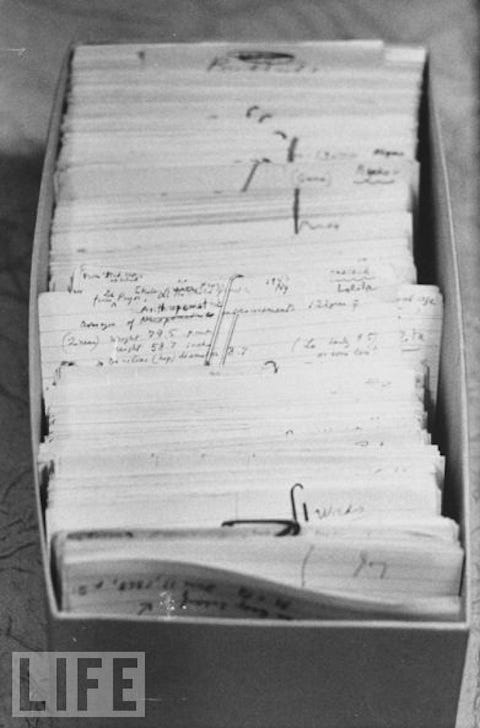
DeLillo’s single paragraph per page method reminds me how many writers use notecards to write novels. Nabokov wrote his books on notecards that he “gradually copied, expanded, and rearranged until they become his novels.” This was the source of a final Nabokov controversy when his son, against his late father’s wishes,3 posthumously published 135 notecards as The Original of Laura. In his TPR interview with Herbert Gold, Nabokov explained his process this way:
The pattern of the thing precedes the thing. I fill in the gaps of the crossword at any spot I happen to choose. These bits I write on index cards until the novel is done. My schedule is flexible, but I am rather particular about my instruments: lined Bristol cards and well sharpened, not too hard, pencils capped with erasers.
While Nabokov expanded his notecards into more traditional novels4, other notecard writers preserve more of the form in the final work. David Markson’s experimental collage novels in “The Notecard Quartet” were, as the name implies, composed on notecards. Markson speaking to Tayt Harlin for Conjunctions:
MARKSON: I use index cards. I store them in the tops of a couple of shoes boxes. If I made a stack of them, they’d probably be about two feet tall. I’m constantly shuffling. This goes on for a couple of years. I might have a few quotations about Joyce, and I figure out which one goes where. I try to make sure I don’t overbalance. I know in the end that there’s going to be more literature, but I try to make sure I have as much about art and music, too. There’s always a certain amount of the classics and philosophy. With the historical stuff, it just depends upon its significance or irony. Then, somewhere along the line, I make notes about Author or whoever it is and figure out where they go.
HARLIN: Have you ever thought of doing a remainders book of what didn’t make it in?
MARKSON: No, in fact, I destroy whatever I don’t use. You know how you have manuscript boxes? I also have a box with the final index cards.
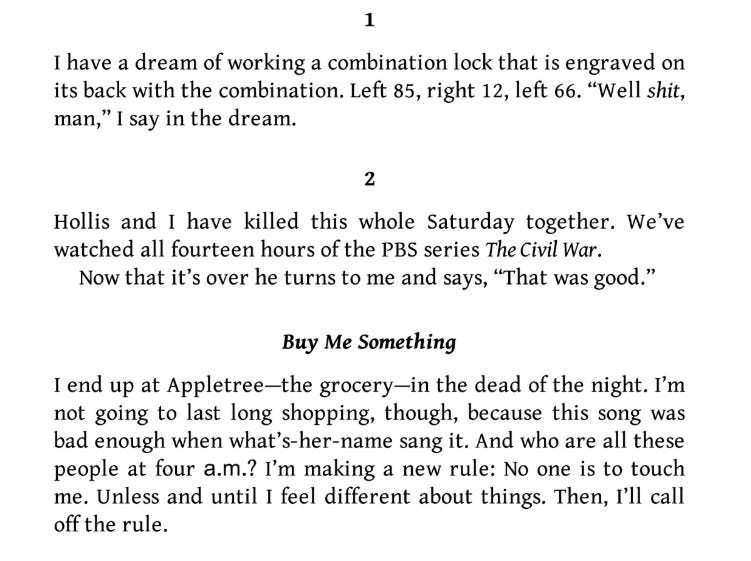
Another notecard novel I admire is Mary Robison’s 2001 novel Why Did I Ever, which was composed on index cards after a period of writer’s block. Blake Butler in Vice writes “Robison took to the practice of writing small sections of text on thousands of notecards, attempting to establish not a plot or string of scenes, but little mechanical pieces that each held up solely on their own.”
(I’m nearly certain I once read that Robison wrote the notecards in her car during breaks from her Hollywood job—a job mirrored by the main character—but I can’t find the source.)
The result is a novel-in-fragments composed of over 500 short sections (sometimes numbered, sometimes with titles) that mix brief narrative scenes, quotes, anecdotes, and even sections as short as a single word like “Huh.” It’s a funny novel that reads like a Twitter feed from back when Twitter was good (and also called Twitter).
Nicholson Baker’s Roleplay
I’ve written about Nicholson Baker’s brilliant first novel, The Mezzanine, which he wrote by dictating into a voice recorder. The novel itself is a strange one, composed almost entirely in digressions and asides (many in footnotes) that the narrator thinks while riding an escalator from the ground floor to the mezzanine. Despite the formal play of the book, it is a very voice-driven novel and you can imagine how performing the voice could shape it. Baker went further with roleplaying in The Anthologist, as he explained to Alexandria Alter at The Wall Street Journal:
For his recent novel "The Anthologist," a first-person narrative by a frustrated poet who's struggling to write the introduction to a new anthology, he grew out a beard to resemble his character, put on a floppy brown hat, set up a video camera on a tripod and videotaped himself giving poetry lectures. He transcribed about 40 hours worth of tape, and ended up with some 1,000 pages of notes and transcription. Creating the voice of a rambling professor "was something I had to work on a lot in order to get the feeling of being sloppy," said Mr. Baker.
The Novel as Shaggy Dog Joke

This week I taught an old favorite, The Mezzanine by Nicholson Baker, which is one of those novels I believe every young writer should read for the “What the hell? You’re allowed to do that??” factor. The Mezzanine—which was Baker’s debut in 1988—serves as rebuttal to all the usual writing advice about the importance of plot, incitin…
Kazuo Ishiguro’s Emotional Plotting
In the same Alter article, which asked 11 authors about their process, Ishiguro also talks about voice. He says he “auditions” characters by writing chapters in different POVs. What seems especially interesting is his preparation method:
Before he begins a draft, he compiles folders of notes and flow charts that lay out not just the plot but also more subtle aspects of the narrative, such as a character’s emotions or memories.
Obsessive preparation “gives me the opportunity to have my narrators suppress meaning and evade meaning when they say one thing and mean something else,” says Mr. Ishiguro.
While many writers map out plot beats, mapping out characters’ memories and emotions isn’t as common. But it makes perfect sense that this process would help Ishiguro capture the signature restraint and evasions his characters display.
Garielle Lutz’s Recursive Sentences
I’m not sure any contemporary writer epitomizes the sentence-driven author more than Garielle Lutz. Anyone who loves sentences as objects d’art will likely love Lutz’s strange and estranging sentences. Here’s the opening of the story “Mine”:
Do what I do: come from a family, have parents, have done things, shitty things, over and over and over. There was the one day I got too friendly with my friend. The next summer, I welcomed men into the house while my mother and father were at work. I did this to the exclusion of everything else I was cut out for at twenty-two. The men passed through me one way or the other and came out narrowly mine.
Lutz practices a method of writing where the sonics in a sentence produce the subsequent sentences. Lutz explained this in a brilliant essay “The Sentence Is a Lonely Place”:
Consecution: a recursive procedure by which one word pursues itself into its successor by discharging something from deep within itself into what follows. The discharge can take many forms and often produces startling outcomes, such as when Christine Schutt, in “The Summer after Barbara Claffey,” is seeking the inevitable adjective to insert into the final slot in the sentence “Here is the house at night, lit up tall and ______.” What she winds up doing is literally dragging forward the previous adjective, tall, and using it as the base on which further letters can be erected. The result is the astounding, perfect tallowy—the sort of adjective she never could have arrived at if she had turned a synonymicon upside down in search of words that capture the quality of light.
This method isn’t just about stringing together beautiful sentences, but about using the acoustics of sentences to generate the other parts of the story from characters to events. It creates a very unique type of story, one dense with both sonics and meaning.
Zadie Smith’s Obsessive Perspective Disorder
When I was in graduate school, Zadie Smith gave an excellent craft talk during which she described her “Obsessive Perspective Disorder” novel-writing process that I’ve thought about many times since. (Lutz’s essay above was from the same craft series, in fact.) Basically, Smith has to spend forever tinkering with the first 20 pages until the tone and the voice are perfected. Then the rest of the novel springs forth. Luckily, I can quote her directly instead of just my flawed memory as the lecture was published in The Believer:
In the case of On Beauty my OPD spun completely out of control: I reworked those first twenty pages for almost two years. I really felt I was losing my mind. I can hardly stand to look at my novels in general, but the first twenty pages of each in particular give me heart palpitations. It’s like taking a tour of a cell in which I was once incarcerated.
Yet while OPD is happening, somehow the work of the rest of the novel gets done. That’s the strange thing. It’s as if you’re winding the key of a toy car tighter and tighter…. when you finally let it go, it travels at a crazy speed. When I finally settled on a tone, the rest of the book was finished in five months. I think worrying over the first twenty pages is my way of working on the whole novel, my way of finding its structure, its plot, its characters—all of which, for a Micro Manager, are contained in the sensibility of a sentence. Once I get the tone, everything else follows. You hear interior decorators say the same about a shade of paint.
Okay, that’s probably enough work for Labor Day. The last thing I’ll say is that process is not static. Most writers I know would tell you that each book requires new techniques to complete and that their process varies by project and circumstance. I imagine the authors above would agree. This also means that if your process is not working or you feel stuck in a rut, then maybe it is time to change it up. Perhaps by attempting one of the above?
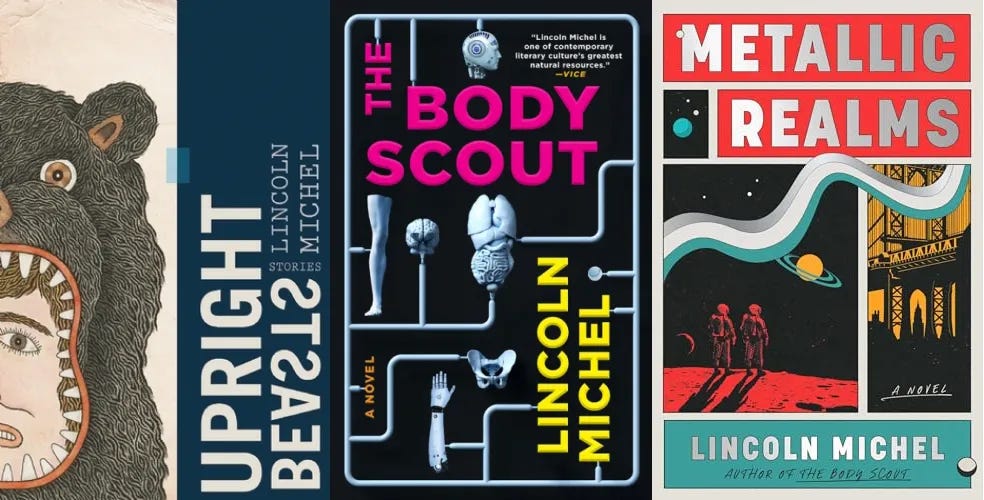
My new novel Metallic Realms is out in stores! Reviews have called the book “brilliant” (Esquire), “riveting” (Publishers Weekly), “hilariously clever” (Elle), “a total blast” (Chicago Tribune), “unrelentingly smart and inventive” (Locus), and “just plain wonderful” (Booklist). My previous books are the science fiction noir novel The Body Scout and the genre-bending story collection Upright Beasts. If you enjoy this newsletter, perhaps you’ll enjoy one or more of those books too.
These old posts on César Aira, Zadie Smith, and Michael Moorcock are in the paid archive. I’ve summarized the first two in this article.
Craft, labor, works… it kinda fits.
Put me in the “boo” camp for not respecting the artist’s wishes. And yet I’m glad Brod published Kafka’s works. I guess, as always, it depends…
Well, relatively speaking. Nabokov could be as experimental as the rest of ‘em.
Great stuff, especially the Garielle Lutz (I was unaware of her work and will try that carrying-forward exercise with a student, especially because I'm still struggling to understand her method, myself!). Fyi the links to Kimberly King Parsons's Substack articles about Lutz don't seem to be working.
Thank you. That was a great read.