

Hi all,
You may have noticed my Counter Craft posts have slowed a little the last couple of months. That is because I’ve been furiously revising my forthcoming horror novel Haunted Hills. I’m going to write a little about revision today since, well, it is occupying much of my mind.
First though, I was recently asked by The Substack Post to join Kathleen Schmidt and John Paul Brammer to chat about LLMs, the $2 million book deal cancelled over alleged AI use, and the general state of publishing. The conversation was hosted by Danya Issawi and I think it turned out well! If you aren’t totally burned out on AI discourse,1 then give it a read here:

Coincidentally, I just saw someone share my AI-dread-inspired short story “Algorithm America.” I wrote it soon after ChatGPT was released and decided to self-publish it on Counter Craft in 2023 partly as an experiment in publishing fiction here but mostly because I didn’t want to wait for the (often very long) lit mag submission process given the story’s timely subject matter. I feel the story has held up pretty well, if I do say so myself. Section III, about writers fighting over LLM use, feels appropriate after the aforementioned Substack Post roundtable. Maybe I’ll publish some more short stories on Counter Craft in the future. Either way, if you’re interested in reading “Algorithm America,” here it is:

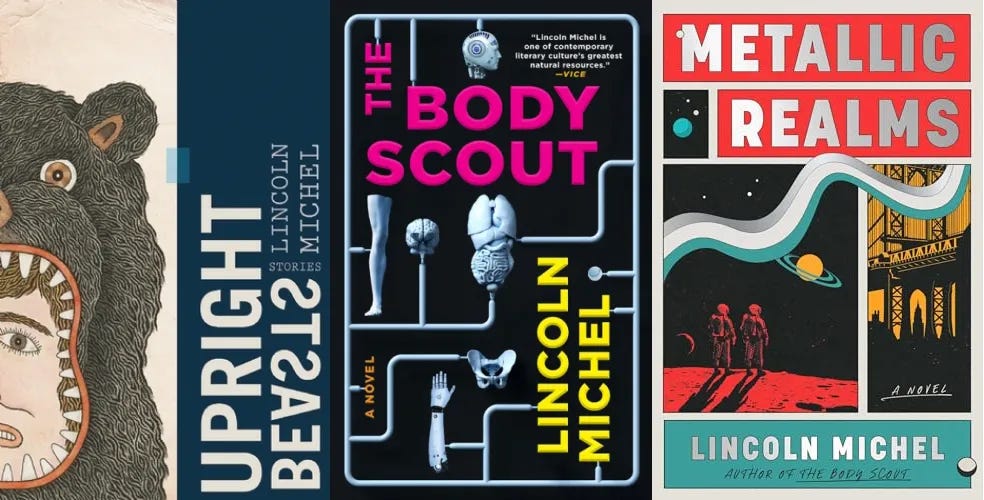
And while I’m sharing links, my first novel, The Body Scout, got a very nice review here on Substack from Necessary Friction:
The Body Scout easily earns its slot on the cyberpunk shelf. It’s a biting, incredibly intelligent neo noir digging into questions of corporatism, scientific progress, entertainment, business, and the self. All told via the seedy world behind America’s favorite pastime. And through it all there’s a real heart amid the despair, an upbeat and optimistic belief in humans and their ability to be better.
One thing I love about literary Substack is that people here actually review older books. Newsletter writers don’t have to worry about the news cycles and publication dates quite as much. We’re writing for subscribers, not social media clicks. And the cliché is true. Every old book is new to someone. And, given how few books most people read, probably new to functionally everyone.
THE HORRORS OF REVISION
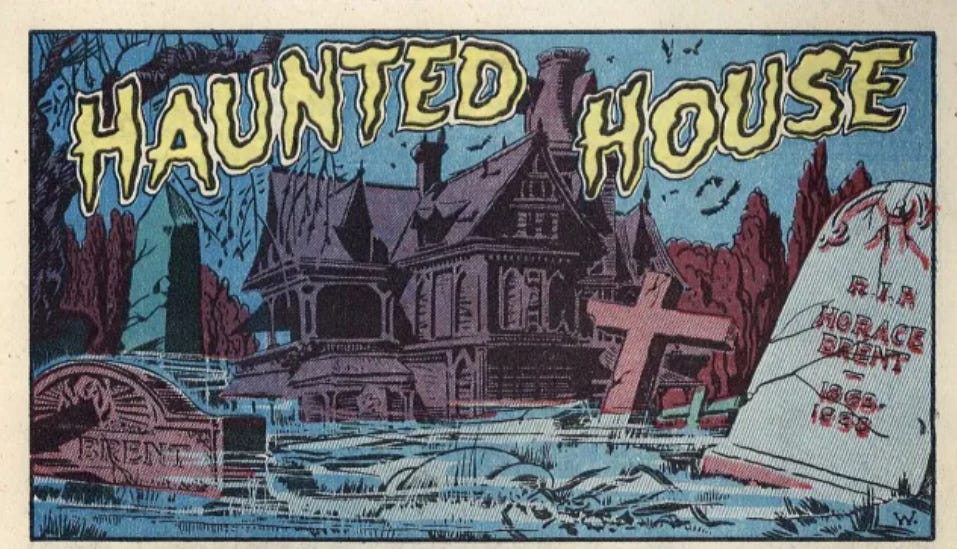
This brings me back to revising Haunted Hills, my sort of Invisible Cities meets The Haunting of Hill House novel. (Now is probably the time for me to hone an elevator pitch…)
The revision of this novel has been quite different from revising my last ones. Partly, this is because I sold the novel on partial (about 50% complete), which changed my approach to writing the final half. By “approach” I mean writing in a blind panic slash furious creative fugue state as the deadline loomed. Do I recommend this tactic? Well, maybe not. But it did force me to come up with ideas I might not have thought up without the pressure cooker of time. I wrote some weird (derogatory) chapters but also a lot of weird (complimentary) ones that help make the book. My editor seemed to think so. He said it was my best novel, which is always what you want to hear. But he also said it needed a lot of structural work and reordering. I expected as much.
The second reason revising this novel has been a different experience is, well, I apparently like to punish myself. A professor once told me that with each novel you have to learn how to write a novel all over again. Some lessons carry over, sure, but mostly you create a whole new set of problems that require new solutions.2 Perhaps I took this as a challenge instead of advice. So far, I’ve changed up the style, structure, and genre of every novel I’ve written (including a couple abandoned ones).
My first novel, The Body Scout, was a science-fiction noir novel set in a near-future sports league. My second, Metallic Realms, was a comic novel set in contemporary NYC with embedded far-future space adventure stories. Both required different approaches to revision, but both were at least first-person novels with a small cast of characters. Haunted Hills is different. It’s written in a roving third-person POV with a large cast of characters. The setting is real estate development filled with haunted houses, and so there are three layers of characters: the living, the dead, and the houses themselves.3 Compared to my first two novels, the revising of Haunted Hills4 has involved far more chapter reordering as well as character rewriting. An important character introduced in act I might now only first appear in act III. Two other characters are merged or one is split into two roles. Etc. It has been like solving a jigsaw puzzle with a laser cutter where I’m moving pieces into new arrangements while also cutting new knobs and holes to make them fit.
Maybe that metaphor doesn’t make the most sense. Oh well. It’s late at night as I write this.
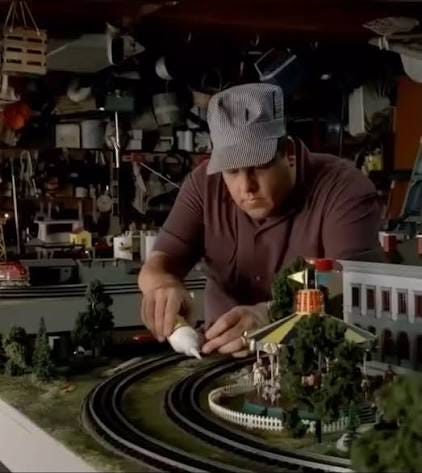
I’m making much larger changes (in terms of structure, plot, and characters) and also many radical reorderings and rearrangings. This isn’t necessarily a harder way to revise. My first novel had a noir / mystery plot with a linear structure. This is a more straightforward way to tell a story, but it also means that it is trickier to change plot beats or character roles. There’s a clear starting point and destination. Elements are fixed in place, like cars on a train, and removing one in the middle could cause derailment before reaching the end of the tracks. A novel like Haunted Hills has a more expansive canvas, more like a model train layout,5 I suppose, and there are many ways the track can be rerouted. Maybe it could go under a bridge or over a little river. Why not add some more shrubbery here? Maybe add a post office or a carousel there? Or even a whole new track or two that converge with the first?
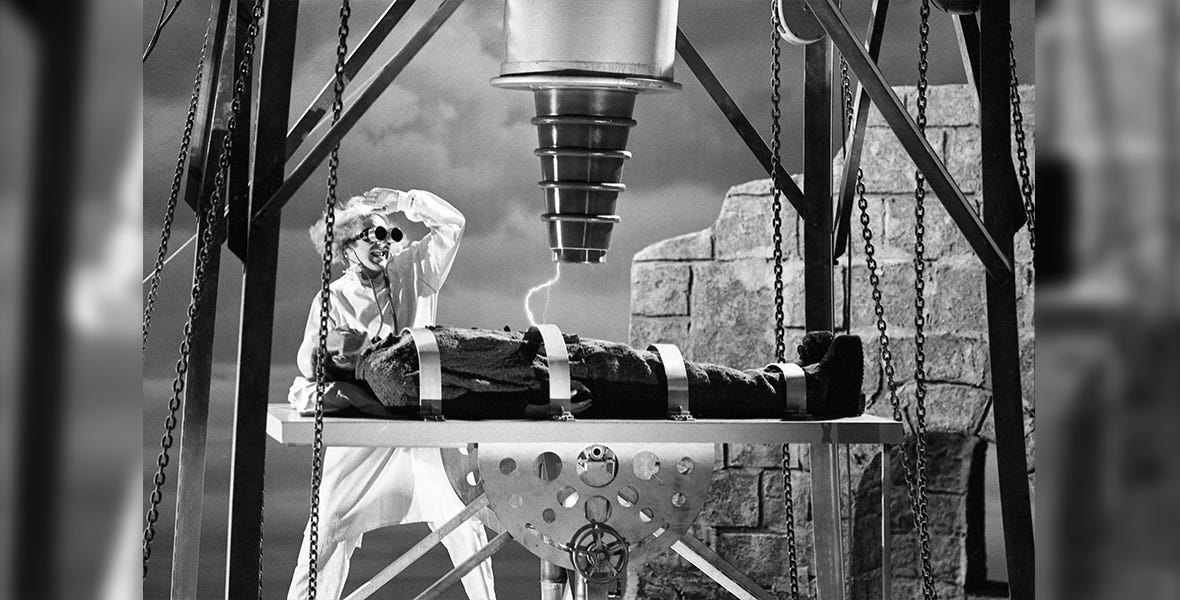
Let me switch metaphors again. Since I’m writing a horror novel, I’ll say the revision has been like Frankensteining6 a creature together. I gathered a whole bloody heap of macabre parts. I splayed them on my metal slab of a draft at times haphazardly. A few were maggot-ridden and needed to be tossed, but most were in fine rigor mortis shape. They just needed to be stitched together properly. Each bone coated with the right muscles. The heart and lungs and gut hooked into proper arteries and veins. So, I’ve moved limbs and rearranged organs. Realized some bones were extraneous and certain appendages missing. The creature is largely made of the same parts, but swapped into new spots. The hope is that when the creature is done and everything from the awful arteries to festering fingernails is in place, the story will come alive.
If I have one bit of revision advice to offer—once you have a full first draft, aka the most important step—it is to work from macro to micro. Get the full skeleton of structure in place first. The right number of narrative limbs and story appendages all set in their proper spots. Then proceed to worry about the chapter organs and scene viscera. Once those are all connected, only then should you focus on stitching up small wounds and bandaging blemishes on the skin of sentences. That is to say, don’t spend your time polishing paragraphs and reworking scenes if those parts are going to be hacked off and replaced. That can make the whole process more dispiriting. It also makes it harder to do the necessary hacking and restitching. Easier to kill a darling when it’s half-dead already.
At least, that’s what works for me.
I suppose I have one other bit of advice, which is that the only way I know how to revise is to get your hands in the guts! Get messy. Palpate and squeeze. Slosh around, elbows deep, in the story itself. This is when the inspirations strike like lightning. This is when the creature begins to thrum with life.
To drop the metaphor, I mean that the way to revise is to read and reread the work. Print it out and mark it up. Make multiple draft files and test out different POVs or switch up the order of scenes. It is by reading and reworking that you get inspired. You see new connections that can be made. Different ways to explore the themes. The obvious plot point to tweak or the ending that makes the chapter sing. Changes to character or scene or story that don’t just complete the novel, but that do so in a way that feels organic to you because they indeed come from your brain as it turns everything over again and again.
To tie this back to the opening, this is one reason why I’m skeptical of outsourcing your creativity to LLMs. I am sure some artists who have a very different process will find good uses for LLM collaboration.7 And others who say they would never let an LLM write their prose will still turn to it for structural edits and revision direction. Whatever works. For me, though, I would not want an LLM to edit my story or write (or rewrite) my prose because it cannot string veins and capillaries or stitch limbs and organs the way my brain will. There is just no way that it would feel the texture of the text and the shape of the structure in the same way. I don’t feel the need to argue humans are better than machines at art. The LLM might create some other creature. Perhaps even one just as alive. Who knows? But it would not be my creature. And that’s the only kind of monster I want to release into the world.8
My new novel Metallic Realms is out in stores! Reviews have called the book “brilliant” (Esquire), “riveting” (Publishers Weekly), “hilariously clever” (Elle), “a total blast” (Chicago Tribune), “unrelentingly smart and inventive” (Locus), and “just plain wonderful” (Booklist). My previous books are the science fiction noir novel The Body Scout and the genre-bending story collection Upright Beasts. If you enjoy this newsletter, perhaps you’ll enjoy one or more of those books too.
If you are burned out on it, well, I relate. But I fear it isn’t going away any time soon…
Isn’t that what writing a novel is at its core? Giving yourself a series of problems to solve.
I’ve often rolled my eyes at the old “the setting is a character” saw, but, well, it’s true here!
The Revising of Haunted Hills kinda sounds like a horror novel title itself. Sequel?
I’m in a metaphor mood, it seems. And I think I heard the model train metaphor from George Saunders first.
Sure, this can be a verb. Why not?
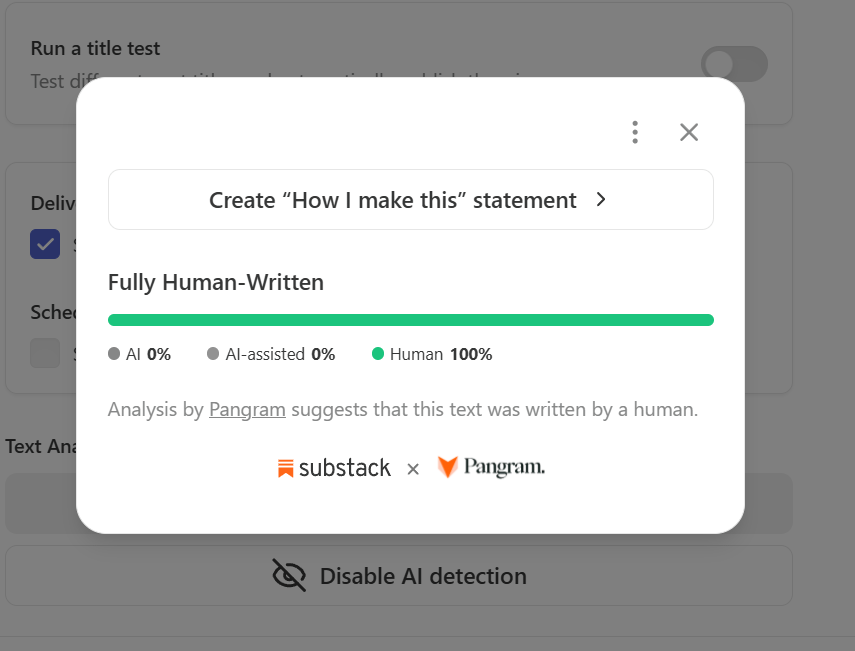
Substack has introduced a new “AI detector” to posts. I don’t plan to use it, but out of curiosity I had it scan this article:
And, yes, it will inevitably come back to haunt me for my hubris. That is another thing mad scientists and novelists have in common.
Yes to all of this! When I hear that an LLM is being used for "revising" I am filled with immediate horror. I tend to do a LOT of drafts and a LOT of structural edits: my current project is on draft 7 atm. I spend more time revising than I do drafting, and this is a normal part of my process. The idea that I could/should outsource this piece is utterly appalling to me. Revision=writing, and LLMs will not and should not write my book!
Sorry to double post, but the issue with LLMs is not completely novel (no pun intended). It's ghostwriting. It's a work written by someone/something other than the person claiming authorship. That's always been present in literature. LLMs here, like everywhere else, lower the cost to a point where anyone can afford to do it. It's not a complete analogy, but that's part of it.