
Processing: How Paul Tremblay Wrote Dead But Dreaming of Electric Sheep
The author on writing horror and comedy, unusual narrative approaches, and pouring AI anxieties into fiction.

Processing is Counter Craft’s semi-regular interview series where I talk to authors about the craft and writing process behind their work. You can find previous entries here.
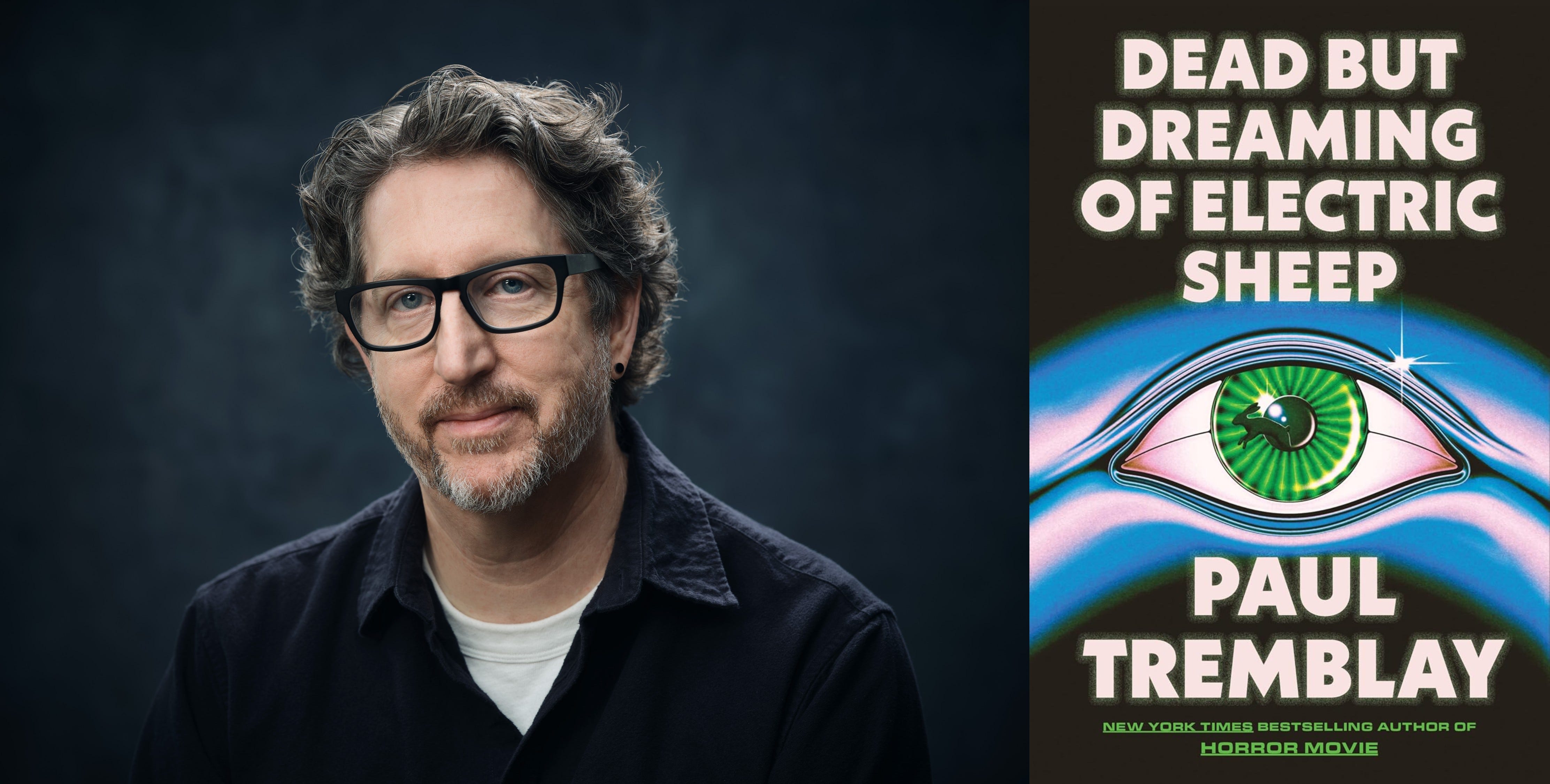
This week, I’m excited to be talking with Paul Tremblay about his weird and wild new science-fiction horror novel Dead But Dreaming of Electric Sheep. Tremblay is the award-winning author of novels like The Cabin at the End of the World and A Head Full of Ghosts, among many other inventive and excellent horror works. Tremblay’s newest, Dead But Dreaming of Electric Sheep, turns a dark eye to AI and the tech companies trying to monetize our onrushing dystopia. The novel follows Julia Flang, a Gen Z slacker and video gamer, who gets recruited by her big tech exec mother for a secret job: piloting an AI-controlled braindead body across state lines. But the man—nicknamed Bernie as in Weekend at Bernie’s—is not as braindead as the corporation claims. Between Flang’s chapters, the narrative falls into the nightmarish rabbit hole of Bernie’s mind as he fights to retain a sense of self against the AI controls. The result is satirical, surreal, and terrifying. (You can read more about it here.)
I talked to Tremblay over email about unusual narrative approaches, pouring AI anxieties into fiction, and how writing “as hard and as pride-swallowing and teeth-gnashing as it often is, it’s also a fucking beautiful way to spend your time.”
Dead But Dreaming of Electric Sheep has a braided narrative structure with two main storylines. The first follows Julia Flang, a slacker slash video gamer who gets hired to pilot a braindead body across state lines for a corporation that is testing experimental AI tech. The second is a surreal and horrifying journey occurring in the allegedly braindead character’s mind. The first is more straightforwardly narrated while the second is not only surreal but increasingly plays around with form including text boxes, multiple columns, and other interesting design choices.
How did you come up with this structure? Were there always two storylines or did the novel’s form click together during drafting?
Very early in the process (How early? Well before I wrote page one.) I knew the story would need two narrators and two points of view. I wanted Julia’s chapters to be a grounded-in-reality narrative, describing her experience controlling “Bernie” (let’s call the dude with the tech in his brain Bernie for now) in an almost quotidian way but with (hopefully) humor directed at the tech corporation. I wanted all that juxtaposed with Bernie’s surrealistic nightmare experience. I knew the Bernie chapters would be hard to read (and that’s okay, yeah?) given the attention it would demand from the reader and given, well, the body horror ickiness. My 77-year-old father just confirmed this telling me he didn’t like the book because being in Bernie’s head was too awful. Thanks, Dad? Though, if I wanted a goodreads review to call me on the phone…wait, I would never want a goodreads review to call me on the phone, and why am I anthropomorphizing a goodreads review? Anyway, I wanted the humor in the Julia chapters to help balance things. Like a playground seesaw!
Formal playfulness is something I always love when done well, as it is here. I was also interested in how “analog” the Bernie chapters were in the sense that the formal elements are like art pieces on the canvas of the page. They feel fit for print rather than the internet or social media apps. They also called to mind physical arts like cut-and-paste collage (or else early computer hobbyist art) in a way that felt like a formal complement to the novel’s anti-AI / global tech corp themes. Can you talk about the formal elements of those chapters including how you created them?
Thank you, Lincoln! I’m a sucker for formal playfulness as long as it isn’t a gimmick. If I’m going to employ an unusual approach (let’s call it that) within the narrative, I have to be able to convince myself that using it not only serves the story, but it is the best way for me to tell it. With Bernie’s hacked/colonized mind, I wanted to do all I could to replicate his disorienting experience for the reader. After an initially clunky close third person POV, I adopted second-person instead. Bernie’s direct thoughts appear as fractured and separate from the main text within rectangular text boxes, which is a visual shorthand for the pieces of himself bubbling up through the muck of his id. Later, the text boxes become even more necessary to help the reader identify who or what is thinking/speaking. That it all looks like cut-and-paste physical art is a bonus, and also, frankly, a result of my limitations as a designer and what I could do in Word. But I’m more than okay with limitations. Believe me, I’ve worked with limitations my whole life!
There’s a great tradition of horror playing with form (e.g., House of Leaves or your own The Pallbearer’s Club). Why do you think horror and unusual forms work together so well?
That’s a great question. I don’t think I’ve ever considered that before. I’m usually too busy justifying the usage of unusual forms. I certainly can’t speak for other horror fans, but my favorite works of horror inform and make me fear (or even more afraid) of the present. When I’m writing a horror story, even if it’s not set in present day, I’m aiming to engage with and disturb the readers of our current data-glutted-disinformation age. To presume anyone is going to be reading your (a general you; of course everyone will be reading Lincoln Michel’s work in the future!) stories five or ten or fifty years from now is folly. I mean, fuck, it’s hard enough writing a story that works *now*, I can’t imagine trying to write something to appeal to the AI/human/lobster hybrids that will be around in one hundred years. Joking (somewhat) aside, the inclusion of formal playfulness feels like a logical outgrowth of trying to emotionally move the now-readers by making my weird stories feel as real as possible.
A family dealing with a maybe possession? A reality TV crew would totally show up and a blogger would be detailing what happened on the show. A found memoir? Who found it? Of course the person who found it wouldn’t be able to resist commenting and giving her rebuttal. An infamous cursed film? Having the characters sitting around telling the reader about the movie sounds boring, so why not include the screenplay? In all those cases, the stories felt more real to me with the inclusion of the extra-textual stuff. And if it feels more real, then I’ll be even more afraid. Maybe horror’s transgression and the visceral response it elicits lends to the employment of unusual forms, particularly of the meta-fictional type, where the story threatens to infect reality. I don’t know. I have threatened my publisher that someday I will demand pop-up pages....
Dead But Dreaming has a pointed critique of AI, especially the type of “Artificial Intelligence” that became mainstream when ChatGPT was released in late 2022. This made me curious about the novel’s timeline. Was AI always centered in the novel or did you have an idea for the novel before the ChatGPT age?
In the early spring of 2023, I read Mary Roach’s Stiff: The Curious Lives of Human Cadavers and I flashed on an image of a dead guy sitting on an airplane, his body being controlled by a remote user. Even though it was, at the time, a seemingly silly scenario, I try not to be in the business of telling my subconscious what’s silly or not for fear that it will stop bringing me ideas. So, I wrote it down in a notebook, thinking I likely wouldn’t go back to it. At that point things like Midjourney and LLMs were just beginning to be on my radar. A few months later, in late May, friend and writer Christopher Golden asked if I wanted to be a part of a class action lawsuit suing OpenAI on behalf of writers. I said, “Fuck yeah,” without really thinking about what that might entail. In July we filed suit (https://llmlitigation.com/). After spending the second half of 2023 learning about OpenAI and other corporations like them (how they operate, what they had done and were continuing to do), I didn’t think that the AI-controlled body idea was all that silly anymore. I started other research for the novel (mainly reading about consciousness and how it might be defined; I recommend Christopher Koch’s The Feeling of Life Itself) in early 2024, and from there I poured all my AI anxieties into the novel, as well as celebrating my love for messy, beautiful, imperfect pop art. Hopefully the novel doesn’t read as too didactic, except where it is supposed to be didactic.
The novel really balances comedy—some of the Bernie scenes could appear in, well, a slapstick comedy like Weekend at Bernie’s—and spine-tingling horror. How do you approach this balance when writing?
I like horror comedies as much as the next tattooed and black-t-shirt wearing fan, but I much prefer horror comedies that are scary/disturbing when it’s supposed to be scary/disturbing and funny when it’s supposed to be funny. I was most nervous about the (attempted) humor, but I had the most fun writing those bits. To ignore the pathos and slapstick at a reanimated mostly dead person’s behalf would’ve been neglecting my writerly duties. To help with the humorist tone in Julia’s chapters, I reread two of my favorite Patrick deWitt novels (The Librarianist and The Sister Brothers). I only allowed myself to read three pages per sitting. The sitting was, um, literal, with me in front of my laptop, ready to work on my novel after reading the three pages. It was like a pre-reward before writing! I would be genuinely excited to sit at the laptop (instead of the usual procrastination and dread) because I got to reread a few pages of my favorite books.
As far as the balance went, I figured the horror/disturbing stuff would be there, and I wouldn’t have any trouble dredging that up. I actively looked for places to insert the humor. I hope it works. It worked for me? (Yes, I’m obnoxiously admitting I made myself laugh. My mom always tells me I’m so funny, though.)
You’re an author who often blurs genres, with a novel like this including elements of body horror, science fiction, and surreal fantasy. I’m always curious how writers approach genre. Is genre or “genre bending” something on your mind when writing or is it something you don’t think about and feel is a question for marketers and not authors?
Until this June, I’ve been a full-time high school mathematics teacher. I enjoyed teaching but I also viewed the job as my artistic safety net. I didn’t need my writing to help support my family and give us shitty health insurance. This empowered me to say no and to publish in the independent presses when the other empowered people said no. I was going to write my weird horror-tinged shit and then let other people figure out what to do with it. Now, I’m beyond fortunate to work with my friend and agent Stephen Barbara, and since 2014 my editor Jennifer Brehl. Both allow me a wide definition of what horror or dark fiction is and can be. So, in general, I do not think about genre or marketing concerns until after the book is done. However, I’d be lying if I didn’t admit that I worried a little about Dead But Dreaming of Electric Sheep. Would folks who read me before be willing to follow me there? Would new folks give it a try? Would my dad like it? (We have the answer to that one.) Valid questions with (some) still unknown answers. I can proudly say that I didn’t change one thing in the book because of those questions. I think writing to the imagined proclivities of imagined readers is madness (and again speaking only for me) and doing so would kill my desire to write. I love writing the messed-up stuff that occurs to my brain at a particular point in time, and more times than not I think, “Hey, this turned out kinda cool. I hope other people like it too.”
POV has been on my mind recently, and I was very taken by your use of POV in Dead But Dreaming of Electric Sheep and how the novel combines third-person, second-person, and later first-person-plural. How did you approach point of view in this novel? And how do you approach it generally as a writer?
I don’t have an MFA and I don’t have an English degree and what little I think I know is this: POV has to be included in any writer’s interrogation of their story. POV is not a default setting. It’s a choice, one that has to be chosen with the purpose of serving the story. As much as I feel more comfortable writing first-person, it can’t and I won’t let it be my default. The story’s needs dictate the POV. Bernie’s chapters, as previously mentioned, is a great example. His early chapters just weren’t working in third. With it, there was an arm’s length between the character and the reader. It had to be second because I needed the reader as close to being in Bernie’s head as I could make them.
I wanted to ask about your intertextual allusions in the novel (sorry to sound like a stuffy English professor there). The title is a play on Philip K. Dick’s Do Androids Dream of Electric Sheep and Julia regularly references movies like The Big Lebowski and Weekend at Bernie’s. The rabbit tattoo conjures both Alice in Wonderland and The Matrix. Etc. What role did these allusions serve for you?
While some of the references started as me fumbling around to build Julia’s character, basically me thinking something like “Huh, it’d be weird to have a Gen Zer walking around quoting the Dude. Why would she do that? Why would she need to do that?” As Julia fleshed out, she became a celebration of art, of the human (so fucked that we even have to qualify the following as such now) joy in communicating and connecting through art. That is art’s purpose; to make us feel less alone. It doesn’t matter if you or the other characters don’t get her references, you still understand she is attempting to communicate while sharing a bit of herself. Later in my book, when the AI attempts similar references, it might be funny, but you’re probably laughing nervously.
Lastly, since AI is central to the novel and everyone and their uncle is freaking out about the future of literature in the age of LLMs, what advice would you give a writer who is trying to write their own unique work without having their mind colonized by tech programs?
The advice would be, simply, write your own unique work and do not go near algorithms that have stolen our books/stories. There is no gray space here. You are not a writer otherwise. You’re not even a hack! (I’m a hack!). You’re a scab; the use of American union language is purposeful. If I sound like a scold, I don’t care.
But maybe I should approach this more positively. The novel, the story, the song, the painting, the art isn’t the final piece (note, I didn’t use the word ‘product’). The art is the effort in tandem with the lived-in and on-going experience of the person who created it. The work is the art. The work is what makes doing it worthwhile. As hard and as pride-swallowing and teeth-gnashing as it often is, it’s also a fucking beautiful way to spend your time.

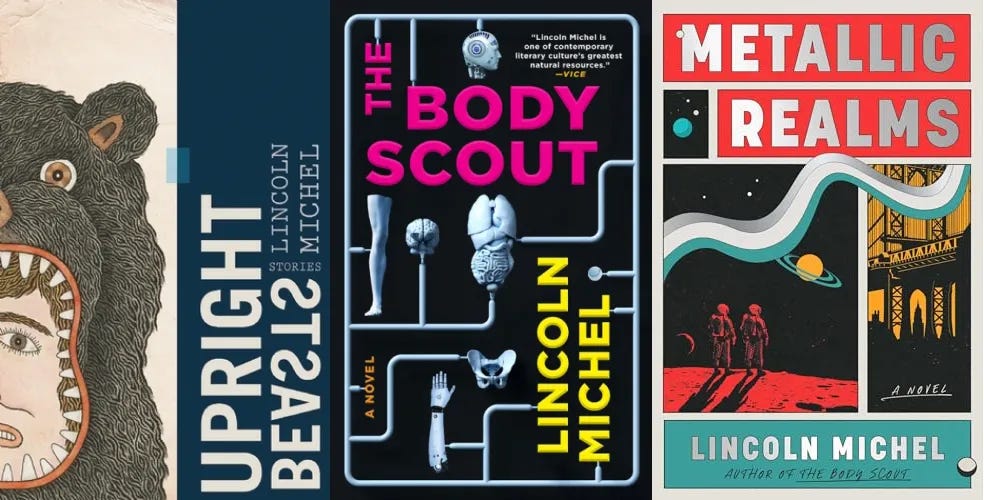
My new novel Metallic Realms is out in stores! Reviews have called the book “brilliant” (Esquire), “riveting” (Publishers Weekly), “hilariously clever” (Elle), “a total blast” (Chicago Tribune), “unrelentingly smart and inventive” (Locus), and “just plain wonderful” (Booklist). My previous books are the science fiction noir novel The Body Scout and the genre-bending story collection Upright Beasts. If you enjoy this newsletter, perhaps you’ll enjoy one or more of those books too.
This was one of the better interviews I've seen with him, especially because you actually ask specific questions about his process rather than the generic 'how'd you come up with this idea?' which is 0% helpful to people who want to try new ways of doing things.
I've been very excited to read his new book, so it was awesome to read about the behind the scenes.
Very insightful...