

Processing is Counter Craft’s semi-regular interview series where I talk to authors about the craft and writing process behind their work. You can find previous entries here.
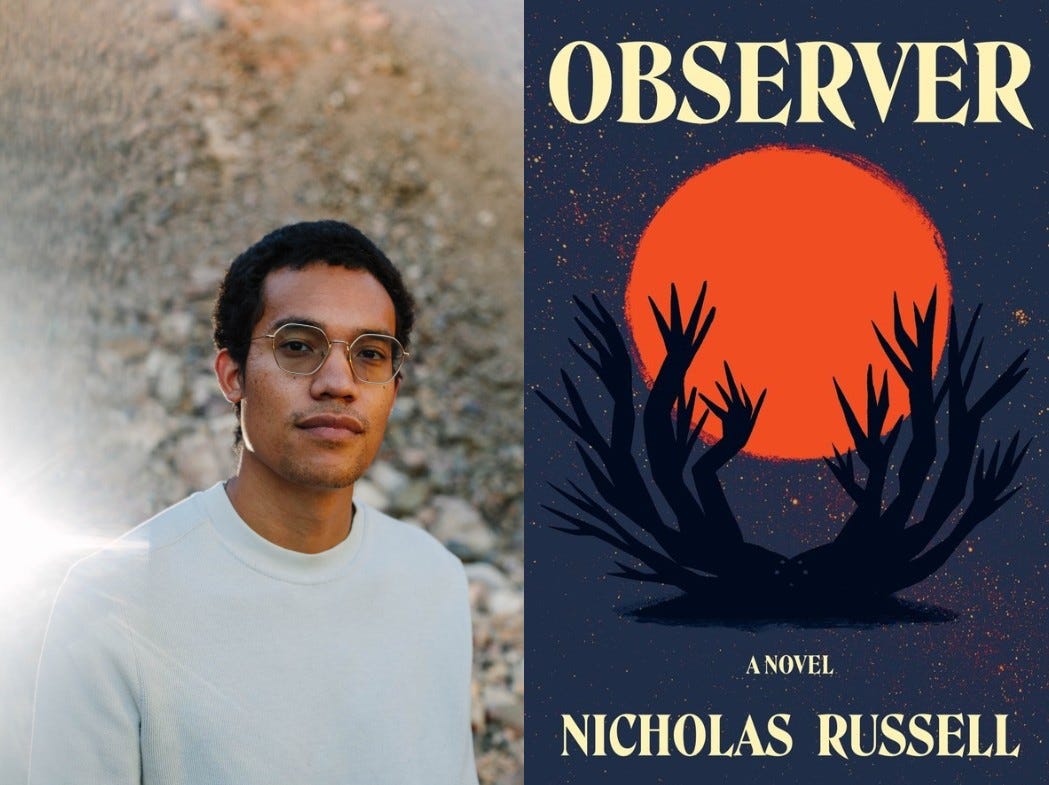
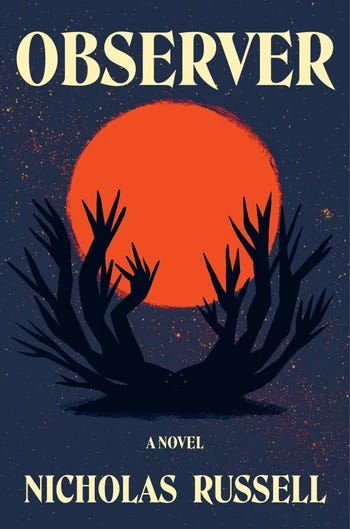
This week I’m excited to be chatting with Nicholas Russell, whose excellent debut desert horror novel Observer is out today. Observer follows a woman named Renata searching for her missing scientist mother in the Nevada desert. I loved the novel enough that I blurbed it, so will quote myself here: “Russell makes the sun-scorched, desiccated West as haunting as any gloomy Gothic manor on the misty moors. The prose is equal parts page-turning and lyrical, and the plot a satisfying combination of science-fiction mysteries, family drama, and unfathomable horrors. A thrilling and chilling debut.”
I talked to Russell over email about desert horror, being “unencumbered by genre,” and the process of writing and selling a debut novel.
Among the things I admired in Observer was the use of setting. Setting is important in any novel, but it’s central to Gothic and horror fiction since those genres tend to depend on atmosphere. Your novel is set in the dry, sparse, and sun-drenched Nevada desert, which in many ways is the opposite of the traditional Gothic setting of moldy manors, misty moors, and dense dark woods. Observer does a fantastic job making the desert terrifying. Can you talk about how you approached the atmosphere and desert setting? While writing, were you consciously thinking about how to subvert or refresh classic horror tropes or elements in the desert setting?
Thanks for that, Lincoln, it means a lot. It’s funny because on one hand, I did want there to be an inversion of a specific horror trope, which is when all the scary stuff happens in an obscured setting: at night, under the cover of darkness, shadows, silhouettes, etc. The desert lends itself to those things as well but it also has the capacity to be so wide open and clear, as if there’s no way anything could possibly be hidden. Even when you’re out there under a full moon, you can see everything.
On the other hand, I always knew Observer would be set in rural Nevada and so there was an element of Well, I have no choice but to engage with certain aspects of the landscape, which forces you to get creative. I wanted there to be something new for readers who are used to horror and Gothic fiction that takes place in dense forests, creeks, moors, those typical English/Northeastern locales. One example that sort of guided me through was this experience I have a lot while hiking where I think I see someone really far off in the distance, on top of a hill or somewhere else off trail, but I can’t tell if they’re facing me or facing the opposite direction. Eventually I get to where I can definitively see where they are and it’s not a person at all. It’s a tree or a rock or some other optical illusion. But then sometimes it is a person and you wonder if they had the same experience with you not knowing what you were from a great distance. That uncertainty, especially when it comes to potentially being perceived in an isolated place, is common and really unsettling.
Horror seems to be rising again in the culture. Publishers tell me the genre is increasingly popular and many breakout hit films and TV shows these days are horror (Backrooms, Obsession, etc.). What do you think draws people to horror in 2026? And, more importantly, what draws you to horror?
This is a question that’s been plaguing me because sometimes I get cynical about what draws people to genre as a whole. I’ve been a bookseller for a long time, over a decade now, and I often see customers merely searching for what’s popular rather than what might appeal to them specifically. And I’m sure you’ve seen this as well in your writing about the industry, the trend chasing that happens in publishing as soon as one thing takes off in a way the industry wasn’t expecting. It leads to glut really quickly. Which is unfair to the writers for whom it’s not a trend or a fad, of course. For my part, I signed my deal with Ecco two years ago, way before the real explosion in horror that’s happening now. At the time, it seemed like a risk for them to take because they don’t publish horror, or really much genre fiction at all. Publishers want to have people believe they know exactly how and when things will shake out, but you just never know. There’s a lot of exciting horror work being put out, for sure. At the same time, it’s so easy for a certain section in a bookstore to become oversaturated.
I do think there’s a big difference between horror in media versus literature. Films and TV can be quite experiential, especially if you’re experiencing them in a theater with other people. In some ways, you’re reacting to the person next to you as much as what’s on screen. But books, while you can discuss them with a group and relive them that way, are still a solitary endeavor that takes time to digest and feel. You live with books in a different way. That’s what I appreciate about the genre, especially when you’re reading something really gross or uncomfortable. I think other readers are drawn to that, there’s a subversion that horror still holds. I often hear customers say they want to try a horror novel or story collection in order to push their boundaries.
Speaking of genre, I think I first came across your fiction when we were both published in the horror-themed issue of McSweeney’s edited by Brian Evenson. I read Observer as a horror novel, but it also has elements of science fiction, mystery fiction, etc. I’m always curious how novelists think about genre when writing. Is genre on your mind when drafting or is something you actively avoid thinking about when writing?
A quick aside: I am constantly returning to that particular McSweeney’s issue, it’s one of the best they’ve ever put out and I urge readers to grab a copy if they’re still available.
I vacillate with the consideration of genre just because it’s always being relitigated and when the concept re-enters the discourse, I have to check in with myself to see where I stand. I see a lot of my work as being in the horror or speculative fiction realm, but that categorization frankly occurs after I write whatever it is I’m working on. Brian is a great example of someone who is almost always shelved in the horror section but within his books are pretty much every genre besides romance. He’s unencumbered by genre, he just does whatever the narrative demands. That’s how I prefer to approach my own fiction. There’s a quote I often think of from the filmmaker David Fincher that’s like, “The audience knows you can do anything. So what don’t you do?” You shouldn’t be constrained by genre expectations but at the same time, whatever happens should make sense within the internal logic of the thing you’ve created. With Observer there was always a central secret to unravel and it has to do with a bunch of scientists in the desert. But it was really only after I finished the first draft that I realized those other genre elements were mixed in.
Observer is your debut novel and I know many readers of this newsletter are looking to publish their own debut. Can you talk about the process of writing and publishing the novel, from first idea to finished product? How long it took, the querying process, etc. Whatever you’re willing to share.
Happy to! I wrote the novel over the course of four years while I was working a day job and freelancing. There were long periods of time when I wouldn’t write anything at all that wasn’t actively contributing to paying rent or groceries. And especially with fiction, where the standard at many lit journals is maybe a $50 honorarium and a couple contributor copies, it just never seemed feasible that I would earn a living with fiction. But that was fine with me because I was able to apply a different part of myself when writing fiction. I saw myself as a short story writer before Observer and that’s how the novel initially began, as a short story. It just kept getting longer and longer.
As far as agenting and the sale of the novel, I got very, very lucky. I never queried and honestly wasn’t in a place to consider doing so for a long time. I’d done workshops at Tin House (now McCormack Writing Center) or VQR where they conduct little speed dates with agents and I’d talked to friends who had queried and the whole thing just seemed like an enterprise I didn’t have the capacity to really think about just then. You have to devote a lot of conscious time and effort into the process and it can be incredibly draining and demoralizing. I knew I’d have to do it eventually if I wanted my writing career to actually begin in any conventional way but I was in freelancing mode and nothing else mattered. Then one day I got an email from this person named Danielle Bukowski at Sterling Lord saying she’d read some of my work and wanted to know if I had representation. I didn’t know who she was and I’d never heard of the agency so I checked with a friend who did and she was like “Danielle is legit.” We had a couple long phone calls and immediately clicked. As we were getting to know each other, I sent her the beginnings of a story collection and she was like “This is cool. Are you working on anything longform?” By then I had Observer as a project I didn’t really know what to do with but I mentioned it and she said “That sounds interesting. Keep going.” So, she signed me and that was life for the next few years, with Danielle checking in periodically, me sending her chapters, and her being like “Keep going.” I was working on the story collection and the novel simultaneously.
There was a brief, delusional detour where the whole process was making me anxious–and by that I mean my own slow-going habits with fiction at the time, nothing to do with Danielle–that I was like “Let’s pitch a nonfiction book project instead!!!” I was just desperate to have a book deal and I had gotten a bit of attention for my writing about the southwest. So, we diverted down that rabbit hole and as we started pitching editors a book proposal, it dawned on me how much I actually didn’t want to write a nonfiction book. That episode lasted a couple months but it spurred me to re-focus on Observer and the story collection anew and really get them into fighting shape. This was spring of 2024 and by the end of the summer after I rewrote a bunch of stories and made real progress into Observer, which was about half done (we sold a partial of the novel rather than a full draft), Danielle was like, “Okay I can sell these.” A couple months later, she did.
In addition to writing fiction, you’re a culture writer for Defector. How does your nonfiction writing inform your fiction writing?
Being edited is a really important part of writing for me and when you freelance a bunch, you get edited in a lot of different ways. Sometimes not in the most helpful or even legible ways, but it teaches you the fact that, at a certain point in the process, writing is collaborative. You learn not to be precious and to consider passages of your work as pieces in a puzzle rather than this beautiful, untouchable work of genius that has to be preserved exactly the way it came out. Nonfiction writing can also be really helpful for research, not just the how but also what. For Observer, I did a bunch of research on observatories and desert ecology and astrophysics, but that can only take you so far. You have to know when the research, when the digging and collating phase where you’re not actually generating prose, is no longer helpful.
One of the themes of Observer is the friction that can exist between science and nature. Do you think of Observer as a climate fiction novel in that way?
It wasn’t intended that way, which isn’t to say an environmental concern isn’t present. Living in the southwest, it’s impossible not to notice how drastically the landscape changes over time. Water is a perennial concern, but resource management in general as well. Perhaps this is a bold claim, but I think anyone writing about or from the southwest who isn’t also in some way clocking how drought and rising temperatures and pollution are affecting the region is being disingenuous.
You’re from Las Vegas, which helps make your novel’s setting feel so real. Do you have any favorite Vegas/Nevada works—films, novels, music, etc.—that you drew on when writing Observer? Or that you’d simply recommend?
There’s a real dearth of good work about Vegas and Nevada, which is both frustrating and exciting. It just means there’s more to mine and explore beyond narratives surrounding the Strip. I will point readers toward a few books, all of which were published this year by long-time Vegas residents and take place in or have a large part set in the city: Dangerland! by Erin Singer, The Spoil by Maile Chapman, and Close Relationships with Strangers by Krista Diamond. In that order, a marriage comedy-drama, a literary horror novel about grief and possession, and a contemporary Nightcrawler-esque psychological thriller about a wildlife photographer who becomes a paparazzo.
I’ll also shout out this experimental documentary film called Deseret by James Benning, which is quite obviously not about Vegas (it’s about Utah and Mormonism) but it provides a really visceral, transportive feeling of the southwest that applies in spades to Nevada.
Lastly, what are you working on next?
I recently finished editing my forthcoming story collection, which is called Southwestern Gothic and comes out in early 2028. I just got back from MacDowell, where I was working on my next (uncontracted) novel. It’s still early days, but I can say that it’s a multigenerational horror novel that takes place over a span of 200+ years and involves werewolves, or at least, my take on them. Stylistically and formally, China Mieville and Faulkner have been big influences. Hopefully you’ll hear more about that in an official way in the near future.
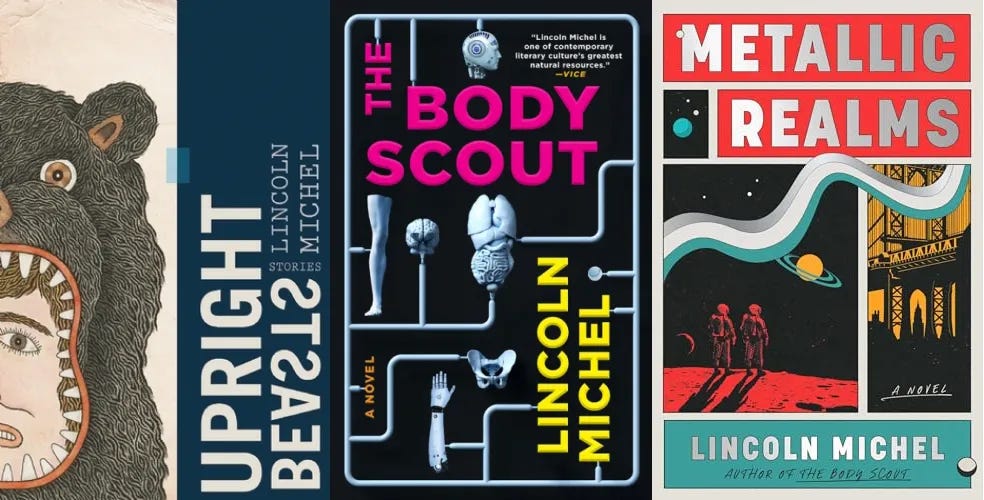
My new novel Metallic Realms is out in stores! Reviews have called the book “brilliant” (Esquire), “riveting” (Publishers Weekly), “hilariously clever” (Elle), “a total blast” (Chicago Tribune), “unrelentingly smart and inventive” (Locus), and “just plain wonderful” (Booklist). My previous books are the science fiction noir novel The Body Scout and the genre-bending story collection Upright Beasts. If you enjoy this newsletter, perhaps you’ll enjoy one or more of those books too.
I was surprised at how swole China Mieville was when I met him.
If he took steroids, would he be Russia Mieville?
Got chills with the explanation of how the desert lends itself to horror. I’m always stuck in a southern gothic mindset given where I’m from, so I am excited to branch out and read this! Something also just reminded me of that Sherlock Holmes story where he’s chasing Mormons across the desert, but I digress... 🧐 Great interview!