

Processing is Counter Craft’s semi-regular interview series where I talk to authors about the craft and writing processes behind their work. You can find previous entries here.
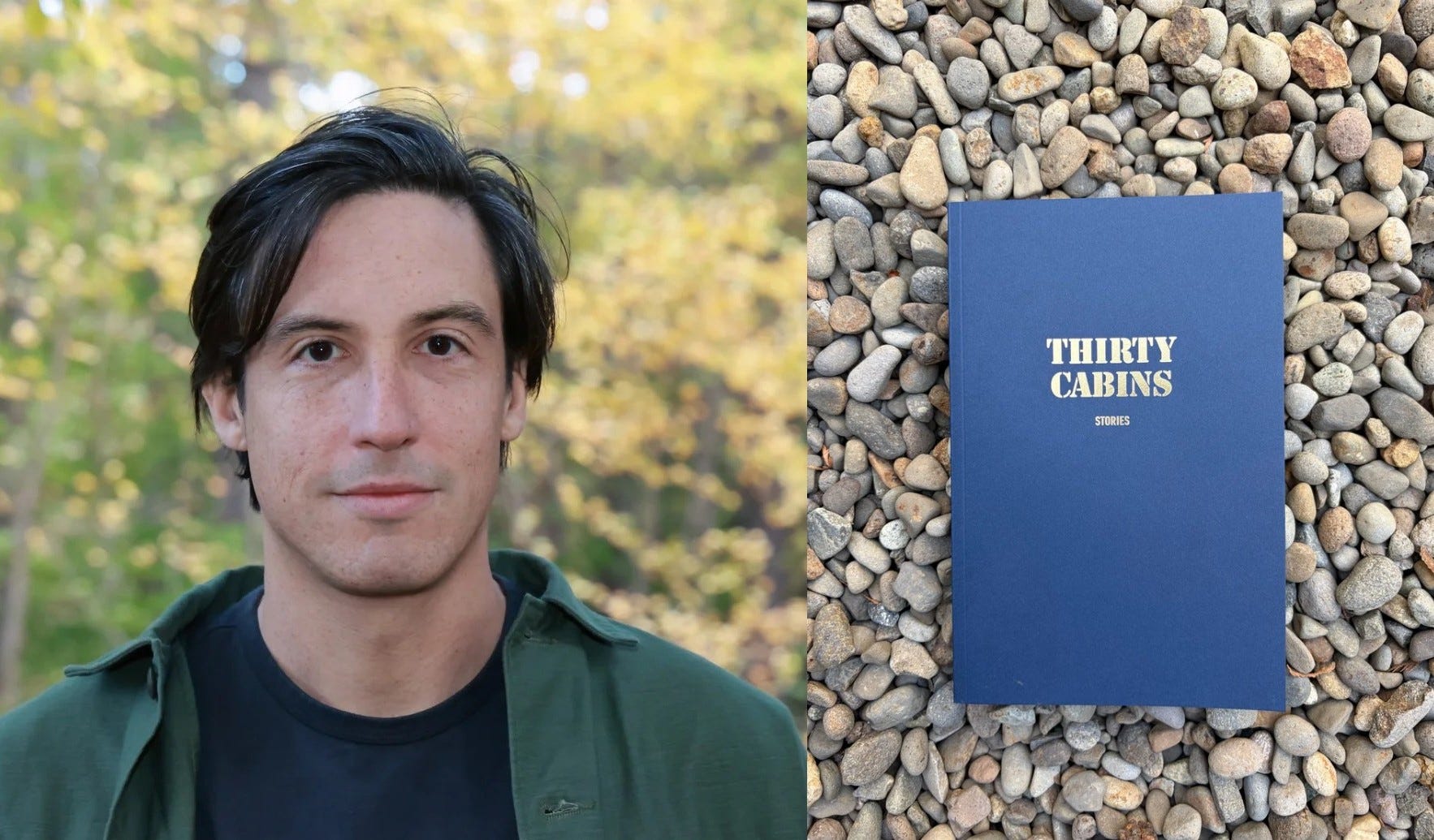
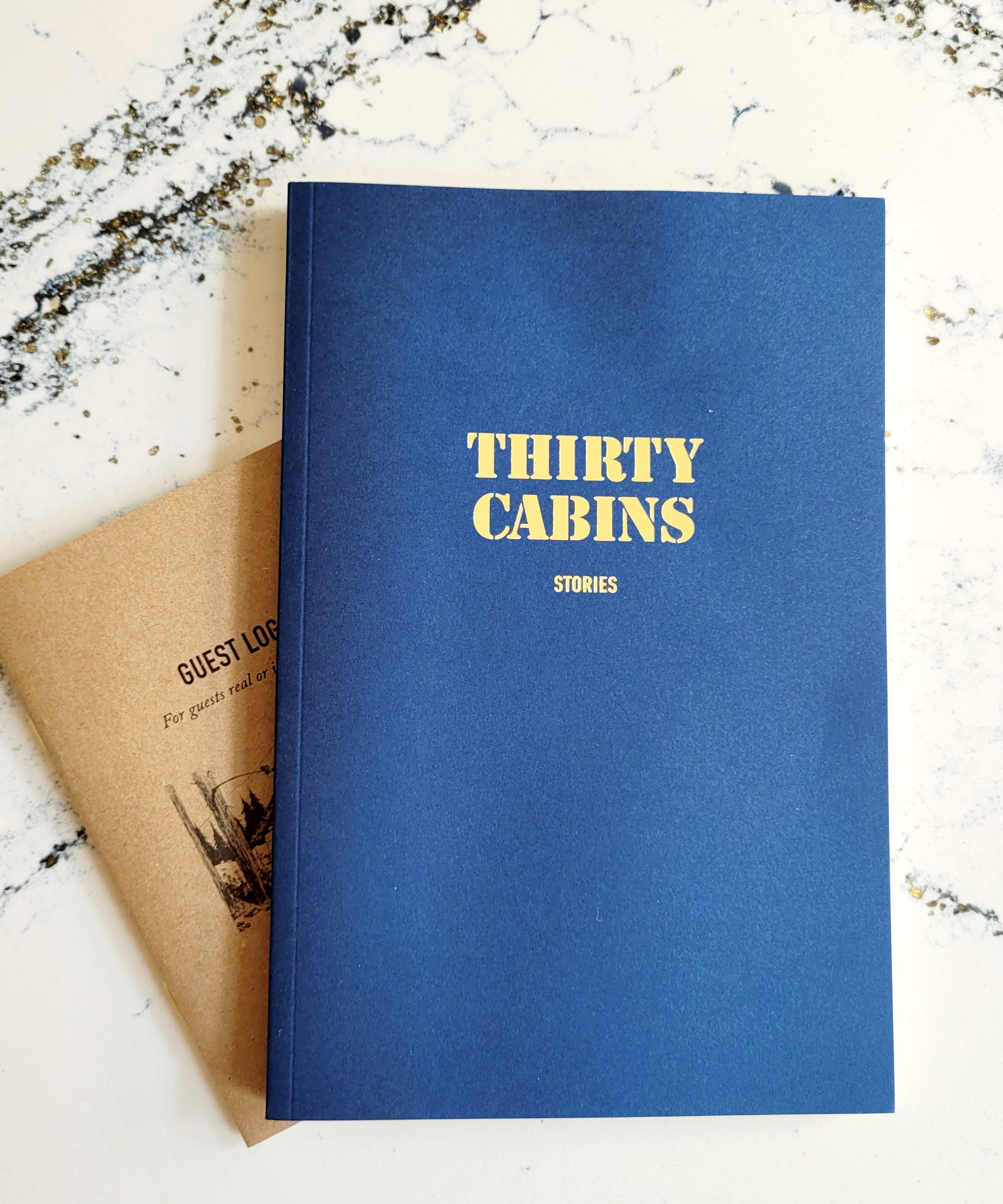
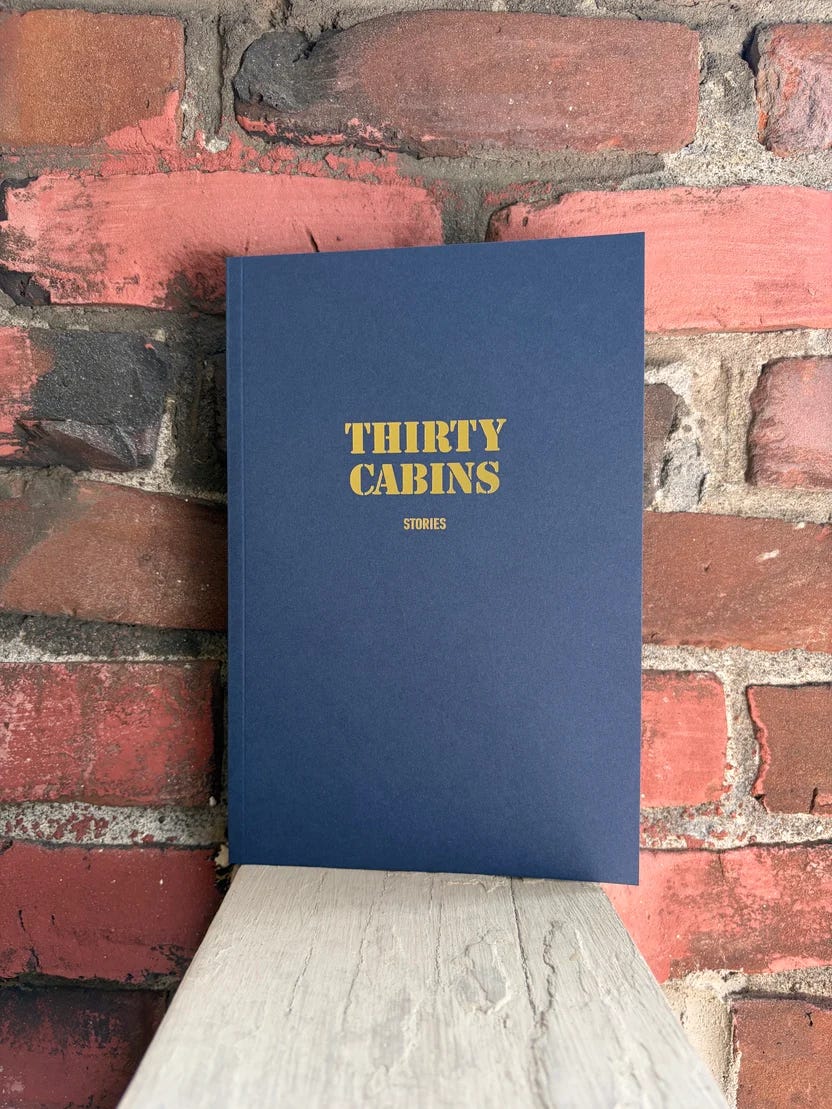
This week I’m chatting with author and editor Josh Riedel about his cool new zine project Thirty Cabins. Riedel asked a bunch of writers (including me) to write flash fiction stories based on a 1918 cabin planning catalogue and then created a beautifully designed zine from the results. It has a great line-up of writers, including many here on Substack such as Ed Park, Isle McElroy, a. natasha joukovsky, and Rachel Khong. If this kind of project sounds up your alley, check out the Thirty Cabins Substack. You can preorder the zine here.
I talked to Riedel over email about making zines, literary cabins, and planning volume two.
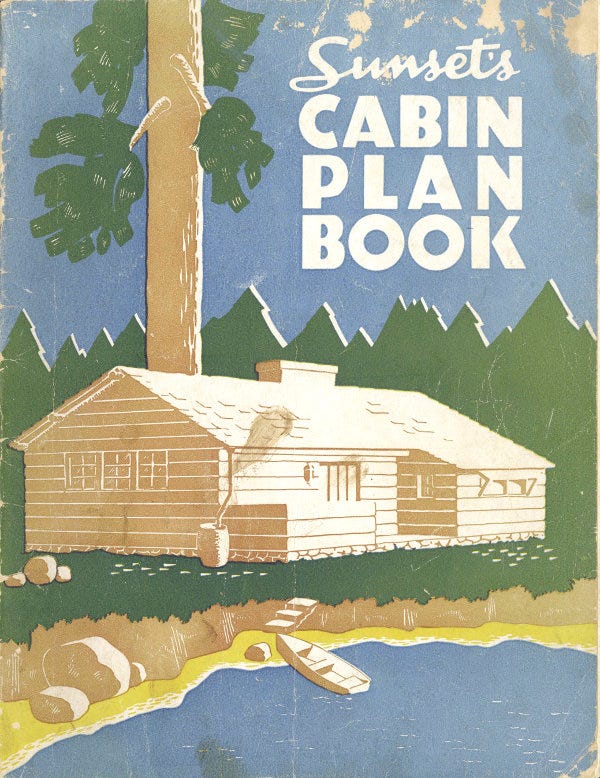
Thirty Cabins is a collection of flash stories inspired by a century-old cabin planning catalog, Sunset’s Cabin Plan Book (1918). How did you come across the catalog? And when did you come up with the idea to invite contemporary authors to write stories inspired by the cabin plans?
I came across the Cabin Plan Book while writing my second novel. If I remember correctly, I needed to know some very specific detail about the construction of a cabin. Maybe what a certain type of shingle is called? Luckily, Project Gutenberg had cataloged the Cabin Plan Book and I was able to find an answer. As I worked on my manuscript, I continued to reference the book, until one day I just started reading for pleasure. I was captivated by the voice, its very American can-do spirit. It made building a cabin in the woods sound so easy!
I came up with the idea for the zine after spending a few weeks at MacDowell, an artist residency known for the cabins sprinkled across its campus. There, I was working on a revision of my cabin novel and talking to a lot of artists about cabins. Poet and illustrator Lena Moses-Schmitt told me about Richard McGuire’s Here, which is a stunning graphic novel that captures a single home through time (a very long stretch of time). So, I guess all these ideas about cabins were swirling around in my head, but also this sense, because I was so deep into this novel revision and not really talking to many of my writer-friends, that I wanted to do something collaborative and community-focused. I pitched the idea to Lena one night at dinner in New York, and she was into it. When I got back home, I wrote up an invitation to potential contributors and started asking people to join.
There is sometimes this notion that literature must be dreary in order to be serious, but Thirty Cabins reminds me of a lot of the playful novels and magazines that got me interested in literature. It’s a little Italo Calvino’s Invisible Cities and a little McSweeney’s. (Side note: I saw you have a story forthcoming in the next McSweeney’s, so congrats!) Was this part of your thinking? To do a project that would be fun and playful and perhaps interest people who think “literary fiction” is “boring”?
I love the description of Thirty Cabins as Invisible Cities meets McSweeney’s! I guess I have been into playful novels and magazines for a while, too. I was obsessed with Choose Your Own Adventure books as a kid, and I’ve sought out McSweeney’s for years. I’m very inspired by how the McSweeney’s crew, helmed by the inimitable Rita Bullwinkel, excel at both form and content. I moved to Portland for college in Tin House’s heyday, and I remember distinctly a double-sided issue they published: one side was “Hope” and the other “Dread.” Ander Monson’s projects with DIAGRAM are an inspiration as well. So, I do have these influences, but I honestly didn’t start the project to pique the interest of people who think “literary fiction” is “boring,” though I do hope those people pick up a copy! I was more interested in bringing together a group of writers I admired and asking them to do something a little different than what they might otherwise work on. I was interested in seeing what the result of that would look like.
The cabin is a classic literary setting. It’s the getaway spot where characters can flee to escape their troubles or journey to in order to find new ones. “The cabin in the woods” is basically an entire subgenre of horror fiction, but it’s also common in literary fiction and other genres. (I just taught Barry Hannah’s “Water Liars” in a class, which is a cabin story.)
I guess I have a few questions here. First, do you have any favorite cabin-centric stories in literature?
There are so many! Lauren Groff’s story “The Midnight Zone” was the first that came to mind for me. Then the cabin in Train Dreams, and the one in Peter Rock’s The Night Swimmers, though I’m not sure either of those novels is cabin-centric. I guess I tend to think of cabins like Thoreau’s or Frost’s when I think of cabins – but the Cabin Plan Book is liberal in its interpretation of what constitutes a cabin: there’re lake houses and mountain huts and modern beach houses and ski lodges. That diversity of structures is something that appealed to me about the book and reflects my more recent interest in summer houses and vacation homes in literature. Joy Williams’s “Summer” and Kelly Link’s “The Summer People” both come to mind, as does Rumaan Alam’s Leave the World Behind. I was entertained by Alexandra Tanner’s “Bitter North,” published a couple years ago in Granta. I know I haven’t even mentioned horror stories. Anyway, I’m sure I’m forgetting so many here…I keep meaning to design a cabin syllabus.
Second, how did the thirty writers approach cabins? Were their commonalities that surprised you in terms of genre, style, or anything else?
Each writer brought their own style and voice to the story. That sounds obvious, I know, but as the stories arrived in my inbox, I was so delighted by how singular each story was. How a Rachel Khong cabin story could only be written by Rachel Khong, etc.
Once all the stories had been submitted, I read them in the order in which they would appear in the zine (our table of contents matches the original book’s). It was so fun to read the stories in order because themes became evident. Kate Folk and Ander Monson’s stories share a phrase, which I think is so cool (like those two writers were writing their stories together in the same imaginary cabin). A Jeff and a Jacob make appearances across multiple stories (Jeff in 3, Jacob in 2). I love Claire Stanford’s clever formal approach to her story, the only one that required the writer to write about not one but three cabins, and Claire did it in just over 500 words, an impressive feat! (All writers were encouraged to stick to around 500 words, though some go longer.) A few of the stories detail the journey to the cabin, which is just as important in my experience as the time in the cabin itself. I was so fascinated with your story, Lincoln, in part because you had the unique challenge of writing the only story that isn’t titled after a cabin. I could go on and on about these stories. I can’t wait for more people to read them (so I have more people to talk about them with!).
Last cabin question: Do you have any particular relationship to cabins yourself? Like a cabin your family visited growing up or an allegedly haunted rotting cabin in the woods near your home?
After grad school, I lived in West Marin, California, on the coast about an hour north of San Francisco, in a redwood cabin. I was so taken by the history of the homes in that town—many of which had been summer vacation cabins for wealthy(ish) people in Berkeley (mostly) and San Francisco in the early 1900s—and that was really when my fascination with cabins began.
Thirty Cabins is a (very lovely) physical book or zine, but you are also promoting it on Substack and perhaps even found some of the authors through Substack. Do you think of Thirty Cabins as something of a hybrid online/offline project?
Most of the authors in the zine I had met in person before inviting them to contribute, and I was familiar with the work of the few I hadn’t met before. So, I didn’t discover any authors through Substack, though I wouldn’t rule that out for future issues. We have published a few stories from the zine in our newsletter, but I’ll admit that when I started the project, I imagined us being even more online. As the project came together, I began to value the tactile aspects of the zine. These days, I read a lot of books on my Kobo (it’s easier to turn pages when you have an infant in your arms), but I think Thirty Cabins is best experienced in its physical form.
I do plan to use our newsletter as a place to have a larger conversation about how people across different fields—visual artists, architects, etc.—conceive of space in their work, and what kind of stories the spaces we inhabit hold. I have an interview with the owner of a home demolition company in the works, for instance. Of course, we’ll continue to publish original fiction and author interviews, alongside news about the zine and related projects.
I imagine some people reading this might have their own idea for a project but no experience producing a physical object like a zine. Can you talk about the steps between concept and final object?
Rebecca Ackermann and I are publishing a deep dive on this in the newsletter! I will say we were after a more polished look for our publication, but I think there’s a lot to be said for visiting print shops like Outlet PDX or following online tutorials to learn how to make zines on the cheap. What I loved most about this project, even more than the final product, was getting a bunch of people together and giving them an excuse to create something they might not have otherwise. There was real collaborative energy around the project, and still is. It was fun to just make something with friends. (Dare I say a lot more fun than reading every single hot take about the publishing industry on Substack, as I am prone to do!)
Lastly, you recently emailed Thirty Cabins contributors to say you’re planning a volume 2 with an entirely new set of writers. Can you talk a bit about that and how you see the project continuing?
The next volume will feature the same thirty cabins with the same cabin titles but with a completely new set of writers. I don’t want to give away too much here, but one change is that the next volume’s writers will not be chosen by me. (Stay tuned to the newsletter for more details.) I’m really looking forward to seeing how the second volume builds on each cabin’s story. I think a lot about Richard McGuire’s Here or Daniel Mason’s North Woods. I like the idea of these thirty cabins each accumulating its own literary history over time.
I’ll also say that we’re working on another project adjacent to Thirty Cabins that we’ll release toward the end of the year. It’s inspired, in part, by small town newspapers.
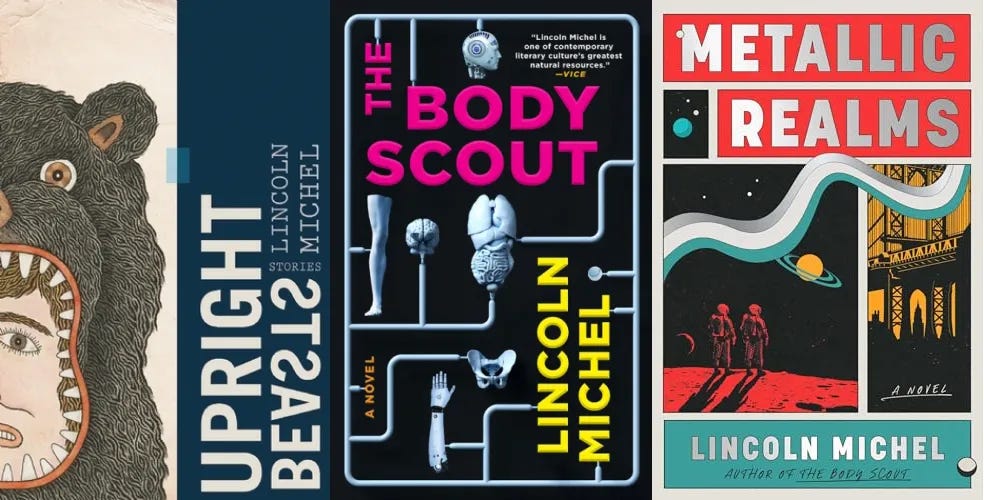
My new novel Metallic Realms is out in stores! Reviews have called the book “brilliant” (Esquire), “riveting” (Publishers Weekly), “hilariously clever” (Elle), “a total blast” (Chicago Tribune), “unrelentingly smart and inventive” (Locus), and “just plain wonderful” (Booklist). My previous books are the science fiction noir novel The Body Scout and the genre-bending story collection Upright Beasts. If you enjoy this newsletter, perhaps you’ll enjoy one or more of those books too.
I preordered THIRTY CABINS after Ron Charles wrote about it recently. I'm looking forward to it!