
Processing: How Hannah Lillith Assadi Wrote Paradiso 17
The author on writing through grief, the ghost of setting, and adding a layer of dream to reality

Processing is Counter Craft’s semi-regular interview series where I talk to authors about the craft and writing process behind their work. You can find previous entries here.
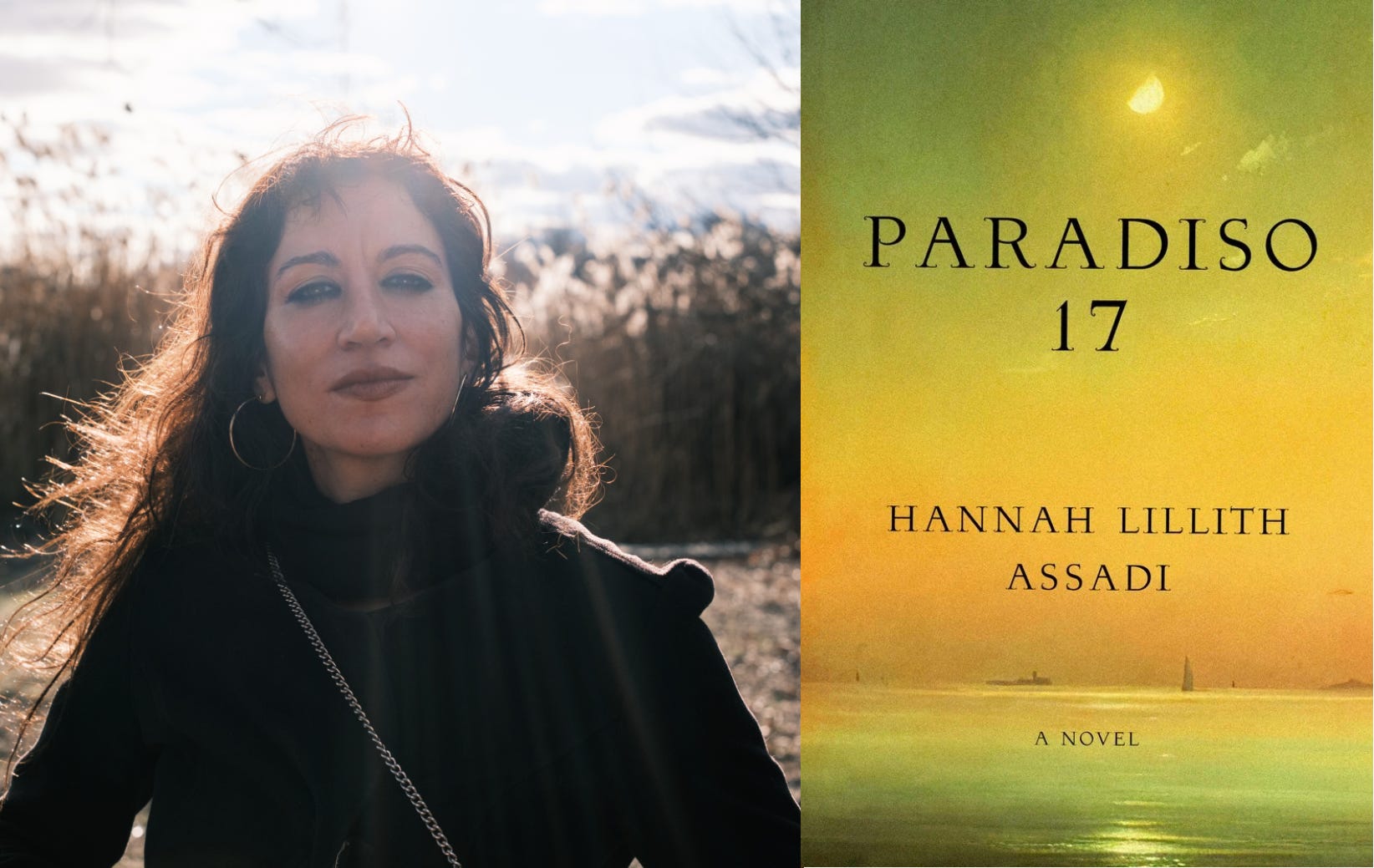
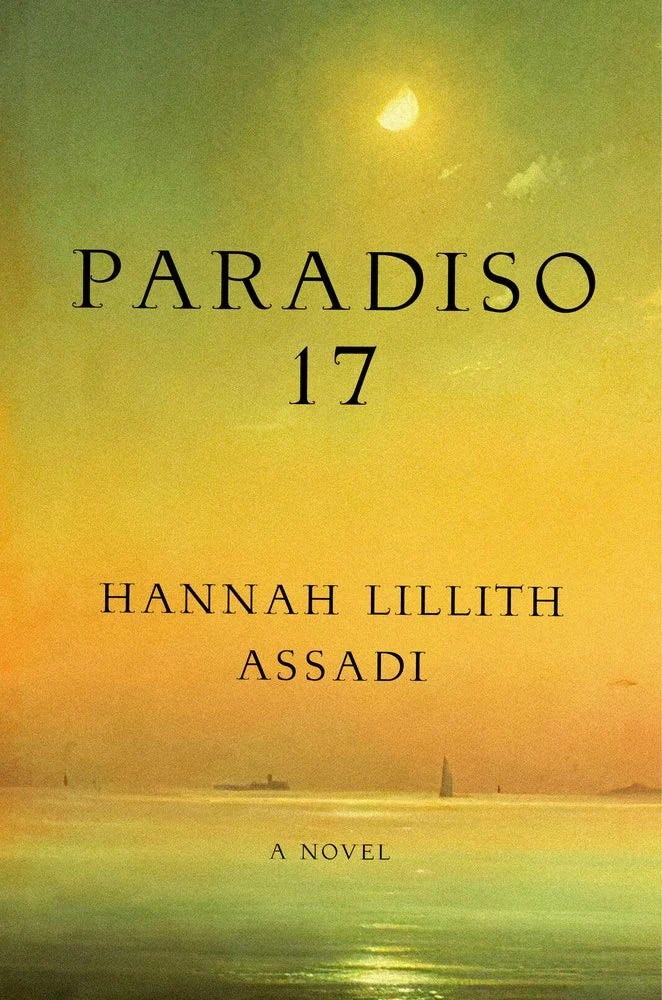
This week, I’m excited to be talking to Hannah Lillith Assadi about her moving, resonant, and all-around excellent new novel Paradiso 17. The book was inspired by the life of her late father, a Palestinian refugee from the Nakba. Like her father, the character Sufien moves around the world still longing for home, eventually coming to America, marrying a Jewish woman, having a daughter, and settling in Arizona. The novel spans a life, from young childhood to old age. It’s a book that is haunted by grief and exile, but also one that is suffused with the fullness of life. There is sadness and love and humor and dreams and everything in between. You can read more about it here.
I spoke with Assadi over email—she graciously took time to answer these questions as she is (as she notes below) in the 39th week of a pregnancy—about writing late at night, Google Maps stalking, the importance of structure, and adding a layer of dream to reality.
Paradiso 17 is organized around place, both thematically, as a novel about a Palestinian man exiled after the Nakba who moves around the world in search of home, and structurally in that the novel is organized by setting. “Part I: The Holy Land,” “Part II: Italy,” “Part III: New York, NY,” etc.
Did you decide on this structural organization before writing the novel, or is it something that emerged while drafting? And how did this focus on setting change how you wrote the novel?
Setting in this novel was a really interesting challenge coming out of my first two novels which were devoted to really particular geographies, the desert in the case of Sonora, and the Atlantic South in The Stars Are Not Yet Bells. I’ve always thought of myself as sort of a landscape painter. And those novels emerged, in some ways, as love letters to place. Here, I knew I wanted the shape of my late father’s life to graph onto this book which meant it had to really move across space (and time). It was tricky to let go of my instincts as a writer, and think more about momentum because there was just so much story to cover. So, in some ways, setting was secondary. But then I held fast to place as a structural device, as you say, so it’s there. And of course, this is a novel about loss of place, so that exilic sense is what actually haunts every page of the book. So, it’s sort of a ghost of setting novel versus a love letter to setting novel like my others.
The book really does a beautiful job evoking these different settings in various historical moments. Every setting felt very real, and there are many settings. I know the novel is somewhat inspired by the life of your own father, and I imagine some details come from his memories. I also noticed that you thank many of the settings in your acknowledgments. Could you talk about the role of research in writing this novel? Either in regard to setting or in general.
I’m really happy to hear that because many of the places in this novel, Palestine in particular, but Kuwait and Italy also, were places I haven’t visited or seen for decades. Much of what’s here in terms of those settings was from what I remember of my father’s outlandish (likely semi-fabricated) stories, but because I didn’t know I was writing this novel until after he passed, I had to fill in the gaps with research. And by research I’m talking pretty low-level. For instance, I consulted some of my paternal uncles and cousins who had old photographs of the various family residences as well as my father’s very good friend whom he met in Italy in the 60s. That friend gave me the address of my father’s old apartment in Florence and I literally stalked Google Maps looking at the entry door to the building for inspiration, and zoomed in on the block and the general environs to give texture to that part of the Italy section.
In addition to place, I was interested in the use of time in this novel. The novel is structured chronologically, but time moves somewhat fluidly with a third-person POV that references future events and the narrative frame that this is Sufien’s memories on his deathbed. I know this is an abstract question, but I’d love to know how you approached time when writing the novel.
Thank you for this observation. I think the sense of time in the novel is as essential as its sense of place, or its sense of loss of place, as it were. I wanted the temporality to feel cyclical, and recursive, and also sort of vertiginous the way it does in trauma and for the traumatized. In order to accomplish this, the novel needed the narrative frame so that the reader knew the inevitable end of Sufien’s trajectory. This protagonist will die. There’s no avoiding it (as it is for us all). And then only from the conclusion can time become fluid, and can the narrator move back and forth through it like another dimension. But also, each chapter title is the chapter’s final sentence, so there is this sense of return and returning in each episode of the character’s life, a characteristic which also marks the end of his story—that supernatural return to Palestine at the end of the novel. So, it’s an end but a beginning, too. That sounds a little cheesy, but hopefully only in trying to explicate it versus the experience of reading it.
Although the novel is largely realist, there is a thread of the supernatural. What inspired you to include that in the novel?
Like you, maybe, I am not satisfied with the real. I live here (most of the time) and this world weighs on my soul, all this very real constant barrage of horror. It seems to me, that if there is any hope for humans, it’s in the supernatural and in our capacity to dream. But more specifically, for this story, I wanted there to be a sense of reckoning and justice. My father died defeated (in his words). I did not want Sufien to die defeated. I wanted the reader to glimpse the return of what was stolen from this character. Only the supernatural could make space for that.
Paradiso 17 is your third novel after Sonora and The Stars Are Not Yet Bells. It’s sometimes said that each novel forces you to learn how to write a novel all over again. (Something I’ve found frustratingly true.) When writing Paradiso 17, what lessons were you able to carry over from your previous novels and what did you have to learn all over again?
I think this is so, so true. It’s as if each novel has its own rules of conception and gestation! But what carried over for me was my commitment to a particular vision, call it the supernatural, as we just spoke about. In all three, I took the raw material of life, and added a dream layer to lift it up. And in all three, I was interested in the blurry line between madness and the prophetic. Craft-wise though, I think structure is paramount and though the structure varies across the three, I consistently rely on a frame story from which I depart and return.
I read that you mostly wrote the novel at night, while your children slept. Can you talk about your writing process in general? Do you have any habits or preferences to get into the right headspace to write?
I think for me, night is the only option, because it’s the only time I’m not distracted by, yes my kids, but also more aggressively, the daily demands of email and text and the constant electronic input of our world. I’m not sure if it’s repeatable for me to write another novel entirely at night. But this one was a product of my grief in the year after my father passed and at night, after everyone slept, was the only time I could be fully with my own grief.
As for habits to get into the writing, I just need to be alone. While writing Paradiso, I won’t lie, I was a bit indulgent. Grief is an altered state unto itself but by the time I settled into writing, I’d definitely had a glass or two of wine, plus a few cigarettes. Since I am, at the time of writing this, 39 weeks pregnant, I’ve been approaching the page completely sober. I have to say, I’ve been less productive.
The novel contains many brief chapters covering many decades of time. Did you outline the novel and plan out the chapters ahead of time? Or was it a case where you wrote many chapters and scenes, some of which were cut during editing?
I didn’t outline it, no. In the year after my father passed, every night (or nearly every night) I wrote for an hour or two, almost furiously everything I could remember about my father’s life in semi-chronological order. I had no idea what I had at the end of it. I thought maybe just a document of grief or madness. Gradually, it took shape. But as you can imagine, a lot had to go. When this went out to editors, it was nearly 100,000 words. In its final form, it’s about 77,000 words, I think. John Freeman, my editor at Knopf, had me cut an entire thread involving a detour to Florida and a really destructive girlfriend. In fact, I think a few girlfriends were cut. It was hard to kill some of these literal darlings of mine, but in retrospect absolutely essential to the movement of the story.
The novel takes its title—and epigraph—from Dante’s Paradiso, in canto 17: “You shall leave behind all you most dearly love, / and that shall be the arrow / first loosed from exile’s bow.” Can you talk about the inspiration from Dante? And what other works, literary or otherwise, influenced you while writing Paradiso 17?
Yes, of course. Though I should say the working title of this novel was Frank Leone, my father’s pen name. I have John to thank again for warning me that this working title made the book sound like a mafioso story, which is funny, but obviously not the right feeling. The epigraph had been there from a very early stage, as I was re-reading The Divine Comedy, while writing the book, and on a whim, I thought, what about a title inspired by the exile canto? And there it was. Later, in the editing process, I grafted it such that the number 17 comes to play a role of huge significance as well. It’s the age Sufien is when he leaves home, but more importantly it’s a motif of his loss. 17 is the number on the door of the stolen house in Palestine, and it haunts him, in various iterations across the course of his exile.
In terms of other texts, I was greatly influenced by some afterlife literature I was reading at the time of writing. I’ve reread Toni Morrison’s Beloved a handful of times and it’s a masterpiece, as we all know, but particularly in its sense of structure.
Lastly, what are you working on next?
I am trying to write a love story that is also a ghost story about a relationship which transpired in my turbulent 20s!
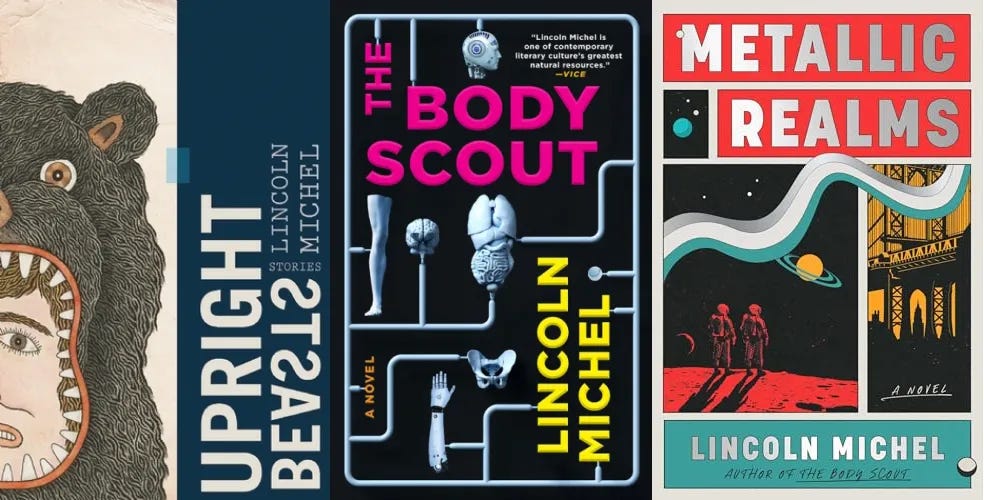
My new novel Metallic Realms is out in stores! Reviews have called the book “brilliant” (Esquire), “riveting” (Publishers Weekly), “hilariously clever” (Elle), “a total blast” (Chicago Tribune), “unrelentingly smart and inventive” (Locus), and “just plain wonderful” (Booklist). My previous books are the science fiction noir novel The Body Scout and the genre-bending story collection Upright Beasts. If you enjoy this newsletter, perhaps you’ll enjoy one or more of those books too.
I appreciate the craft focus of this interview. I love to read, but I also love to know what's going on behind the scenes--literally.
How sad that her father died a “defeated” man, but how wonderful that his story inspired the author to craft this novel. I have not read Assadi, but will rectify that soon. Thank you for this informative and helpful interview.