
Processing: How Brandon Taylor Wrote Minor Black Figures
The author on embodied characters, writing process, and how “a novel should show people fighting and striving against and with and for and alongside each other.”

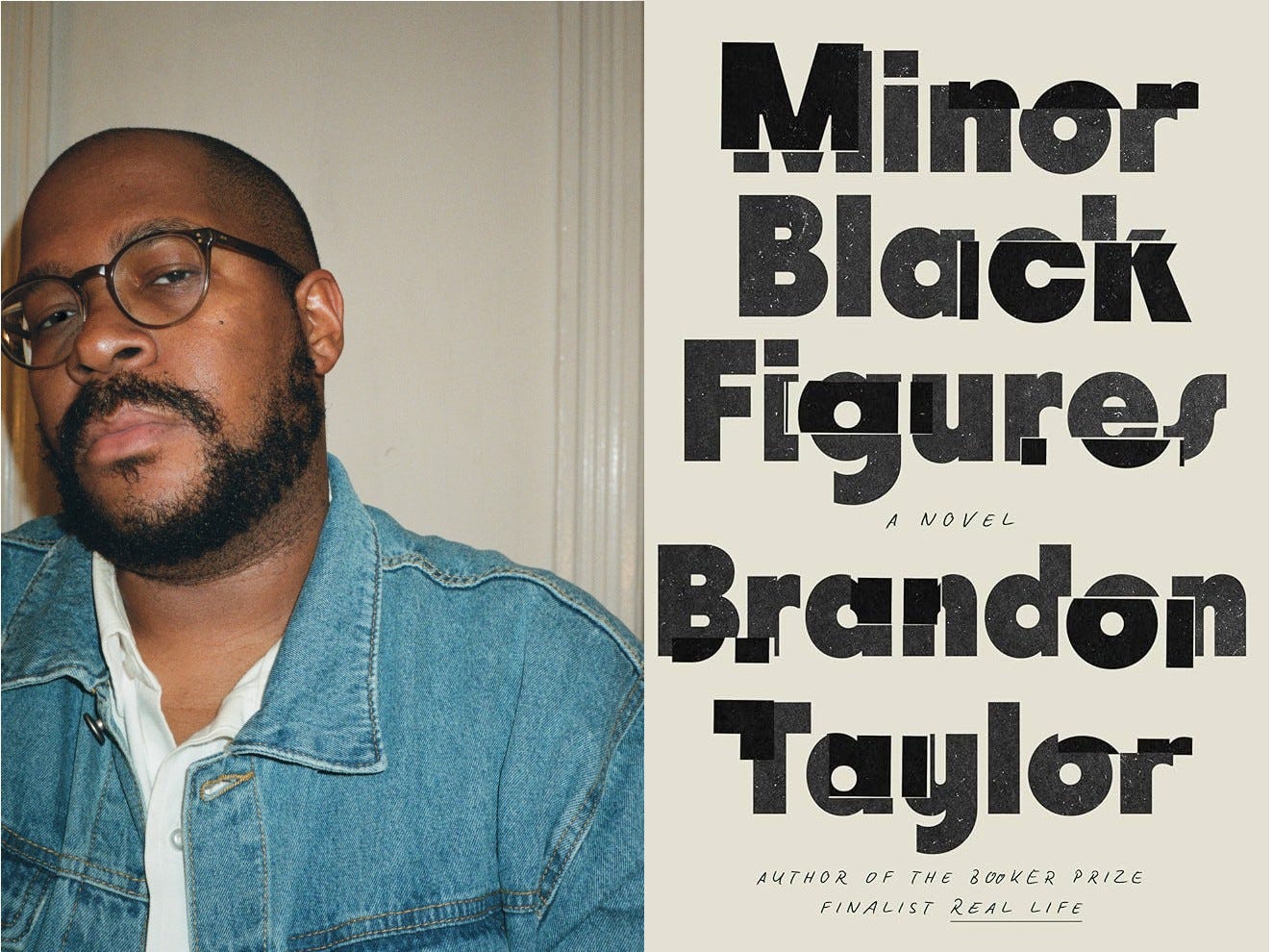
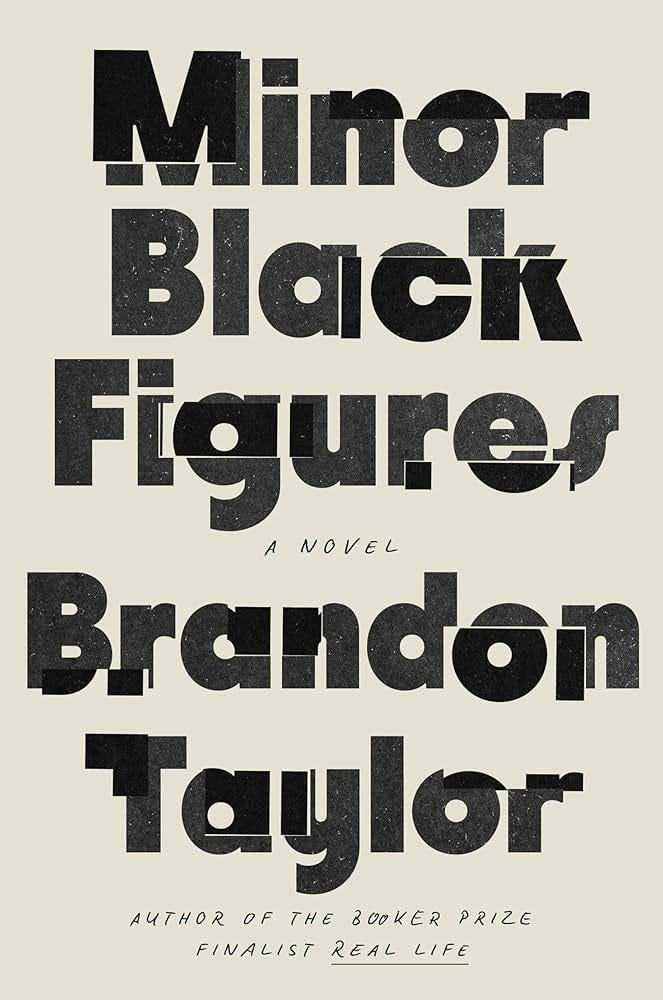
Processing is Counter Craft’s semi-regular interview series where I talk to authors about the craft and writing process behind their work. You can find previous entries here. For the last interview of 2025, I’m excited to be talking to the brilliant author (and essential Substacker) Brandon Taylor. Taylor’s newest novel is Minor Black Figures, which follows an artist named Wyeth in post-lockdown NYC and his relationship with a former seminarian named Keating. It’s a novel of both big ideas and intimate characterization that is unafraid to have its characters openly wrangle with complex questions of art, politics, ideology, faith, and life. There’s also lots of sharp observations, annoying artists, and hot sex.
I talked to Taylor about his writing process, embodied characters, literary theory, and how “a novel should show people fighting and striving against and with and for and alongside each other.”
I’d love to start at the beginning. Minor Black Figures has a lovely opening that takes a wide shot of the time and place, in somewhat abstracted language, before zooming in on the specific protagonist and his individual life. “That summer, they threw bombs and made signs for peace. […] It was not an extraordinary year in a remarkable time. Disgusted, not surprised was the slogan of the era.” I loved this opening for the beauty of its execution, but also because it felt unlike most novel openings today. At least in American fiction. It felt more like the 19th-century novels written by authors who weren’t afraid to sum up an era or situate their work in history.
Can you talk about how you arrived at that opening? Did the opening change during revisions?
The opening of the novel was the hardest part! The book used to open much more in scene, so to speak, with Wyeth outside of a bar, thinking kind of scathing thoughts about this group of artists he doesn’t respect. It’s the kind of opening that we all know very well. Start with a character. Put them in the middle of their conflict, in the middle of the scene, etc. Ground the reader is the traditional advice, there. You hear it in workshops. I’m sure I’ve told my students that before. That kind of fiction is very cinematic, also, because it begins on the pulse of action. But increasingly, I feel like the novel has all of this technology we don’t use anymore. In the intensification of the dramatic aspect of fiction from Henry James down through Chekhov and into Carver, etc, there has been a wholesale deaccessioning of narrative technology from the novel as a form, so that the only thing we come to care about are…characters against the dramatic backdrop.
I wanted to write a novel that had a bigger scale, that could speak of the world and situate the characters’ problems within the context of their time. I wanted a book that could portray the social process, which you really cannot do just through drama alone. Anyway, I fought with myself a lot. And there were a lot of back and forth exchanges with my editor and my agent because they wanted to be “in scene” and honestly, I just feel like…a novel is a book. A reader should have to read it. And if it means it doesn’t function like pre-TV or follow the cinematic logic of television or film, all the better.
But you also touch on something equally important my process in this book, the idea that the book should have…ideas about the world in it. There were moments when my editor said I was getting didactic, or that the book was getting preachy, and honestly, I thought, great, super. A book should also have ideas in it. I think people are so afraid of coming off as didactic that they write these books that offer absolutely no insight or synthesis of ideas. They’re these rote transcriptions of things said and done, with no processing, no gathering up. And also, no morals. No value systems. They’re just these pseudo-dispassionate recording devices, and if I wanted that, I wouldn’t turn to novels. A book should have ideas in it. Ideas that are…ideally (sorry) dramatized and put into tension with other ideas via the world views and social conflicts of the characters in the novel.
A book should have ideas in it. Ideas that are…ideally (sorry) dramatized and put into tension with other ideas via the world views and social conflicts of the characters in the novel.
Minor Black Figures is a novel about a visual artist who interacts with a lot of other visual artists. I find that describing other art forms, especially music and visual art, is quite difficult in prose. But I found your descriptions of the art clear and succinct. I could see what you were describing. Sorry if this is a vague question, but how did you approach ekphrasis, or describing visual art in the medium of text?
I actually wrote this novel solely to have an excuse to describe art. Before I wrote Minor Black Figures, I wrote two other very severe works of fiction that have not yet been published (and perhaps never will). In writing those books, I didn’t let myself describe a lot of art because the main character in one worked in a deli in the Midwest, and also because I was trying to stay away from writing artists and writing about art. I wanted to write real people because I kept getting accused of only writing about “academics” even though all of my characters are working class. Whatever.
So after that, I wanted to really just describe some stuff. Just to cut loose and write about art again. I had this idea that if I wrote a painter, I’d get to do that. That’s the whole reason Wyeth ends up being a painter in the book. I think when you describe art of any sort, it’s helpful to keep in mind that you aren’t trying to achieve a total recreation of the art itself. What you want is to capture the impression of the art. The experience of the art. Now, there is your experience of it as the author and then there is the character’s experience of it, you know. And so you’re kind thinking about the art at a remove or through an additional filter.
My approach in the book was to remember that Wyeth is an artist, a painter specifically. When he’s describing the work, he will be technical, critical, in the same way I am about works of literature. And then another way that is more experiential, viewing as a viewer rather than as a technician. And to render it in simple, direct language, but to let the emotional or subjective experience of the art through so that the reader is able to ascertain that they are not getting an objective view of the art but this character’s subjective experience of it. That’s where the real value is.
Apart from that, some general good description habits are to keep your lines crisp, not to mix your metaphors. Don’t go for too granular all at once. Present a general impression and then move inward with greater specificity. Or begin with something specific, a single observation, and then move out and then back in again. I imagine description as being like looking through a microscope. You move through levels of magnification, but each level of magnification is discrete, locked, clear. There are planes of focus that you move through. You see what you see. Change focus. Then you see something else. Don’t try to do too much all at once.
An issue in modern fiction, that you and I have talked about before, is what you’ve termed “character vapor.” Basically, a lot of modern fiction features disembodied characters who float around having thoughts without seeming to exist in bodies that maneuver a physical world. Your characters, like Wyeth and Keating, are very embodied. They have thoughts, of course, but also are physical on the page. How do you ensure embodiment of your characters? And is it something you focus on in revision, such as adding sensory details to scenes?
I have a theory about character vapor, and it has to do with mediation and the outsourcing of fictionality to incidental narrators. ANYWAY, story for another day. I do try to remember that my characters have bodies, and I try to remind them of their bodies. That while they are standing somewhere having really beautiful, elegant thoughts in the vacuous voids that have become the scenic backdrop of American literary fiction, there is a physical body somewhere dying and decaying. For me, a scene means nothing if there isn’t a matrix or network of physical relations at play. Some people don’t want to write that because they think it’s boring or Victorian to have to describe a room. I think they don’t want to describe a room because they don’t know how to read social texture, and so a room is just a set of mute artifacts to them.
I’m getting sidetracked again. I don’t know that I have a strategy for writing embodiment because I am a writer for whom embodiment is a subject, theme, and natural interest. I think partly because I don’t experience my body in the mediated way that many writers seem to. I am acutely aware of my body at all times. Soreness. A sniffle. The tension in my arches. The pain in my lower back. The grit in my eyes. My body is very present to me, and so it never occurs to me that there are people for whom their body is…invisible? Nonexistent? That is a totally alien human experience to me. But I do think that maybe that’s an area of experience worth exploring. But to the degree that it has been explored in American literature??? It feels like a pathology.
But if we’re talking tips. I don’t know. Think about your character’s physical existence. And after every three beautiful thoughts or observations, describe how they feel in response to something that’s happened in the moment. That’s what I always do when things start to get heady. I come back to the physical world.
This is a sort of inverse question to the last. Does it seem fair to say that Minor Black Figures is more overtly interested in political and ideological questions than your other books? Not that the novel is didactic at all, but your characters are invested in debating aesthetics, politics, religion, etc. What inspired this?
I would describe that as true. I don’t know that the characters in my first three books had robust political or ideological understandings of their lives or their worlds. Their experience was dominated by, well, their own experience of their feelings in response to their love lives, sex lives, or their work lives. But all of that was experienced through this incredibly interpersonal lens. Part of that is because I simply did not know how to write thoughts or ideas. I did not know how to give ideas to characters. I also had no ideas.
But in 2021, I started to read literary criticism and political theory, and I gained a more robust understanding of the world and my own experience of that world. I had a language I could use to understand things better, more clearly, and importantly, with that language, I could begin to express that understanding. All of this allowed me to articulate political and ideological questions, moral questions, in my work. The challenge was how to marry that with my Jamesian dramatic conception of fiction. Because for me, fiction is drama. It is action and rhythm and scene and dialogue to express the interior state. I am a Chekhovian and a Jamesian by nature. I am not, like, a super heady guy. That is not my disposition.
So it was a hard road, frankly. I am still on it, I think. But Minor Black Figures comes out of an intense period of self-study and self-reflection down in the criticism mines. It is particularly influenced by the critic Georg Lukacs, for whom “ideology” is the highest form of characterization. And for him, a novel’s function is to demonstrate the social process, in large part through the conflict of ideology among the characters in that novel. I wanted to a write a book that followed his principles—as much as I could. And I think the book is more vivid and more alive for it. The characters really argue the way that I argue with my friends about the things that matter to us.
And I think if we are going to write a robust, rich, living literature, we have to be able to capture that aspect of life—people arguing, debating, fighting, protesting, striving to bring about a world that reflects their values. It blows my mind that 2020 saw one of the greatest uprisings in modern history, and our novelists and short story writers are acting as though…we were all just inside talking about fruit ninja. Solely because they are afraid of being called didactic. Preachy, etc. At this point, the reality proffered by mainstream literary fiction is so much less politicized and so much less alive than the reality one encounters just walking to a bodega and listening to the guys argue about tariffs.
It blows my mind that 2020 saw one of the greatest uprisings in modern history, and our novelists and short story writers are acting as though…we were all just inside talking about fruit ninja. Solely because they are afraid of being called didactic.
So many of our artists are falling down on the job. They will go to protests. They will do mutual aid. They will do all of this incredible social work. They have these profound ideas about how we should live. About the status of the world. And they sit down to write fiction where none of that enters in at all. Like. The disconnect is astonishing to me. And, frankly, I think it’s evil.
I’m always impressed by your output. You seem to be forever working on several projects, yet your work never feels rushed. Can you talk about your writing process in general? For example, how you use the “retyping in a blank document” tactic?
I want very desperately to be a monogamist, but I do find myself kind of moving from thing to thing. My process is much less organized than it used to be. I’d actually like to return to that. But usually, when I begin a project, I just open a blank doc, and I moved the margins in super tight, as tight as I can get them, until page is a skinny little column text, and I start typing. At those margin sizes, you can’t read anything you type. It’s basically like a snake game, and I just get after it. My goal is simply to move the cursor as I go.
When I have a draft, I print it out and make revisions and edits. When I feel like I’ve gotten to the end of a significant revision, and I’m talking like, a major revision, I retype the whole manuscript from the beginning. Word by word. This is helpful especially if I make big structural changes. I only do this three or four times per manuscript because it takes a long time, even for me.
Was there anything different about your writing process for Minor Black Figures compared to your previous books?
This was the first time I have ever shown pages to an editor while I’ve been writing them. I was working with a new editor after three books, and it seemed like a good time to try a new process. So I showed him the first draft of the first half of the book, and got some interesting and useful feedback that helped me move in a much better direction. And we did many more drafts of this novel than I have ever done of a novel before—most of that was my own doing, to be completely honest, lol. But it was very interesting.
Here comes the Lukács question. One thing that you have been very open about, in your Substack and elsewhere, is how much literary theory you have been reading over the last few years. You’ve said that despite writing novels you didn’t feel you knew that much about literature and so you decided to read up on it. I’m curious how directly or indirectly your reading of theory changed your approach to Minor Black Figures compared to your previous novels?
I definitely did not know anything about literature despite writing novels and short stories. I think it is entirely possible to be a writer and go your whole life and not know a single thing about literature. And for some people, that is a blissful, productive, and very lucrative way to live. They can go blithely along, acting as though their insights are novel and without precedent, and they can sometimes convince other people to pay them for it. The literary ecosystem is filled with that kind of thing.
Maybe it’s because I grew up in a family that told me how stupid I was at every opportunity, but I’ve always had an intense suspicion of my own ideas, and I don’t believe something until I’ve tracked it down to its source. As a result, I just felt like my understanding of literature was, frankly, childish and disgraceful for someone writing books. So I set about trying to get some adult ideas about literature. I asked my buddy Christian Lorentzen (America’s best literary critic, imho) for some things to read to learn about literature, and he gave me a list that changed my life.
Then I came to Georg Lukács, and…I mean. There is my life pre-Lukács and my life post-Lukacs. Reading Theory of the Novel (his worst book of literary theory, imo) and Writer and Critic and Studies in European Realism and The Historical Novel and all of his collected works on realism. I mean, it just gave me such a rigorous framework through which to read and understand and analyze literature. He’s also just such a profoundly stylish writer. And a wonderfully cranky guy. He is also more optimistic and hopeful than people give him credit for. I know, I know, he’s controversial because hates modernism (and, like, was he wrong???? Put your tomatoes down!) but to me, he is such a beacon and a guiding light and my north star.
And without reading his work, I don’t know that I would have written Minor Black Figures. He totally changed my life. The thing that I came back to again and again in writing that novel was this Lukacsian principle of the novel serving to illustrate and demonstrate the social process through dramatizing ideological conflicts and tensions among the characters. That a novel should show people fighting and striving against and with and for and alongside each other, and that a great novel should in part demonstrate how the urgencies of a particular character’s life are drawn out of the bedrock of conflict in their time. Like, it’s so profound, to me, anyway.
A novel should show people fighting and striving against and with and for and alongside each other, and that a great novel should in part demonstrate how the urgencies of a particular character’s life are drawn out of the bedrock of conflict in their time.
I’m sure you, like me, have encountered people who think that reading theory isn’t just pointless but actively harmful for writers (usually something about “destroying one’s authentic voice” or whatever). What do you think such writers are missing out on? And which Lukács should they start with?
One of my students asked about this in seminar this semester. “What if reading theory makes writing harder?” And I told them, “It should.” I’m sorry, but if reading theory makes writing harder for you? Good! You should think about your writing more. You should think more. You should struggle more.
When I was down in the Lukács mines fighting for my life, questioning everything, doubting everything, there were certainly times when I thought, I am never going to write another novel. It was miserable. It was hard. It was humiliating. Painful. Because I was striving for and failing to reach this new level I could now see in front of me because I had read criticism and theory.
But eventually, you come through that. And you begin to make choices on your own terms rather than reacting out of animal instinct. You can begin to draw on ideas rather than batting images. You acquire a greater mastery of your instrument and your technique so that you can forget the technique and express fully, clearly, forcefully, the thing you want to express. But to get there is very hard.
As for Lukács…read Studies in European Realism or Writer and Critic. Then read the collections of writings on Realism and then The Historical Novel..
Sorry, one more “annoying people online” question. Minor Black Figures is written in the third person POV. I’m sure you’re familiar with the BookTok types who say they inherently hate third person and won’t read books written in that POV. Silly people, obviously, but what draws you to that perspective? What opportunities does third person provide that other POVs do not provide?
I write in third person because it is the most flexible perspective for the kind of fiction I want to write, particularly if you use free-indirect discourse. The notion of writing fiction in first-person…I mean…beyond me, frankly. I wouldn’t even know where to start. I can’t begin with a voice. Not with an I. For me, character is a thing I observe, and over time, I come to understand the character. With first-person, I wouldn’t even…know how to start. Like, it’s totally baffling to me how people do it.
With third-person, you have distance to let the character surprise you. You can move in and out of intimacy with them. You can sometimes speak with the voice of the world. You can move forward and back in time. You can relay information that the character themselves doesn’t have. You can do all sorts of weird tricks and the reader will mostly come along because, well, they have been reading third-person their whole lives. That said, I write a very subjectivized third-person. It’s not objective.
But first-person is pure subjectivity. It is hard to organize. The narrator is both witness and participant in the story. It’s very…fluid and changeful, first person. I couldn’t even imagine sitting down and starting a story that way. Never would.
Your fiction is very rooted in scene, at least in my reading, but you always provide a great balance of description and digression within scenes. (A lot of the funniest parts are in Wyeth’s digressive thoughts, such as the description of NYC renting that includes this line: “The landlord was really a series of shell companies stacked in a trench coat, and he’d stopped trying to figure out where his rent check was actually going when it was withdrawn from his account.”)
How do you approach narrative balance in a scene?
For all of my anti-cinematic rantings, I am, unfortunately, a Chekhovian and a Jamesian, and so scene is kind of the core of what I do, haha. Like, my fiction has a very intense dramatic element. If it’s not in scene, it’s not real to me! I’m sorry, that’s just my temperament. But as I’ve matured as a writer, I think I’ve come to see that even in James or Chekhov or Mavis Gallant or Alice Munro, there are these wonderful digressions. That drama isn’t just what people say or do, but what they say or do as it is rooted in the full context of their lives. And the way that you achieve that richness of context is via digression, via flashback, via asides. When you look at Shakespeare, you find this wonderful, almost maniacal sense of play formally. The scenes comprise all these different components, so that you have parentheticals, soliloquy, dialogue, lyric flights of poetry, etc.
Look at Dickens, Trollope, Zola, Tolstoy, James, and others. They will be in the middle of a scene and then offer either a really funny joke as a parenthetical or they’ll pause the action to unfurl a whole minibiography with its own twists and turns. When I think about that, scene becomes an incredibly elastic element of story. So I feel a great permission to pack scenes with all kinds of stuff, so it’s not just physical action, but the things that contextualize and situate those physical actions.
I’m never trying to do rote transcription. I am trying to provide maximal contact area between what a character says or does and their deeper motivations. This is why I teach Stanislavski in my fiction workshops. So students can appreciate what it takes to ground an action in something of meaning. How to convey to a reader all the different meanings and shadings contained within every act or gesture.
And for that, in fiction, you know, you use backstory, flashback, exposition, summary, free-indirect, all this stuff, you use it alongside what a character says or does. That is what makes a scene. The goal is not to get too far off task, unless it’s for a reason.
As a last question, in an interview with Henry Oliver here on Substack you said that while writing Minor Black Figures you were trying to “bring back all of what a novel can do.” The novel is a great success there. But, I imagine no novel can do everything, so what are you trying to do in your next novel that you couldn’t put in this one?
Minor Black Figures captures the social process as it is glimpsed and experienced by one character. In my next book, I want to go full Dickens, full Toni Morrison, and demonstrate the social process from inside of many different characters at many different levels of society. I’m going for it in the next one.
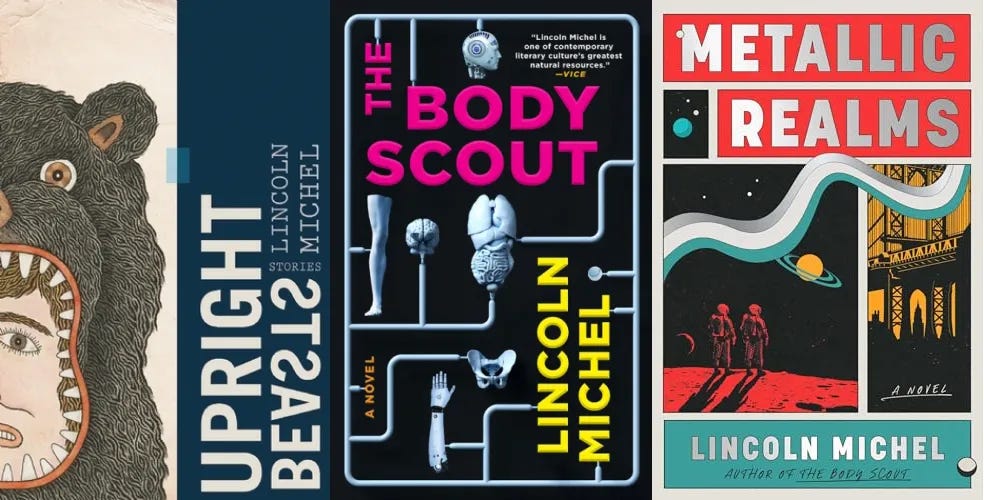
My new novel Metallic Realms is out in stores! Reviews have called the book “brilliant” (Esquire), “riveting” (Publishers Weekly), “hilariously clever” (Elle), “a total blast” (Chicago Tribune), “unrelentingly smart and inventive” (Locus), and “just plain wonderful” (Booklist). My previous books are the science fiction noir novel The Body Scout and the genre-bending story collection Upright Beasts. If you enjoy this newsletter, perhaps you’ll enjoy one or more of those books too.
Great interview! Very educating. Agree that "3rd person" is the most freeing POV.
Ooo I like that idea of the "snake game" that Brandon Taylor mentions about having super smaller margins to get writing. I've played other snake games, but this one seems more fruitful than those.