

Processing is Counter Craft’s semi-regular interview series where I talk to authors about the craft and writing process behind their work. You can find previous entries here.
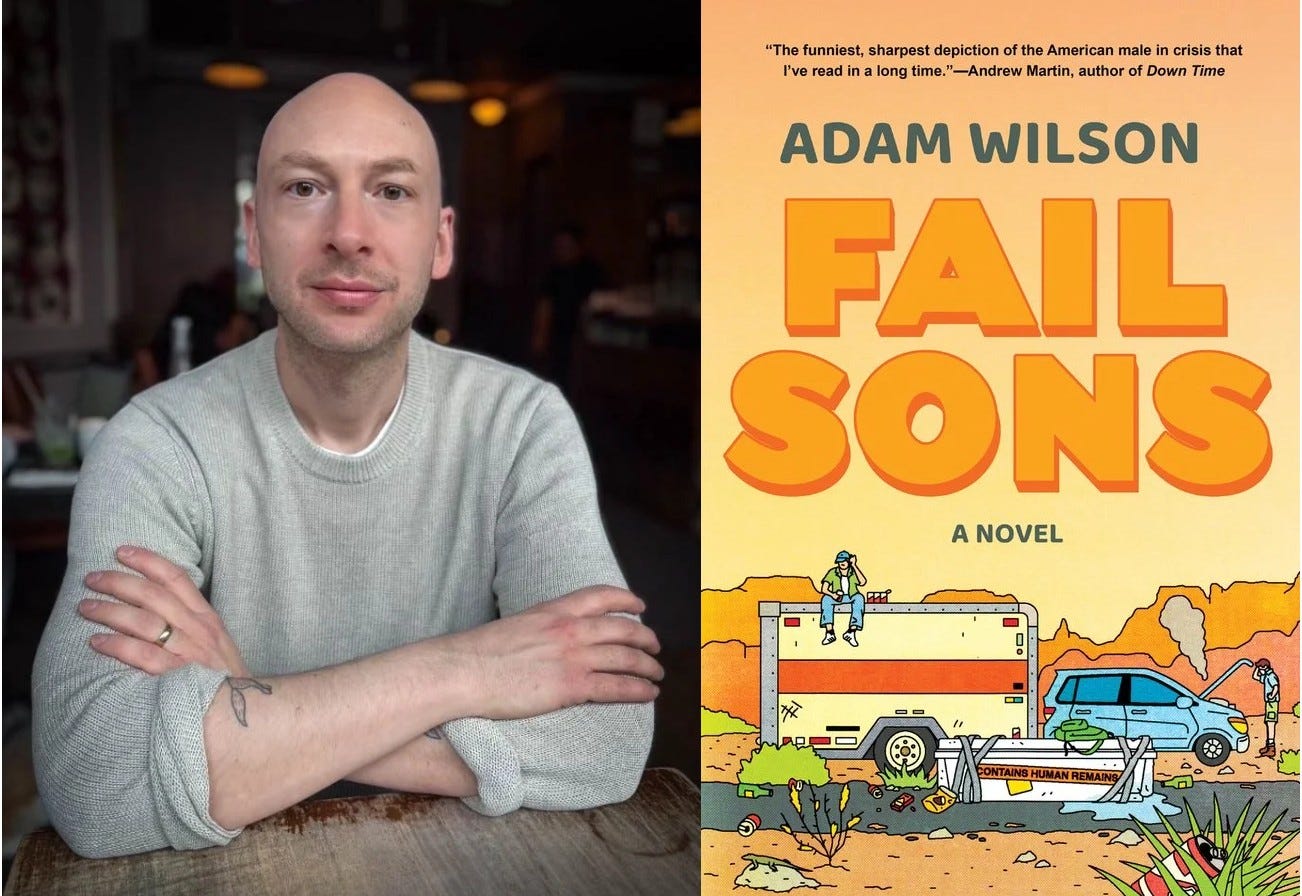
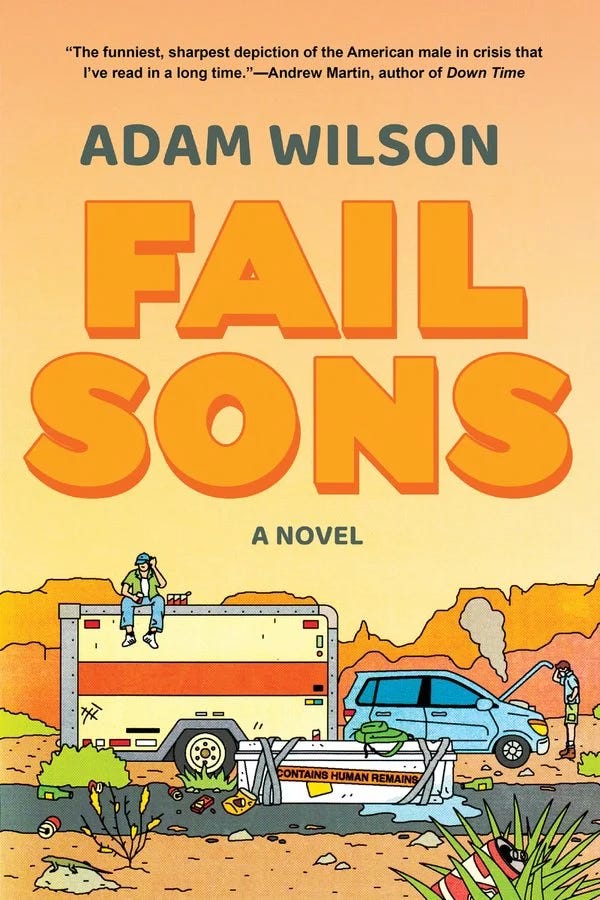
This week I’m excited to be chatting with Adam Wilson, an old friend whose hilarious and heartfelt new novel Fail Sons is out in stores today. Fail Sons follows two brothers, Scott and Nick, as they race across the country to deliver their cryonically frozen father to a new facility without letting the body dip below –109°. It’s part As I Lay Dying and part—as the narrator Scott keeps insisting—Speed. As Wilson notes below, the novel is a millennial midlife crisis novel and it tackles masculinity, fatherhood, COVID, and the general insanity of contemporary America. There’s also lots of drugs, neo-hippie hitchhikers, a missing toe, and lots of other fun stuff. I tore through it and you will too.
I talked to Wilson over email about novels in fragments, fiction as a form of lucid dreaming, processing one’s life through art.
Fail Sons is described on the back cover as “a darkly comic 21st century update of As I Lay Dying,” which is an excellent elevator pitch and fits the plot. However, the novel’s fragmented form and wry humor reminded me of a different novel that you and I both admire: Mary Robison’s Why Did I Ever. I recently wrote about how Robison (and other fragmentary novelists) composed by writing short sections on notecards. Can you talk about the fragment form of Fail Sons? Why did you choose this form and how did you compose and arrange the novel?
In the seminar I’m currently teaching, we do a unit on fragment novels: Speedboat, Sleepless Nights, Why Did I Ever, Dept. of Speculation, and Flat Earth. All of these books are written by women. Jenny Offill once said that she used fragments to capture her disjointed sense of time during the sleep-deprived days of early motherhood. I began writing Fail Sons right after my first son’s birth in 2018, but the bulk of the initial draft came during the pandemic, when he was nearly two. Daycare had closed, my wife—who works in tech—was in round-the-clock Zoom meetings, and I was my son’s sole daytime caretaker, at least for a while. A fragmented style felt obvious given these conditions, as writing anything more sustained than a paragraph seemed impossible. I found it interesting, maybe even subversive, to explore contemporary masculinity using what some people consider a fundamentally female form. At its outset, Scott, the narrator, is on the cusp of fatherhood. Terminally unemployed, he has semi-reluctantly signed on to be a stay-at-home dad, the kind of aging hipster (like myself) who haunts the Prospect Park playgrounds in a Pavement t-shirt. I liked the idea that the book’s very structure might gesture at the shifting gender paradigm in Millennial families, even if that gesture only existed in my mind.
Fail Sons is also a road trip novel, with the two brothers driving across the country from west to east. What type of road trip research did you do for this novel? Have you driven through the areas the brothers visit yourself?
I have visited most of the places, though any plans to return and do research were curtailed by the pandemic and then by having a second kid, so the settings in the book are all triangulated between my memory, my imagination, and Google. This feels like the right balance, at least for fiction—books that wear their research on their sleeves can get boring quickly. That said, I’m terrified that anyone from Arizona, Colorado, Utah, Idaho, or Kansas will find evidence of my tourist-level familiarity with those locales. We recently had people over for dinner, and I was surprised to learn that a friend’s boyfriend was raised in a Mormon family. Most of what I know about Mormons comes from HBO’s Big Love (in the novel, Scott admits to the same) and my book’s Mormon characters—twenty-something hitchhikers who’ve run away from home to sell weed and join a Gen Z commune—are based on people I met at Phish shows on the East Coast when I was in my teens and early twenties. In the novel, I made them Mormon because they’re hitchhiking through Utah. Anyway, I suddenly panicked that this person would read the novel and think that a lazy researcher such as myself should have stayed in his lane.
The road trip novel seems like one of the fundamental archetypes of American fiction, dating back at least as far—if we can be a bit loose with the meaning of “road”—as Mark Twain’s Huckleberry Finn. What’s the appeal of the road trip novel for you? And if you agree it is essential to American literature, why do you think that is?
Didn’t Hemingway say that all of American literature comes out of Huck Finn? Not that I put much stock in Hemingway, but Huck is definitely the urtext for the American road novel, though on a global level you could go back to The Odyssey, The Book of Exodus etc. These are all basically stories about men running away from their problems. The American version, specifically, tends to be about escape from the stifling conditions of work, family, and responsibility. I grew up fantasizing about being Neal Cassady in On the Road or Neal Cassady in The Electric Kool-Aid Acid Test, a guy trying to outrun death—or at least adulthood—by driving fast and getting stoned. By the time I wrote Fail Sons, I was no longer a romantic young man, but a middle-aged one coping with my new responsibilities as a dad. To slightly digress from the road trip question, Fail Sons is also a midlife crisis novel, so I decided to reread a bunch of 20th-century male midlife crisis novels as research: Rabbit, Run, Light Years, Revolutionary Road, The Sportswriter. What struck me is that all of their protagonists are much younger than I am (mid-20s to early 30s). For the most part, these characters are ensconced in bourgeois suburbia, and desperate to escape it. Their crises involve having achieved the American Dream—wife, kids, house, job—and realizing they’re unhappy with its spoils. I wanted to write a book that reflected what I see as the central issue of the Millennial midlife crisis: not the desire to escape from a bourgeois existence, but the realization that, at 40, you still haven’t achieved it! Thus, my protagonist is not driving west toward freedom, but driving east to make it home for the birth of his son.
I wanted to write a book that reflected what I see as the central issue of the Millennial midlife crisis: not the desire to escape from a bourgeois existence, but the realization that, at 40, you still haven’t achieved it!
This is your third novel (and fourth book). How was the writing process for this one similar and different to the process for the previous books?
My previous novel, Sensations Machines, is a near-future murder mystery/satire about Wall Street, big tech, hip-hop, politics, and all sorts of other things. It is long, and high concept, and formally complex, with many characters and points-of-view. Not to keep bringing everything back to kids, but it’s a book I couldn’t have written after becoming a parent—completing it demanded time and focus that I no longer have. This time around I wanted to write something streamlined and relatively simple, a book that took place in a more contained universe. So: two guys in a car driving from point A to point B. I thought it would be quick and easy, but I got frustrated halfway through a first draft and put the project away for two years. I didn’t think I’d ever finish it, but then I was out of other ideas, so I did. I guess my point is that every book is different, but it never gets easier, at least not for me.
Although I wouldn’t call this a plot-centric novel per se, there is a very clear plot with a classic ticking clock structure. The brothers have to arrive at the cryo clinic by a specific date and the father’s frozen corpse will be ruined if it dips above a certain temperature. Additionally, the narrator’s wife is pregnant with a looming due date. How do you think about plot and plotting when writing?
The basic plot is baked into the premise, and I figured I’d wing it from there. This turned out to be more difficult than I imagined, probably because plot isn’t something I’m intuitively good at. But for that reason, I found it really satisfying when I did eventually come up with the narrative turns that the story seemed to demand.
There are many film references in Fail Sons and the narrator often processes his experiences through film and other visual images. E.g., the many references to Speed or the following fragment: “I’ve never been to this part of the country before. I’d seen the relevant cinema: Butch and Sundance in the flaxen dust swirl, John Ford’s technicolor skies. But only in person is the scale apparent, its humbling magnitude.”
Film is also a central feature of Flatscreen and some of your stories. What opportunities does using film as a lens provide you in your stories?
To quote Walker Percy’s The Moviegoer:
Other people, so I have read, treasure memorable moments in their lives: the time one climbed the Parthenon at sunrise, the summer night one met a lonely girl in Central Park and achieved with her a sweet and natural relationship, as they say in books. I too once met a girl in Central Park, but it is not much to remember. What I remember is the time John Wayne killed three men with a carbine as he was falling to the dusty street in Stagecoach, and the time the kitten found Orson Welles in the doorway in The Third Man.
Point being, I’m a firm believer that people’s experiences of art—films, books, music, etc.—are as formative as any other experiences, and it’s precious and dishonest to pretend otherwise. In Fail Sons, specifically, Scott is a former magazine editor, and his midlife crisis is connected to his newfound feelings of obsolescence. It’s not just that he’s out of a career, but that he’s spent his adult life building a cultural knowledge base that seems to have been rendered worthless by things like recommendation algorithms. In the book, his constant cultural references tend to fall on indifferent ears, and I think that among many other things, Fail Sons contains a comic but earnest lament for a social language that’s quickly going extinct.
In general, there is a theme of art as means of processing the narrator’s world. (He also “spent four years in creative writing workshops revising the same short story about a young guy grieving his cryo-preserved dad.”)
This isn’t autofiction, but there are elements of your own life and I remember you saying something along the lines of all your books taking place a few years after your own milestone life experiences like college, marriage, fatherhood. Am I remembering that right? And if so, can you elaborate a bit?
For me, fiction writing is a kind of lucid dreaming, a place to work through problems that my conscious brain can’t directly face. This isn’t a quick process, and it often takes some distance from an experience for me to be able to look at it sideways, through the warped lens of fiction, rather than head-on, if that makes any sense whatsoever.
Lastly, Fail Sons is a comic novel, and a very funny one. What comic writers or just straight-up comedians do you draw inspiration from? And how do you approach balancing the comedy and tragedy (or at least emotional gut punch) of your novels?
Sam Lipsyte and Paul Beatty are huge influences, and have been since I first started seriously writing, so much so that I sometimes refer to my first novel as Lipsyte fanfic. Patricia Lockwood’s memoir, Priestdaddy, made me laugh out loud more than any book I’ve ever read—I kept waking my wife up with my laughter while I was reading it in bed—and it also has a lot to say about complicated parents. As for balancing comedy and tragedy, it often comes down to paring back the comedy to make sure it’s not getting in the tragedy’s way.
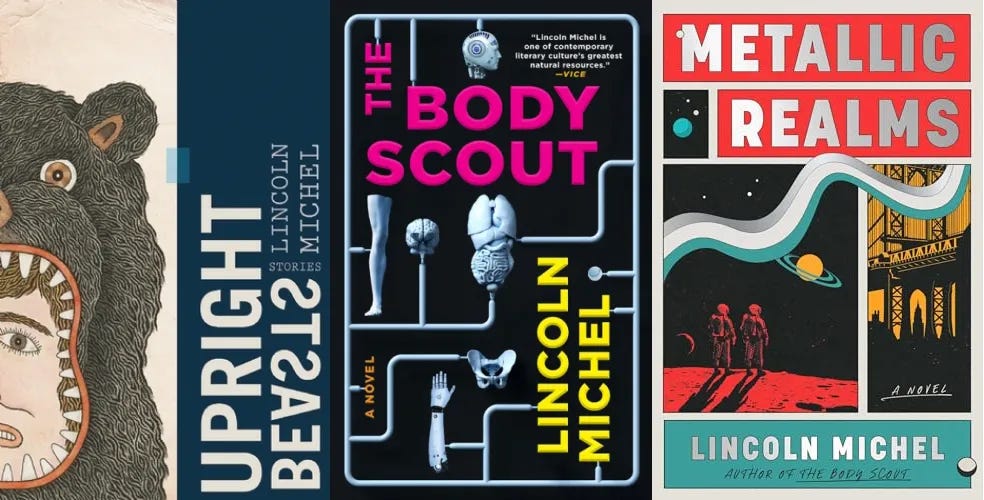
My new novel Metallic Realms is out in stores! Reviews have called the book “brilliant” (Esquire), “riveting” (Publishers Weekly), “hilariously clever” (Elle), “a total blast” (Chicago Tribune), “unrelentingly smart and inventive” (Locus), and “just plain wonderful” (Booklist). My previous books are the science fiction noir novel The Body Scout and the genre-bending story collection Upright Beasts. If you enjoy this newsletter, perhaps you’ll enjoy one or more of those books too.
Great interview. The fragment form discussion caught me because I write serial fiction, and I face the inverse problem. Each episode must satisfy on its own while the larger arc stays hidden until the right moment. Wilson composing on notecards and arranging later sounds freeing and terrifying in equal measure. Curious whether he ever found a fragment that refused to fit anywhere and had to become its own thing.
I loved the bit about fragments coming from a life where nothing longer than a paragraph was possible. Building after hours feels the same. The constraint became the form instead of a compromise.