

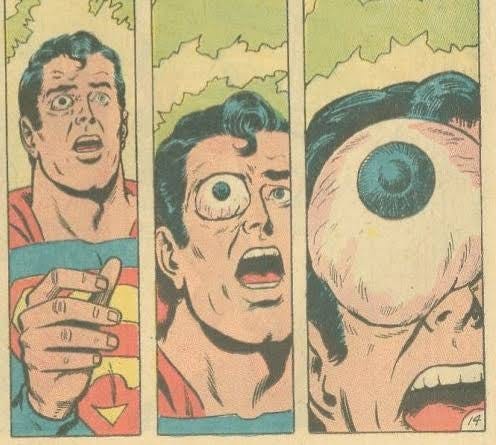
Because no one reads anymore, it’s increasingly common for people to opine on the state of literature who have not seen or touched a book in many years. Some seem unsure of what a book even was. A triangular device that emitted light? A box of knickknacks? A group of splotches that, if one relaxed one’s eyes, revealed a three-dimensional dog or butterfly?
If I exaggerate, it is only slightly. Because my algorithms feed me book takes, I can hardly go a day without seeing contradictory claims, sometimes from the same posters. “Books are all too long!” “Books are all too short!” “They only publish dense postmodernism!” “They only publish breezy book club fiction!” “They’re all plotless!” “They’re all overly plotted wannabe TV scripts!” So on and so forth.
Despite my opening sentence, I am not such a doomer about the state of literature and reading—see the end of this post—but to the degree that people are reading less, the reason is obvious. It’s the phones. Of course it’s the phones. Who are we kidding? It’s the phones and by extension the apps, streaming services, GenAI, short-form vertical videos, cell phone games, and all the myriad cheap or free entertainment (or brainrotting) options made omnipresent by constant internet access.
Our obsession with phones isn’t merely cutting into our book reading time, but our cultural enjoyment of, well, anything that isn’t on a phone. Movie theater attendance is down. Museum attendance is down. Newspaper circulations are down. People trade books for tweets, feature films for vertical (i.e., phone) microdramas, and even short pop songs for even shorter TikTok snippets. TV shows are now made to be “second screens” watched in the background without interrupting people’s cellphone scrolling.
It’s the phones. How could it not be the case? The average American spends 7 hours looking at screens a day, an amount that grows as generations get younger (Gen Z is apparently 9 hours). The majority of this is phones. The old labor rallying call was “eight hours for work, eight hours to rest, eight hours to do what we want.” The people have spoken. What they want is their phone.
You can lament this or celebrate it. Either way, if people’s free time is increasingly absorbed by their phones then of course they will have less time to read books, watch movies, go to museums, and so on and so forth. It’s obvious. So obvious that it is boring to say. We all know the problem, we all participate in the problem, and we all aren’t going to do anything about it. What else can you say? It’s so obvious and boring that writers more interested in takes than truth bend themselves into pretzels to come up with other explanations.
The Slow Death of the Mass Market Paperback
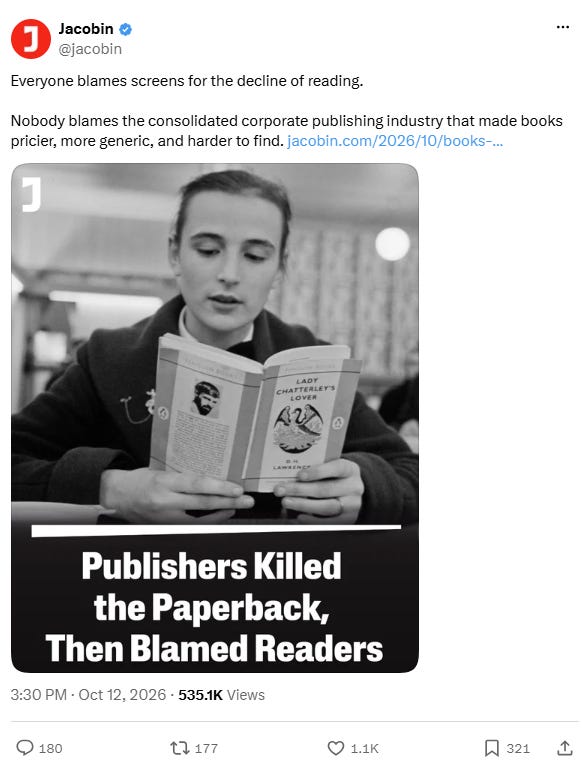
A recent example is a Jacobin article by Ned Rust, shared with the erroneous claim that “publishers killed the paperback.”1 Rust’s article isn’t as silly as Jacobin’s social media account or most of the posters who shared the article without (shocker) reading past the headline. Rust doesn’t claim paperbacks are dead—they are not—but suggests the fading of a specific paperback format, the mass market paperback, played a notable role in “the decline and fall of the American reading habit.” (The article was a response to the recent article in The Atlantic by Rose Horowitch called “The End of Reading Is Here.”)
In the discourse around this article, and similar ones, many seem unsure of what a mass market paperback is. It doesn’t mean any paperback or any paperback of a popular book. The mass market paperback (MMP) is a specific format made from cheap paper, cheap glue, and cheap covers. They have been historically made with a smaller trim size than the trade paperback format (TPB)2 with tiny, condensed text. The upsides of the MMP are they cost less and are more portable.3 The downsides are everything else. They are a poor reading experience—thin paper, cramped text, easily cracking spines—and will sometimes literally break apart while you read.
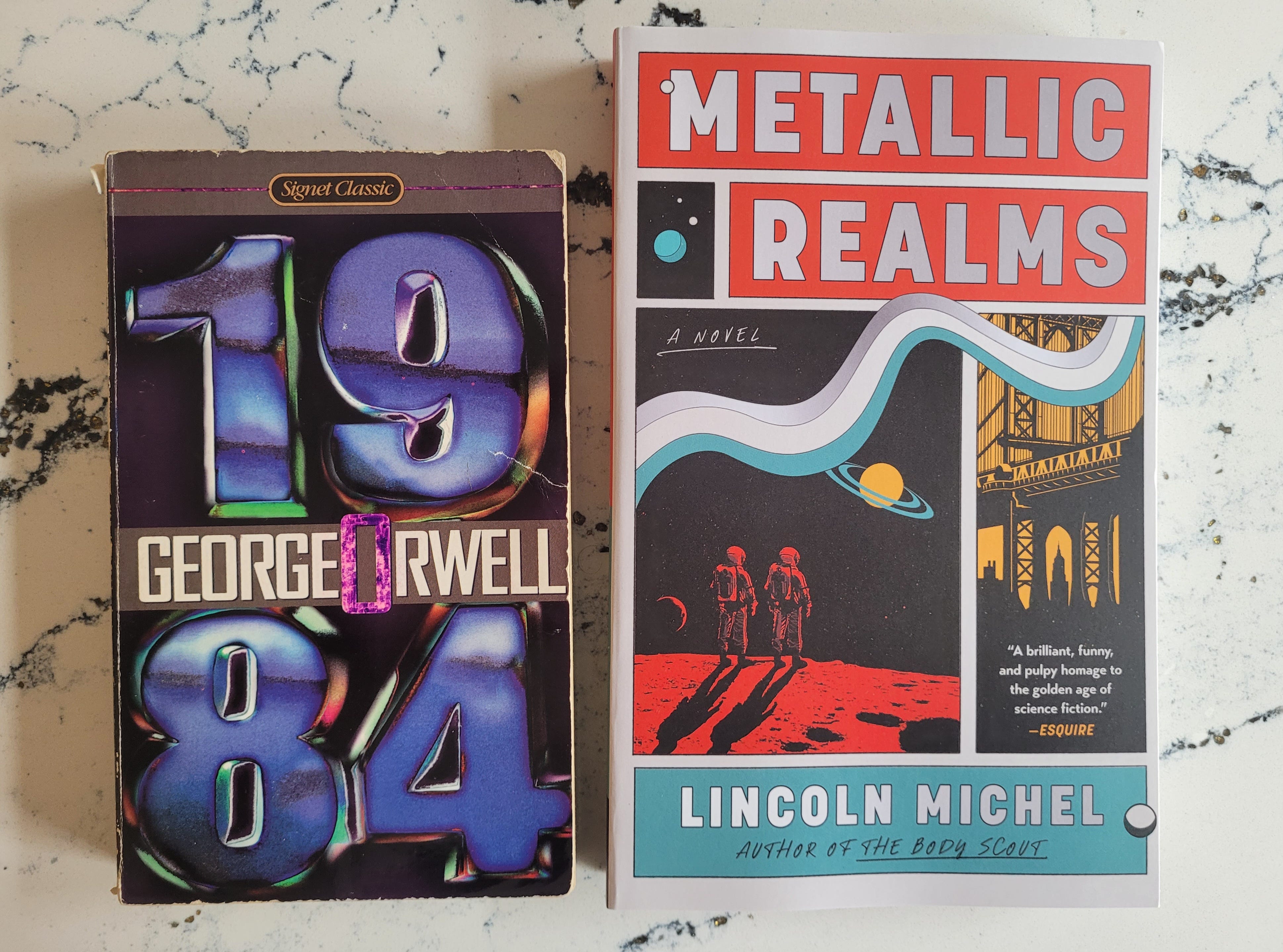
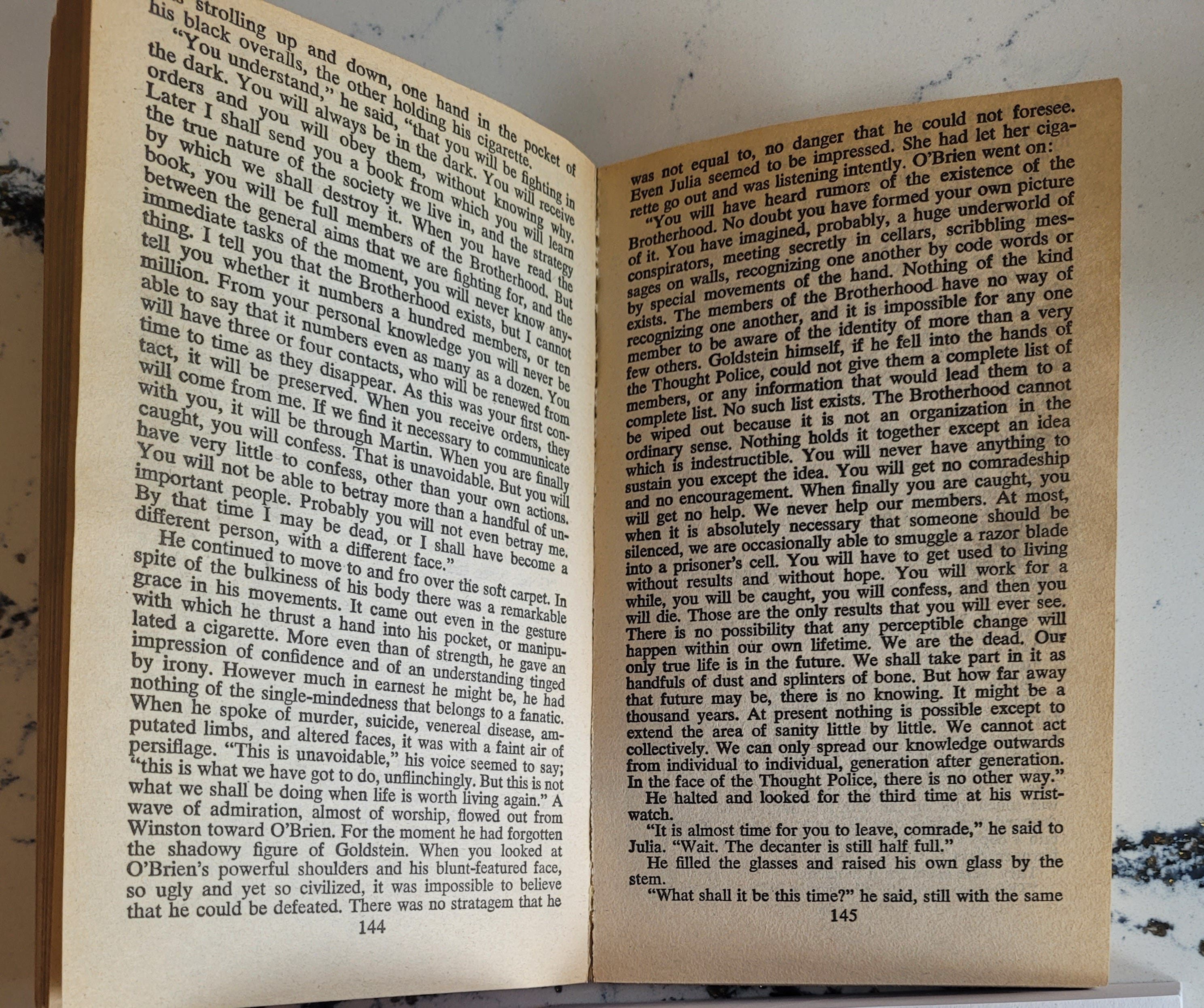
Cost aside, nearly everyone prefers trade paperbacks.4 TPBs come in a more comfortable size (unless you have tiny little toddler hands5) with thicker paper and more durability. And if you like the small size, publishers put out a lot of smaller trim size TPBs these days. While MMPs were hugely popular up through the age of 80s airport fiction, the popularity dropped off a cliff over the past few decades. During all the lamentations of the loss of MMPs over the past few years, I do not believe I have even once seen anyone say they still actively purchased new MMPs.
Why did the MMP fall out of favor with readers? The normal argument is that readers concerned about costs and/or portability moved to other formats, especially ebooks and audiobooks. Anyone with an ereader or ereader app on their phone can get infinite ebooks from libraries with ease. 75% of American households have Amazon Prime accounts, which includes unlimited access to a rotating selection of thousands of ebooks and audiobooks.6 Plus, online retail means cheap print books (especially used books) are easy to get. So, readers have plenty of cheap options. Of course, many no longer read books. The second argument would be, well, the phones. People who might have read a Robert Ludlum MMP while, say, waiting for the dentist are now more likely to scroll TikTok or play Candy Crush.
It’s sometimes hard to remember what life was like before cell phones, but people used to have significant amounts of outside-the-home downtime—in doctors’ offices, airports,7 bathrooms,8 waiting for friends, etc.—that they filled by reading printed text. Mass market paperbacks, yes, but also magazines and newspapers. All of these things have disappeared as people instead scroll their phones.
Rust’s article does not attempt to rebut these arguments. It avoids them entirely. (There is not a single mention of ebooks or audiobooks, for example.) For a more in-depth rebuttal of Rust’s article, I recommend Jared Henderson’s article on the topic. I will say that Rust’s general argument about “enshittified” literature strikes me as somewhat backward. The height of MMPs was the 80s and 90s when commercial fiction of questionable merit dominated sales and every grocery store had spinner racks of Steel, Patterson, and Clancy. The MMP, despite its noble origin, was in some ways a cause rather than victim of the rise of commercial fiction, corporate consolidation, and other issues Rust brings up.
You Can’t Fan Fiction Reality
What the Jacobin article reminded me is how frequently I see takes about publishing (and reading and education and etc.) that simply ignore the biggest elephants in the room. First, yes, the phones. (Come on! It’s the phones.) But there is also a positive side to phones, or at least the internet, that is also ignored in these fan fic accounts of reality: readers have more access to great literature (and films and music and etc.) than ever before. Every single person who can read a Jacobin article online has easy access to a functionally infinite supply of great literature from throughout history and across the world. With a couple quick clicks, they could read Middlemarch or Moby-Dick or any other great text for cheap or free. They could. You could. I could.
99.9% of us do not. (Myself included, much of the time.)
It’s not because grocery stores no longer sell Clan of the Cave Bear next to the Bubble Yum gum. Be serious.
It’s also not because of mean high school English teachers, experimental postmodernist writers (that few people read), overly political literary awards (that few pay attention to), creative writing programs, or most of the other villains that hot takes reach for. For one thing, such villains can’t explain the corresponding decline of cinema, magazines, newspapers, and so many other art forms and industries.
So, why?
Well, that’s an uncomfortable question. Accepting that people have more access to enriching material—not just books but great cinema, enlightening lectures, beautiful art, and everything else—and actively choose to ignore it in favor of various shades of slop is… depressing. If you have any kind of populist leaning, left or right, you don’t want to blame the public for their tastes. It’s more psychologically comforting to deny the masses all agency. “The phones” is a harder villain to grapple with because we choose to use them. We elect to doomscroll, brainrot, ragebait, and slopwallow. We create social media content. We are the problem with phones.
Look, you can disagree with me. There are reasonable counterarguments, I’m sure. However, I think anyone who wants to seriously tackle these questions must at least contend with three facts:
1) The public has more access to more books in more formats at more price points than ever before in history.
Anyone with a library app (or Amazon Prime account) can get infinite ebooks and audiobooks for free. There are overflowing little free libraries in every town. Online stores sell used books of every variety for a couple bucks. The great works of literature from history are published in cheap print editions and are free in various digital formats on sites like Project Gutenberg in a few clicks. If you hate what corporate publishing has to offer, there are ever-multiplying independent presses in every genre and an enormous self-publishing world with millions of new books each year. Audiobooks have never been as common or easy to access. Nor have translations.
Now, the vast access to books in many formats may come with its own problem. So much choice makes decisions hard and discoverability harder. Yet your analysis of the state of literature cannot begin with the fantasy that people are losing access to text.
2) The richest tech companies in world history have spent untold billions designing devices and programs to be as addictive as possible (and siphon away as much of the revenue as possible).
Shockingly, gigantic tech corps are good at their job and their job is making us addicted to their hardware and software. They have fine-tuned algorithms and pioneered new forms of free slop (so all revenue goes to them instead of creators). People love this shit. We do. Even if you want to celebrate this fact, to declare that TikTok videos and clickbait are good and valuable, there is still the blunt fact that free or cheap entertainment options are ever expanding. Podcasts, YouTubes, TikToks, cellphone games, GenAI, etc. etc. In such a world, all other questions aside, you would expect the average person’s book reading time to decrease. You would also expect ther average person’s feature film watching, museum going, magazine reading, etc. to decrease. And… it has!
3) The “Gatekeepers” Have Less Influence Than Ever Before
None of what I’m saying is a defense of corporate publishing, which has many problems (at least from my point of view). It’s also not a defense of the “elitist” gatekeepers of whatever sort annoy you. Because another fact many wish to ignore is that gatekeepers’ influence is at an all-time low. Book reviews and awards have shrinking influence on sales every year. Self-publishing, in various forms, is enormous. Some gatekeepers (like Big 5 publishers) are still powerful, yes, but they are increasingly reacting to public taste rather than the shapers of it.
When a corporate publisher reprints a book that was already popular on AO3 or the Kindle Unlimited store—a common practice in 2026—they are following the masses, not leading them. Consider the two buzziest sales categories in books: Romantasy and LitRPGs. The most popular Romantasy author, Rebecca Yarros, just sold close to 1 million copies of her new book in its first week. Yarros is published by Entangled, an independent publisher.9 The genre in general exploded in fan fic, self-pub, and small presses. LitRPGs also developed in online spaces outside the sight of literary tastemakers and cultural gatekeepers. (Many of those still do not even know what a LitRPG10 is, I’d wager.)
We live in the world that poptimists have always wanted. People have access to free and cheap entertainment in every format. People are freely choosing what to spend their time with. We should grapple with this honestly.
A Little Bit of Hope at the End
I’m not a literary doomer. Yes, few people read great literature but this has more or less always been the case. Perhaps watching microdramas on your phone in the dentist’s office is worse than reading James Patterson, but not by such a great degree I can get too fussed about it. People will do what they want. Nothing you or I can do.
Still, I’d like to think the tides may be turning on phone use in the culture at large. If one thing is eternally true about culture, it’s that it changes.
I was recently speaking to an editor who returned from the Frankfurt Book Festival, where apparently one of the most talked about sales categories is puzzle books. Physical puzzle books like Murdel and Murdoku11 are selling like hot cakes because people want to log off. My hope amid the doom of AI is that the slopification of online spaces will encourage even more of us—I include myself here!—to log off. Indeed, I am already limiting my social media use because the apps are so filled with AI spam and slop that just isn’t worth wading through.
And many people do read. They do. They read.
Every day, I ride the NYC subway and people around me are reading books. (On the way home from drafting this post, the man next to me was reading The Odyssey and the woman across from me a Kindle. I was midway through I Gave You Eyes and You Looked to Darkness.)
[Edited to add: My friend Maxwell Neely-Cohen points out that a huge number of people do download classics from Project Gutenberg.]
On Thursday, I read new fiction alongside some great writers at a completely packed reading for The Metropolitan Review. It was lovely and energizing. A room full of people in a sixth-floor walk-up talking about books and listening to people read some fiction and poetry.
The culture you want is out there and the only way to grow it is to put down your phone and join.
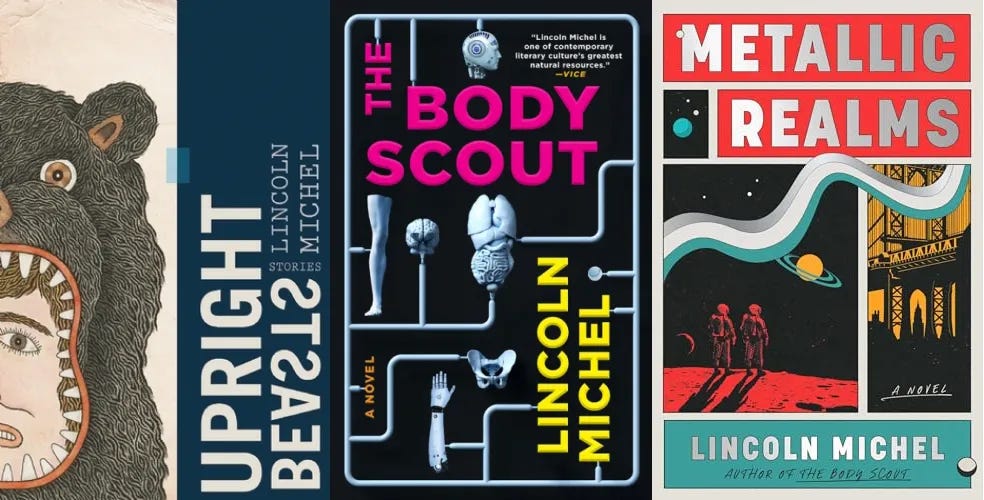
My new novel Metallic Realms will be out in paperback next month! Reviews have called the book “brilliant” (Esquire), “riveting” (Publishers Weekly), “hilariously clever” (Elle), “a total blast” (Chicago Tribune), “unrelentingly smart and inventive” (Locus), and “just plain wonderful” (Booklist). My previous books are the science fiction noir novel The Body Scout and the genre-bending story collection Upright Beasts. If you enjoy this newsletter, perhaps you’ll enjoy one or more of those books too.
Something that no one who has set foot into a bookstore recently could believe.
This just means the dimensions of the pages.
I have fond memories of always keeping a MMP in my jacket pocket to read on subway rides when I first moved to NYC. (I still tend to carry books but I now own jackets with larger pockets that fit standard paperbacks.)
Aka the standard paperbacks you see in bookstores.
No judgement.
Some large accounts claimed that subscription services do not exist for books. Again, see my first paragraph. Many people do not read books or pay any attention to readers and reading in the real world.
Such a significant source of reading time that commercial fiction was called “airport books.”
The “bathroom book” was an entire publishing category. When I was growing up, nearly every friend’s house whose bathroom I visited would have some bathroom book of trivia, quotes, or jokes.
Independent in the sense of not one of the Big 5 conglomerates. It’s a venture capitalist-backed publisher whose COO is the former CEO of Tinder. Which might tell you a lot about the direction of mass market fiction…
Google Dungeon Crawler Carl.
Murder mystery logic and Sudoku-style puzzles, respectively.
I appreciate you staring at this problem without providing any feel-good catch-all solution. I don’t think The People en masse are entirely to blame for the way phones have dominated our lives; there is ample blame for the tech corporations that profit off of our collective addiction… but doomscrolling is what people are choosing to do instead of reading. It’s technically free and much lower commitment than actively reading or watching something, but it accomplishes basically nothing. We (speaking mainly for myself here) can and should make better choices with our devices.
I think sometimes our political and social commentary, in the goal of not sounding like elitists, has a little bit of “the public is always right” going on, like people are never at fault for their own decisions and if they were really free from X or Y oppressive force, then they would unleash their real spirit as perfect angels. But the reality is that lots of people have bad taste and want to read shit. There’s no way to say it without sounding like a snob, but I think you did as good a job as possible here.
The Mass Market paperback served a purpose only Luxury Goods retailers still understand. Giving up on the format, and the placement in mass market type places meant that the publisher’s lost an entire frontier of awareness. Luxury goods retailers, don’t open stores in target demographic areas to make money. They pay for retail space, to get their name up in areas where people who might buy something can see it. Those shops with a lone salesperson waiting for a single customer a day are all about visibility marketing. Publishers didn’t fight for keeping the checkout lanes stocked with books and magazines. They didn’t try and find “waiting areas” where they could stock cheap paperbacks with extra pages that listed the backlist or upcoming books and where to buy them. And they were never smart about putting an easy offer to buy the next in the series with a QR code or direction to an e-commerce site to buy.