
Metallic Realms Lands! And Thoughts on Writing for Yourself Instead of the Market
Plus: A Bonus Story for Counter Craft Readers


Dear readers,
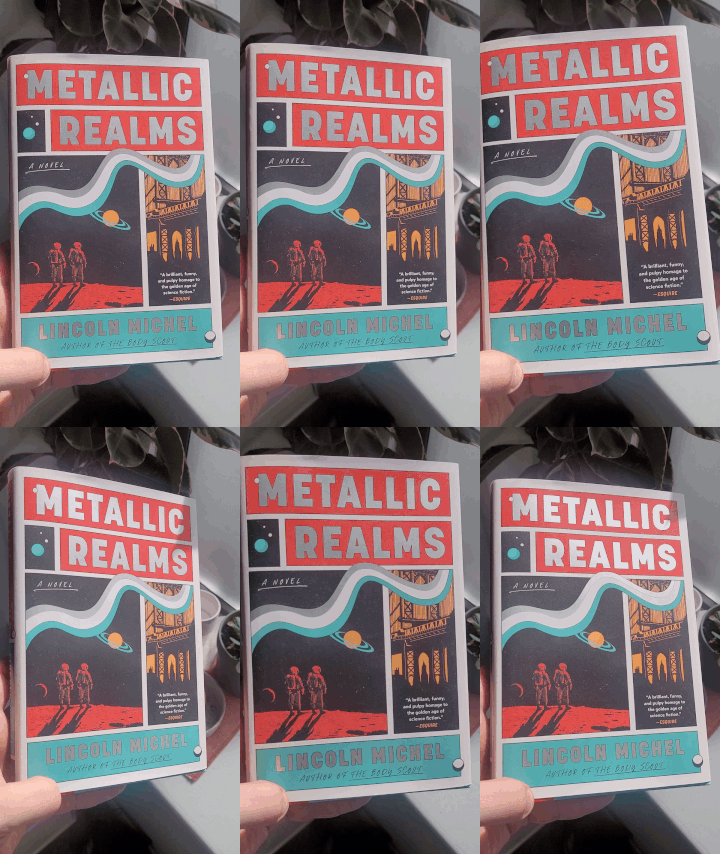
My second novel, Metallic Realms, lands in a bookstore near you…. today! It's a comic, quasi-autofictional, and half-science-fictional novel about a group of struggling writers in New York City. It is also about friendships, artistic failure, horrible roommates, millennial malaise, and the power and peril of storytelling. Oh, and space adventure. It’s a strange—but I think quite fun—novel that I wrote initially for my own enjoyment while ignoring my fears that it would be rejected by publishers as too weird, too niche, and just too not-what-the-market-wants. Maybe that’s the best way to write? Some thoughts on that below.
I hope you’ll consider picking up a copy from your local indie bookstore, library, or else online retailer. And if you enjoy the novel, please consider reviewing on Amazon or Goodreads. Lastly, my publisher and I are offering a FREE bonus story for Counter Craft readers. If you’re interested in that, read on or else scroll to the bottom of this post.
The reviews for Metallic Realms so far been beyond flattering: “Brilliant” (Esquire), “riveting” (Publishers Weekly [starred review] ), “hilariously clever” (Elle), “I left this book feeling … assured of the future of storytelling” (The Masters Review), and “Exciting and tragic and funny and bewildering and just plain wonderful” (Booklist). Metallic Realms has also received lovely praise from authors I admire such as Brandon Taylor (“The great novel of stan culture”), Ed Park ( “A total blast!”), Helen Phillips (“Delighted me at every turn”), Vauhini Vara (“A wild, playful, mind-bending ride”), Kevin Brockmeier (“Delightful to behold”), Henry Hoke (“A galactic achievement”), and Matt Bell (“The most fun I’ve had reading all year”).
And did I mention the cover has metallic foil stamping? More info and fuller blurbs on the official publisher page.
A Brief Overview of How I Wrote Metallic Realms
Since this newsletter breaks down writing processes and craft, I figured some readers might find it interesting to know how I came up with Metallic Realms. It’s a tricky question to answer because, for me, there is never a single inspiration point. No one genesis. I tend to have lots of ideas (often vague ones) that my brain mulls over for months or years. They might be plot points or characters or themes or entire novel structures. They just float around up there until, at some point, enough of them “click” together to form the spine of a novel. Or, to switch metaphors, until I find a strong central idea whose magnetic pull is able to gather the shiny slivers of other ideas to it.
Let me be more specific. For a long time—nearly 20 years—I’ve had a vague idea to write a novel chronicling the rise and fall of a writing movement entirely in the form of a short story anthology. I love structure and find great inspiration in the kind of strange structural constraints the Oulipians used. This hypothetical novel would’ve been 100% realist and traced the group’s destruction entirely within the short autofictional stories via the authors’ stand-in characters. Anyway, I never got anywhere with the idea.
Then in 2018, when I was at a writing residency and working on some “serious” novel or another I decided to take a break and just write a weird gonzo space opera tale for kicks. The kind of fun and funny and not-taking-itself-so-seriously SFF story I loved as a teen. I had a blast. I started drafting more of these weird space adventure tales with the same characters but realized I had no idea what to do with them.
Then I started to think about who was writing these stories, the implied author(s), and connected the two ideas. Why not have a novel that’s an anthology of space opera stories and chapters that chronicle the rise and fall of a writing collective. Combining these ideas necessitated changes to original structure concept. Namely, I would need a real-world storyline running through the stories. Here, the magnetic pull of this concept drew in other ideas, notes, and desires of mine. I’d always wanted to write a buffoonish faux-academic narrator a la Nabokov’s Pale Fire. I wanted to play around with footnotes in the way of Baker’s The Mezzanine. I took inspiration for including fiction within a fiction and satirizing the writing world from Everett’s Erasure. For the space stories, I wanted to write homage-slash-pastiches of authors like Ursula K. Le Guin and Italo Calvino as well as shows like Star Trek: The Next Generation that have meant so much to me. I wanted to write my own version of autofiction, a style I also read and love, though I could only do it in an inverted and obscured way. And many questions that preoccupy my thoughts—on “literary vs genre” fiction, artistic struggles, millennial malaise, climate change, trying to make art while the world burns, etc.—all attracted themselves like shiny metal slivers to the central magnet idea.
These combined in my mind as the story of “Michael Lincoln,” an obsessive fan and self-appointed scholar of his friends’ science fiction tales. He would write long chapters of “analysis” of each short story that would reveal the in-fighting and drama surrounding the writing collective and digress into his own life story. I began writing toward this new novel in 2019, before I had sold my debut The Body Scout. I fully committed to it during COVID lockdown in 2020 and 2021. Perhaps being physically isolated from my friends made me feel even more compelled to write about friendship, warts and all. And when the whole world was falling apart, it was freeing to write about the small dramas of struggling artists.
Obviously I’m being brief and reductive. Countless other ideas went into this book. Many of them arose out of the drafting itself. But this was the gist. The novel went through many revisions of course—and here I must give thanks to my excellent agent Angeline Rodriquez and amazing editor
. Characters were cut or combined. Chapters replaced. Different themes emphasized or deemphasized. Almost all of the space opera stories were either dramatically rewritten or scrapped entirely except, ironically, that first story. (“The Duchy of the Toe Adam” appears only somewhat changed in the book.) Etc. The novel was sold in 2023 and is now out, well, today.So, there’s the timeline of the book. Some original ideas dating back decades. The first real usable text in 2018. The full commitment in 2020-21. Novel sold in 2023. Publication 2025.
On Writing Your Weird Ideas Without Worry about the Market
I mentioned Metallic Realms was a novel I wrote initially for my own amusement, incorporating all the things I love in fiction in one place without much concern for whether it would sell. Or more accurately, I worried that it wouldn’t sell and wrote it anyway. This may sound like humblebragging, but it’s true.
When I started writing Metallic Realms, I hadn’t yet sold my debut novel and had failed to sell a novel before that. I feared my career had stalled out. And Metallic Realms does several things that I’ve always been advised against doing. First, it is a novel about writers—the “navel-gazing” thing everyone loves to groan about—and failed writers at that. Second, it’s a novel that includes short stories within it. Short stories are already a very hard sell these days, and embedding them into a novel could easily make the book fail as both novel and as stories. Third, the novel dances between literary fiction and science fiction in a way that could easily fail to satisfy either “side.” Lastly, the novel is a satire with an “unlikable narrator.” Despite the great history of comic writing in America from Twain to today, many publishers and critics look down on comedic writing when they aren’t overlooking it. (The fact that Everett’s James just won the Pulitzer is a case in point. Everett has been one of America’s greatest and funniest novelists for decades and it wasn’t until now, several dozen novels deep and in his late 60s, that he has gotten his due.)
Maybe I was wrong. Maybe all those things are more popular than I believed. The point is that I believed they were all damaging to the novel’s potential publication and I wrote the book anyway. And so far it is has been my most successful book yet. It sold—which has not been the case for every book I’ve written!—and to a fantastic publisher in Atria Books. It’s received great pre-pub reviews, including my first starred review from Publishers Weekly. Much of my writing career has turned out this way. The stories that I thought were the most unpublishable are the ones that have been accepted by the best magazines and the weird ideas I thought no one would like are the ones that have resonated the most. On the flipside, the times I’ve tried to write to the market have all been failures.
My point here is that if you, dear reader, are getting caught up in worrying about what agents and publishers are supposed to want… maybe don’t? Maybe just write that thing that only you can write, the thing that gathers up all your obsessions and ideas in one place. Because that just might be the book that makes you stand out. And even if it doesn’t pan out—the writing life is very hard no matter how good you are—at least you’ve made something that only you could make.
Bonus Metallic Realms Tale for Counter Craft Readers!
My publisher and I wanted to offer a special bonus to my Counter Craft readers: a free extra space tale. Metallic Realms revolves around a science fiction writing collective called “the Orb 4” who write a series of space opera tales called the Star Rot Chronicles. The stories in the novel are perhaps “good-bad” stories, both homages and send-ups of different SF styles and sub-genres. I wrote quite a lot of stories that were rewritten or scrapped during revisions. This bonus story is my favorite of them. It was cut for a practical reason: it was too long. Not too long for a tale—it is a fairly standard short story length at ~3,100 words—but long for a tale embedded in a novel. It stalled the momentum of the main narrative.
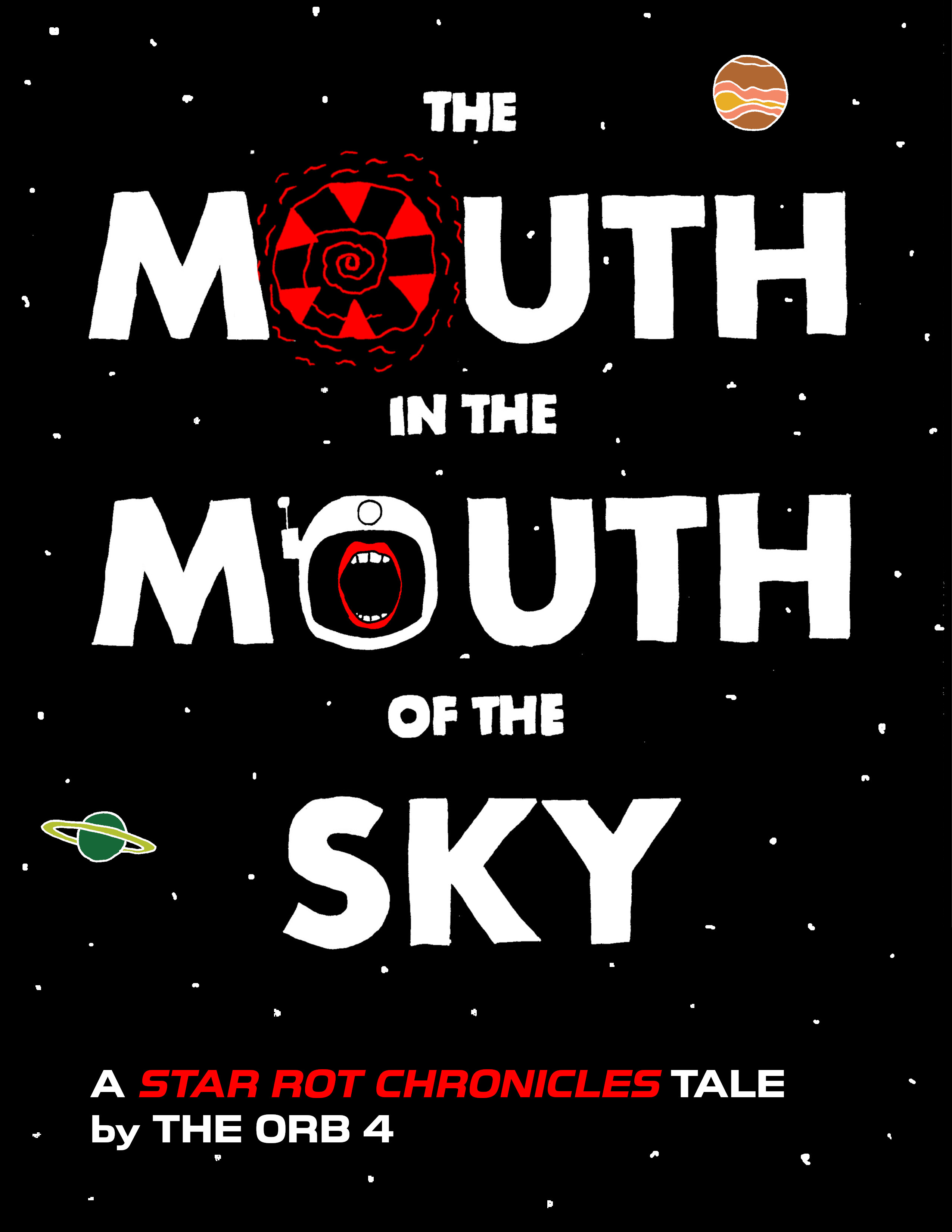
Anyway, I was interested in figuring out a way to use the story and offering it for free to my Counter Craft readers seemed like the right move. I won’t say anything more except that it will make more sense if you have already read Metallic Realms. Also, please imagine the following cover—which I drew—as an in-universe cover made by the Orb 4 themselves.
If you’re interested in this free tale, just put your email into this Google Form. I’ll email to everyone on Friday. And I’ll check the form sporadically in the future, to send to future sign-ups.
If this post makes you intrigued to check out Metallic Realms, it should be available just about anywhere books are sold. If you live in NYC, the launch party will take place tomorrow night (May 14th) at McNally Jackson Seaport.
I’ll be back to regular Counter Craft posting next week.

Woohoo! Very excited to read (both book & short story)!
Congrats, Lincoln!! Wishing you much success.