

Quick reminder: I’m running a subscription incentive (free book) for the month of March. More info here.
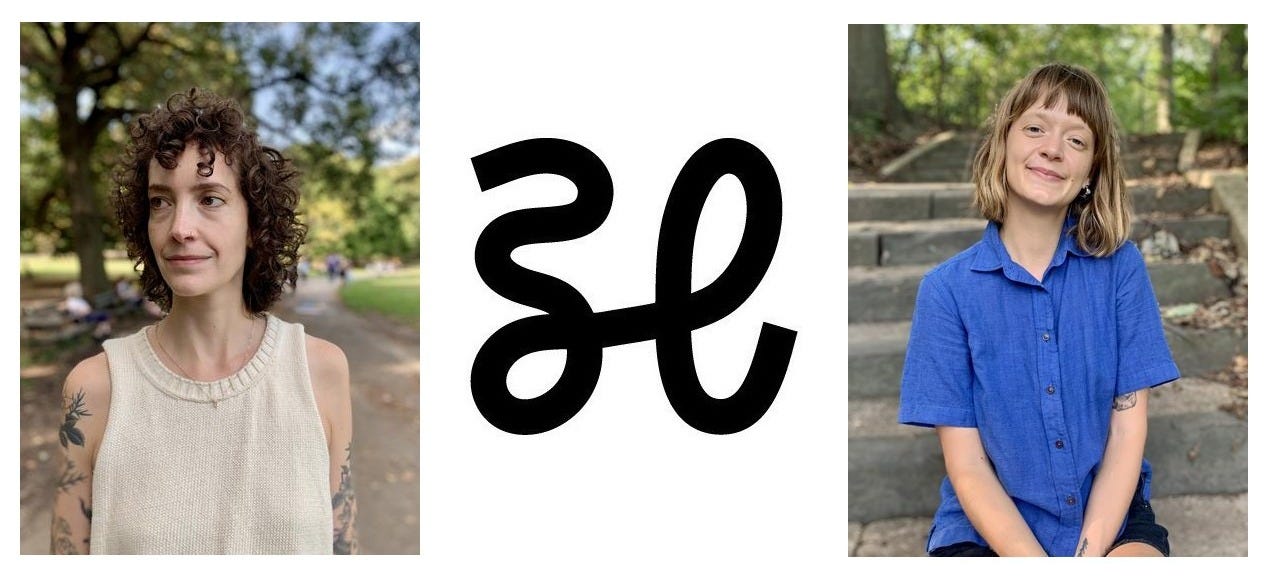
Last year, I expanded my interview series from authors to other members of the literary world like editors, translators, and bookstore buyers. I’m planning to continue that this year, and this week I’m excited to be talking to Julia Ringo and Naomi Huffman of the very cool press Hagfish. Recently, I wrote a piece about literature needing a “do it ourselves” mindset and how we need to create more innovative and flexible publishing models. Hagfish is a great example of that. They’re a hybrid independent press, editorial studio, and literary agency that focuses on reissuing underread books by women authors. They publish a small number of excellent books, design them beautifully, and market them thoughtfully. Plus, their colophon and name are taken from the strange, eel-shaped deep-sea fish.
I spoke to Huffman and Ringo about literary resurrections, running a hybrid business, and being “nimble and imaginative” as a small press.
I’ve wanted to talk to you both for a while and reached out after writing an article about how, in this time of flux and chaos in the industry, publishing needs to think up new models and have more of a “do it ourselves” mindset. Hagfish is a great example of doing things in a different way. You’re a hybrid editorial studio, literary agency, and independent literary press that puts out excellent books like Rosalyn Drexler’s To Smithereens and Iphgenia Baal’s Man Hating Psycho. How did you start Hagfish, and why did you settle on this hybrid studio/agency/press structure?
NH: We started Hagfish, in part, because we had a hunch that there was room in the industry for a project that was explicitly feminist, funny, brash, and strange. We also knew there were a lot of truly incredible books that were out of print and weren’t likely to be reissued by other presses, given what we understood to be their typical selection criteria and processes. The idea of working for ourselves was also really appealing.
We’re generally risk-averse realists, and we had worked in publishing long enough to know that we couldn’t expect book revenue to keep it running, at least not at first. We announced the studio ahead of the press, and worked for two years on a range of editorial projects with writers, agents, and publishers. In the background, we were sorting through the foundational decisions of starting a small press: acquiring our first titles, setting up distribution, the branding and design of our books. The studio remains our primary source of revenue; it allows us to pay ourselves while we’re getting the press and agency to be more financially independent.
How did you settle on the hagfish as a name and logo?
JR: We were working at FSG when we first started thinking about the project; FSG’s colophon depicts three fish, and MCD’s an electric eel, so sea creatures were on our mind. We liked the idea of an animal that is a little strange, a little resilient, and perhaps not immediately glamorous. Hagfish are deep-sea scavengers; they live on the ocean floor and feed on what others have overlooked or discarded, which felt like an apt metaphor for our work. They’re a little mysterious and a little strange, and they have a sharp bite.
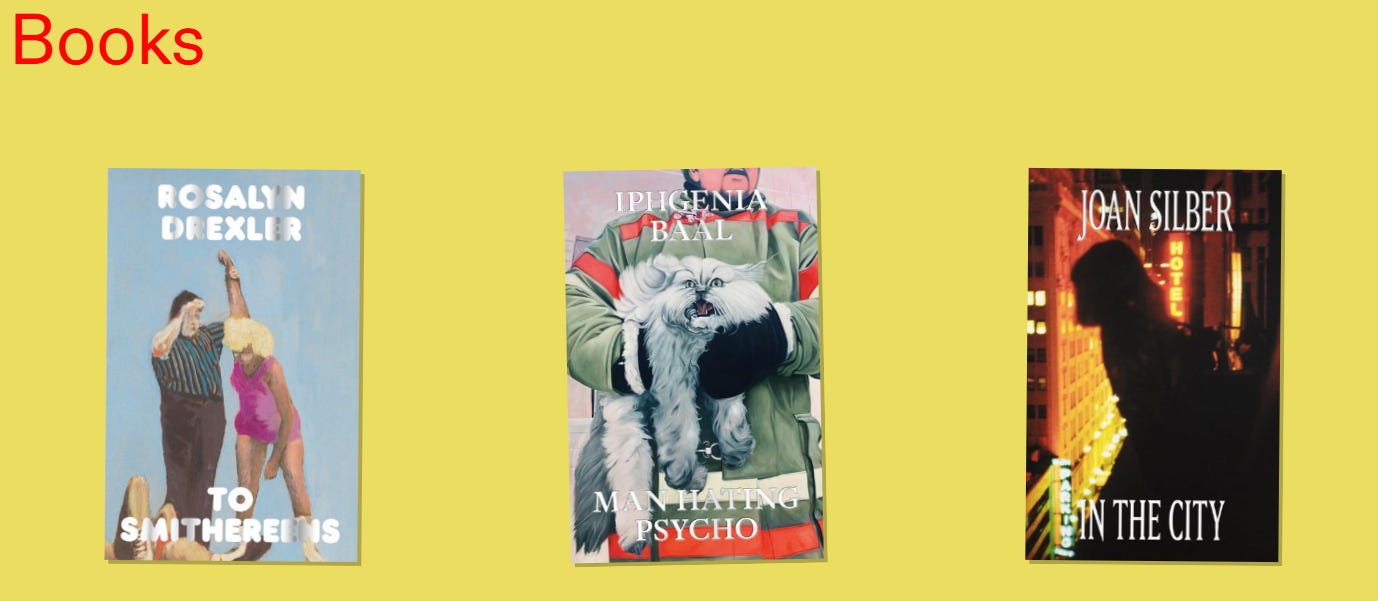
As I understand it, one of the motivations for Hagfish was “literary resurrections,” especially of overlooked women writers. Drexler’s To Smithereens was first published in the 1970s, and your next book, Joan Silber’s In the City, was first published in the 1980s. As agents, you helped sell a reissue of Nettie Jones’s 1983 novel Fish Tales.
Can you talk about this focus on literary resurrections, and how and where you find these overlooked gems?
NH: I first got a taste of the work that attends reissues—working with an author’s estate, sorting through their out-of-print and unpublished work—in 2018, when I sought out the archive of the late author and journalist Katherine Dunn. I spent the better part of a year transcribing her unpublished short stories, which became the collection Near Flesh, and then learned about the existence of an unpublished novel manuscript, Toad, that Dunn had unsuccessfully submitted to publishers in the late 1970s. (FSG eventually released both, in 2025 and 2022, respectively). I fell completely for this kind of work—it was intimate and emotional, and thoroughly thrilling, and it immediately became the only thing I wanted to do in publishing.
The “discovery” process is unique to each project; we start from square one every time. We’re looking for mostly women writers from a working-class perspective who wrote in spite of the many demands on their time. Broadly, we like voice-driven work that pushes against the conventions of its era, and which inevitably resonates with the social and political struggles of our time. We find our books and writers in used bookstores, and referenced in other writers’ writing, and from bookseller suggestions, and, more recently, from readers of our books.
A lot of publishers talk about “literary community” in a vague way without perhaps putting much effort into community. Hagfish seems sincerely invested in literary community. How do you think about community at Hagfish?
NH: I don’t know that we’re invested in literary community more than any other small press; we’re just trying to advocate for books and writers we admire, and which we know our readers will appreciate. It’s tempting to think of literary community as a purely positive force, when really it’s neutral, at best, and often demands free labor or favors performed in good faith without acknowledging the tremendous value of those things.
Anyway! We do think of ourselves as especially sensitive to readers and booksellers; it’s why, before we acquired anything, we spent a good deal of time meeting with booksellers and store owners to share our ideas for Hagfish with them. We asked them about things like distribution, book design, and their favorite overlooked writers. We see ourselves as publishing within a consortium composed of those folks, for and with our readers.
Julia and I are both very allergic to social media—and we only have an Instagram account, which I am constantly threatening to delete. I don’t know, it feels gross to convince readers the best way to “stay in touch” with us is through an app owned by fascists. And because the long-term relevance (not to mention security) of Instagram and similar platforms are dubious, it seems dumb to devote significant energy to expanding our readership there. When we launched our members-only newsletter Bottom Feeder we chose not to do it on Substack (whoops) because we didn’t want to force our readers to give the Substack people any of the money they were paying to support us. I’m sure this cost us some number of subscribers, but I don’t worry about it; they’ll find us if they want to. Our membership and the newsletter are growing slowly and steadily, and the members are really engaged—our newsletter has an insane open rate.
You met while working at FSG and together have a lot of experience in different parts of traditional publishing in both Big 5 presses and independent presses. Since I opened this by talking about changing publishing models, what is something you think big presses could learn from small presses? And what could small presses stand to learn from how the big presses operate?
NH: Those working at Big 5 publishers need to think more about the actual sales performance of their books. The corporate structure insulates you from that—you get a paycheck even if the books you’re working on aren’t profitable. But this means some editors, at a certain stage in their careers, become as concerned with having the power to offer an impressive advance, or the chance to work with a legendary agent, as they are with publishing a talented author. It means some publicists and marketers orchestrate compelling campaigns that don’t actually improve sales. I’m not advocating for more retaliation for poor sales—publishing workers need jobs; it’s ideal, really, that publishers don’t expect all of their books to make money—but the industry needs to be more sensitive to sales feedback, and more willing to experiment with new strategies.
As for small presses, I’d like to see a stronger set of tenets form around independent publishing and the role it serves within the industry at large. It’s pretty common to encounter a small publisher complaining about having one of their authors “stolen” by a Big 5, to which I’m like, Can we drop the proprietary attitude? And also—yes, exactly! Independent publishers should delight in kickstarting a writer’s career and being bellwethers of emerging literary trends. That’s precisely what readers want from us.
As a small press, you publish a limited number of books and publish them well. You put out two books in 2025 and have your third forthcoming this spring. Some small presses—especially ones that are just starting—struggle to get attention, and some perhaps even eschew thinking about the marketing, publicity, and other “boring business stuff.” But even your first publication, To Smithereens, got great coverage and was named a best book of 2025 by The New York Times. How does Hagfish approach marketing and publicity as a small team?
JR: Because we publish only a few books each year, we try to treat every book as an event, thinking carefully about design, timing, press outreach, bookseller relationships. Mostly, we talk to people, especially booksellers, and work closely with them to champion our books. On the events side, we try to get creative and aim to reach beyond the normal audience of reading-goers.
We don’t have a huge budget for these things, but we can be nimble and imaginative, and people respond to genuine enthusiasm.
From the outside, it seems like Hagfish has both an ethos and a lot of flexibility. You initially didn’t plan to be a literary agency, correct? Your focus is on resurrecting older books, but you also published Man Hating Psycho (first published in 2021 in the UK) and have said you’re open to publishing other types of books too. Where do you see Hagfish going next?
JR: The agency side of the business emerged organically, as we found ourselves working with writers whose projects we cared about and felt we could support more meaningfully by different avenues. But yes, we’ve intentionally built a business with the capacity to adapt however we need it to. In speaking about the authors we want to support, we sometimes use the term “underpublished,” a broad enough concept to encompass various forms of underappreciation or lack of attention that may befall a writer. We don’t want to wind up feeling trapped by any too-narrow definitions of what we’re looking for, but instead be guided by our taste, our instincts, and our sense of possibility.
For the future, we’d like to continue to grow the agency—having always worked on the publishing side, it’s been fun for us to develop these skills and work with writers in new ways. We want to keep developing our membership program, making sure it feels as rewarding for our readers to follow us as their support is to us. As more of our books emerge, we hope readers will become ever more certain of what a Hagfish book looks like, and to know that they can count on our authors to surprise, provoke, delight.
Is there any advice you’d offer to anyone looking to start their own literary project, whether it be a press or agency or something else?
Both: Do it.
I think many literary people look at publishing-related news, like the Washington Post shuttering its book section, and feel only despair. Is there anything about the state of publishing and literature in 2026 that you find exciting or hopeful?
JR: And we haven’t even mentioned the specter of AI! In fact, what we find exciting is that we feel there’s a real longing for the analog and anti-algorithm; readers want a beautiful physical object, they want to stand in a room with other readers, they respond to a bookstore’s curated shelves or a bookseller’s in-person recommendation. Indie bookstores are thriving in many places; literary translation and reissues are more prominent than ever–see the explosive success of Jacqueline Harpman’s I Who Have Never Known Men, from Transit Books. We know that many readers share both our anxieties and our love for the offbeat and surprising; we just have to meet them where they are.
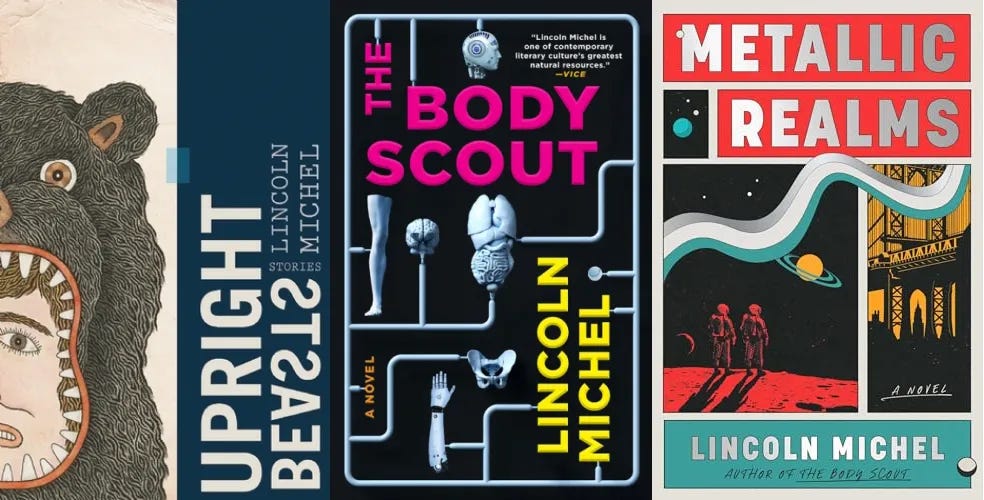
My new novel Metallic Realms is out in stores! Reviews have called the book “brilliant” (Esquire), “riveting” (Publishers Weekly), “hilariously clever” (Elle), “a total blast” (Chicago Tribune), “unrelentingly smart and inventive” (Locus), and “just plain wonderful” (Booklist). My previous books are the science fiction noir novel The Body Scout and the genre-bending story collection Upright Beasts. If you enjoy this newsletter, perhaps you’ll enjoy one or more of those books too.
I love Hagfish! Their books are so beautifully and thoughtfully designed. I'm looking forward to whatever they put out next. I feel really lucky because I have ARCs of each of their releases so far, and they are like old school galleys--no cover images, just the title on a colorful paper cover.
I love everything about this: the ethos, the clear-sightedness, the focus on the "under published", the multi-faceted approach, but I particularly like the comment about the literary community being at best neutral.