


In personal book news, I was interviewed by the great Stephen Fishbach at the Paraphrase Podcast about Metallic Realms, science fiction, comedy, tragedy, and other things. Take a listen here.
Recently, I’ve been thinking about book reviews. Not just the ever-dismal news that professional review space is being hacked down to nothing (the Associated Press is the latest axe-swinger), but how book coverage and the reception of books may change in the age of LLMs. Most of the discourse on “AI” in literature has been about the writing of books: how will authors use or not use LLMs to generate texts? There’s been less discussion of the inverse question: how will we read books in relation to LLM text?
I’m not going to rehash all the arguments for and against LLMs here. The programs have uses and problems. Most people have firm opinions, and I’ve shared my own thoughts plenty of other times. No matter what your stance is on LLMs, there are two things that seem clear:
1) LLMs are nowhere close to becoming actual intelligences
2) LLMs aren’t going away
After the dud of GPT-5, even the hype-driven media has come around to the skeptic’s point of view that LLM technology alone isn’t going to produce “AGI” à la super intelligent entities like Data from Star Trek or Samantha in Her. This has actually been a rapid shift. Only a few months ago, many in the media and tech circles gave credence to forecasts such as “AI 2027”—written by a group of AI researchers and experts—that predicted dueling AI supercomputer gods would appear in a couple years and either help humanity colonize the stars or else eliminate all human life by 2030. (Yes, this was considered serious rather than silly fan fiction back in spring.)

LLMs and other GenAI programs are complex and fascinating (and in their effects on people often terrifying), yet remain at their core souped-up autopredict software. They produce text that is probable-sounding but not necessarily accurate or even coherent. That doesn’t mean they are going away. LLMs can also be used in truly useful ways, such as analyzing large data sets or research. But there are also plenty of areas where “probable-sounding but not necessarily accurate or even coherent” text works just fine. High school students skipping homework, spambots, propaganda, the low-quality “content” and clickbait that makes up most of the web, or for use in already awful interactions like customer service bots.
And then there’s books. LLMs can be used in artistically thoughtful ways to further a human artist’s project. That’s another topic. What I’ve long been worried about is the flood of generic LLM text—the “slop,” as we’ve named it—that could or maybe already is drowning the internet. Amazon is already flooded with low-quality AI-produced books. Often, they have titles and covers meant to trick readers into thinking they are the books the customer was searching for. Other times, they’re from grifters who spam the ebook stores with endless books or use AI to generate some (or most) of the text in paint-by-numbers novels in popular niches. While there haven’t been notable scandals in traditional publishing—at least that I’ve seen—it is inevitable we’ll have some soon. Editors and agents are already spotting AI-generated books in their submission and query queues and are (understandably) worried about accepting such work for artistic and legal reasons.
Bluntly, it might not be long before the majority of text we encounter in a given day will be LLM-generated. So, how will readers and critics evaluate human-authored books when the world is filled with generic LLM text? What will they seek out that is similar or different to what LLMs produce?
Analogies with past technology can only tell us so much, but I do think about every AI fan’s favorite comparison: photography and painting. AI fans frequently compare LLMs to the invention of cameras, although their history has a lot of, uh, “hallucinations.” It isn’t actually the case that artists all decried the camera and/or said photography could never make art. Nor was “the point” of painting before the camera to create photorealistic representations of the actual world. Reactions varied, the technology changed over decades (and longer), and there is never one point to art. But there is truth to the idea that once photography became commonplace, it changed what we looked for and sought in painting.

If you know any art history, then you know the late 1800s was when we got the beginnings of modernist art and then the explosion of styles beyond realistic representations of the world—impressionism, surrealism, cubism, abstract expressionism, etc. One could argue, albeit reductively, that the invention of picture-taking machines made us value the human in painting. That we began to look even more at the individual style and subjectivity of the artist. Their human brushstrokes, personal feelings, and unique ways of looking at the world. (In fact, you could say the same thing happened to photography. Photography became an art form not by technological advancement to better capture reality but by artistic intervention to manipulate photographs for different effects.)
It seems likely that as we become awash in AI text—in the form of work emails, internet search results, advertisements, customer service, spambots, chatbots, churned out Substack posts, etc.—that we will also start to value the human more in literature. Obviously, some people won’t value human text just as plenty of people already don’t read books today (and never set foot in galleries or go to plays). To each their own. But, for the people who do care about literature and books, what happens?

I’ll state my assumptions. First, that most readers do not want to read text produced in part or whole by LLMs, especially when that isn’t disclosed. People don’t like to be tricked. This isn’t just about AI. See, for example, Milli Vanilli’s career cratering after fans found out they were lip synching to someone else’s vocals. Similarly, I don’t think many will feel like paying for someone else’s LLM-produced texts. The people who value chatting with LLMs or reading LLM outputs will pay the tech companies for that privilege and likely value what is unique to LLMs, such as the chatbot interface or the customization to individual user preferences. I don’t think many will go to a bookstore and buy lots of paperback novels produced by ChekovGPT.
So, in a future (or present?) where much of the text we see is LLM-produced and where most readers will want to avoid purchasing books produced largely by LLMs, what does that do to book criticism? I assume we begin to look more for the human in some way, though I’m both pessimistic and optimistic about how.
The Pessimistic Case
The pessimistic case is that we focus less on the work itself—perhaps figuring it is impossible to know how much or little the human author worked on the text—and more on extratextual elements of the author’s personal biography and public persona. That we read fiction as quasi-memoir (even more than we do now) and expect artists to supplement their art with social media and other non-artistic public material (even more than we do now) in order to display the “authenticity” of the work and show the human connection to the art.
Why is this pessimistic? From my point of view, reading fiction as quasi-autobiography is just a bad and reductive way to read. It’s artistically limiting for the author and imaginatively limiting for the reader. That’s in the tame version. In the nastier online-amplified versions, you end up with incidents like an author being forced to reveal her past sexual assault to show she was allowed to write about sexual assault in a novel or attacked for wrong assumptions about their identity.
Biography can be at times illuminating, but it is only ever one aspect of a work. Art is much larger than the artist. What is even the point of fiction if you can only read it as mere metaphor for memoir?
Or readers and critics may seek more explanations and elaborations on the author’s intents, choices, and inspirations to show the human mind behind a work. Many already seek those questions. For me, art is only “explained” by experiencing the work itself in full. The work is the explanation.

But if readers are looking for evidence that a novel comes from the mind of a human author, then I could imagine reviews focusing even more on the biographical connections or authorial intent.
Or maybe we simply focus more on the artist themselves outside of their art. Obviously, this is already common in our age of stan culture and influencers known for being famous whose “content” is secondary. Even non-famous artists are expected to be active on social media, record TikTok videos, diary blog their publication process, and/or build a platform through reader engagement. There’s nothing bad with any of these, per se, but being good at social media has little to do with being good at writing novels or constructing poems. Currently, there is still space for authors who don’t want to have a public persona at all. Artists who avoid social media entirely. Or who use pen names. Or intentionally obscure their past. You can still go full Ferrante in 2025. Maybe that will end? If readers seek the human connection in art, and are unable to definitively find it in the work itself, they may increasingly seek it outside of the work.
[Editing to add:] There’s an even more pessimistic scenario here. In the world of “influencers,” it is often the case that you get famous for your online content and then figure out some way to monetize that fame. It almost doesn’t matter what the product is. The same influencer might sell hot sauce or webinars or poetry collections. The fame is the point, the product secondary or tertiary. Ghostwritten celebrity books (including novels) are common. Publishers certainly look for author platforms now, though at least the platforms are normally tied to work. I can imagine a future where “authors” are influencers first, and what they write becomes increasingly irrelevant. Just a way to monetize the fame.
The Optimistic Case
The optimistic case, from my point of view, is that instead of focusing on the artist we focus more on art itself. That LLMs become something of a photography moment for books. That literature become more free to explore different styles, subjective feelings, and individual approaches. Literature already does that, of course, but that isn’t necessarily how books are covered today.
The most common complaint I hear about book reviews is that they focus on plot summary with a minimal amount of critical evaluation. Perhaps there is discussion of the political, social, or cultural meaning of the surface-level content. But there is often little focus on the aesthetics of the work or the actual experience of reading the text. This is even more the case with book publicity, which often tells potential readers nothing except a bullet point list of tropes. Add to this the common feeling that “style” is pretentious and that good writing is “invisible prose”—as if the actual medium of the work was irrelevant and all that matters are the plot points that can be summarized on Wikipedia—and it often feels like discussion of literature has little to do with literature at all.
My own biggest pet peeve is how much book coverage has nothing to do with the book as a work, but instead uses a book as a “peg” for a news topic or cultural commentary. Those essays may talk about the book’s alleged cultural relevance or the politics of its subject matter that could be gleaned from the back cover synopsis yet rarely evaluate or explain the actual book.
I don’t actually blame publicists, reviewers, or magazine editors for these things. Selling books is hard and this is what works. Allotted book review space in most publications is short, and readers do care about plot summary. There is often little space (literally) for other things. Many readers buy based on tropes, and in a publicity era defined by social media there is often (again literally) not much space for anything else. What can you say about a book in a tweet or 10-second TikTok? And those peg essays? Having edited a popular literary website, I can tell you that it simply is the case that few people click on a standard book review (especially of a non-famous author) and a lot more will click on some article with a title like “What a New Novel Tells Us about [Hot Button Political or Cultural Issue].”
Things can always change. As book criticism disappears from papers and moves to places like newsletters and podcasts that do allow for lengthier engagement, and as social media fractures and becomes less relevant for sales, and as LLM text is increasingly able to spew out tropey and formulaic text but not individual style or original thought… well, perhaps this will be a time to reevaluate how we talk about and think about books?
Maybe we can focus less on content and more on execution? Perhaps value new ways of creating story instead of formulas and tropes checklists that any LLM can reproduce? Think more about the experience of texts than the trappings? And maybe we can celebrate very visible prose—sentences that writhe and shine and sing with the individual behind them rather than the generic averaging of terabytes of training data (and that even if they were made in conjunction with an LLM would require intention and intervention from an artist’s mind and not be reproducible by mere prompts)—that is after all the substance that novels are made from?
Or maybe not. I don’t know. But sometimes it is nice to be an optimist.
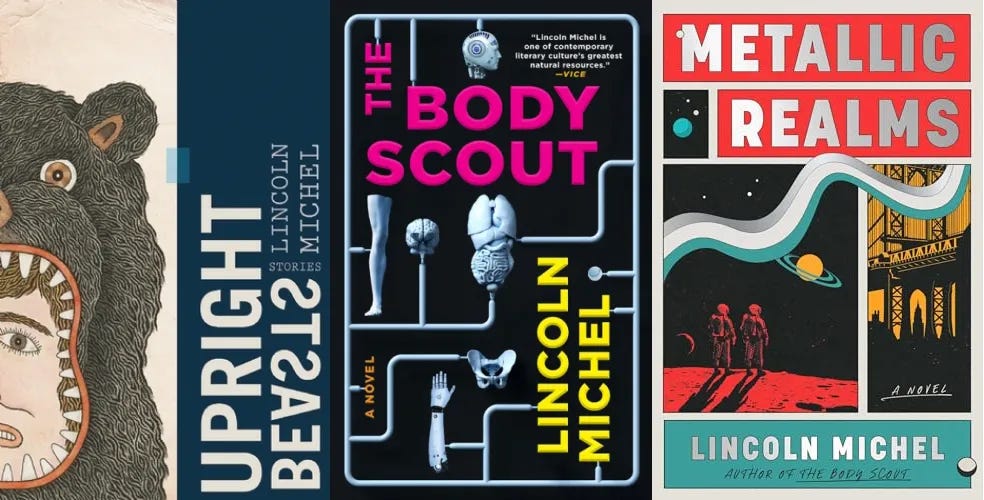
My new novel Metallic Realms is out in stores! Reviews have called the book “brilliant” (Esquire), “riveting” (Publishers Weekly), “hilariously clever” (Elle), “a total blast” (Chicago Tribune), “unrelentingly smart and inventive” (Locus), and “just plain wonderful” (Booklist). My previous books are the science fiction noir novel The Body Scout and the genre-bending story collection Upright Beasts. If you enjoy this newsletter, perhaps you’ll enjoy one or more of those books too.
I agree that people don’t want to be tricked, that they reach through art in order to share the experience of being human. When AI “pretends” that it understands human suffering, that just makes me feel mocked. Great piece.
Thoughtful and well-reasoned as always. I choose optimism too.